


Portal:India


Introduction

.svg?lang=en)
India, officially the Republic of India, is a country in South Asia. It is the seventh-largest country by area; the most populous country since 2023; and, since its independence in 1947, the world's most populous democracy. Bounded by the Indian Ocean on the south, the Arabian Sea on the southwest, and the Bay of Bengal on the southeast, it shares land borders with Pakistan to the west; China, Nepal, and Bhutan to the north; and Bangladesh and Myanmar to the east. In the Indian Ocean, India is near Sri Lanka and the Maldives; its Andaman and Nicobar Islands share a maritime border with Myanmar, Thailand, and Indonesia. (Full article...)

 Featured article –

-
![Image 1 Kapoor Khan in 2024 Kareena Kapoor Khan (pronounced [kəˈriːna kəˈpuːr xɑːn]; née Kapoor; born 21 September 1980) is an Indian actress. She has been known her leading roles in Hindi cinema since 2000. Kapoor is the recipient of several awards, including six Filmfare Awards, and as of 2024, is one of Hindi cinema's highest-paid actresses. Born into the Kapoor family, she is the daughter of actors Babita and Randhir Kapoor, and the younger sister of actress Karisma Kapoor. After making her acting debut in 2000 in Refugee, Kapoor established herself the following year with several roles, including in the top-grossing drama Kabhi Khushi Kabhie Gham. This was followed by a series of commercial failures and negative reviews for her repetitive roles. An against-type performance as a sex worker in the 2004 drama Chameli marked a turning point in her career. She earned critical recognition for her portrayal of a riot victim in the 2004 drama Dev and a character based on Desdemona in the 2006 crime film Omkara. Her performance as a loquacious woman in the romantic comedy Jab We Met (2007) earned her the Filmfare Award for Best Actress. (Full article...)](https://upload.wikimedia.org/wikipedia/en/d/d2/Blank.png)
Kareena Kapoor Khan (pronounced [kəˈriːna kəˈpuːr xɑːn]; née Kapoor; born 21 September 1980) is an Indian actress. She has been known her leading roles in Hindi cinema since 2000. Kapoor is the recipient of several awards, including six Filmfare Awards, and as of 2024, is one of Hindi cinema's highest-paid actresses.
Born into the Kapoor family, she is the daughter of actors Babita and Randhir Kapoor, and the younger sister of actress Karisma Kapoor. After making her acting debut in 2000 in Refugee, Kapoor established herself the following year with several roles, including in the top-grossing drama Kabhi Khushi Kabhie Gham. This was followed by a series of commercial failures and negative reviews for her repetitive roles. An against-type performance as a sex worker in the 2004 drama Chameli marked a turning point in her career. She earned critical recognition for her portrayal of a riot victim in the 2004 drama Dev and a character based on Desdemona in the 2006 crime film Omkara. Her performance as a loquacious woman in the romantic comedy Jab We Met (2007) earned her the Filmfare Award for Best Actress. (Full article...) -

Reginald Heber (21 April 1783 – 3 April 1826) was an English Anglican bishop, a man of letters, and hymn-writer. After 16 years as a country parson, he served as Bishop of Calcutta until his death at the age of 42. The son of a rich landowner and cleric, Heber gained fame at the University of Oxford as a poet. After graduation he made an extended tour of Scandinavia, Russia and Central Europe. Ordained in 1807, he took over his father's old parish, Hodnet, Shropshire. He also wrote hymns and general literature, including a study of the works of the 17th-century cleric Jeremy Taylor.
He was consecrated Bishop of Calcutta in October 1823. He travelled widely and worked to improve the spiritual and general living conditions of his flock. Arduous duties, a hostile climate and poor health led to his collapse and death after less than three years in India. Memorials were erected there and in St Paul's Cathedral, London. A collection of his hymns appeared soon after his death. "Holy, Holy, Holy! Lord God Almighty" remains popular for Trinity Sunday, while "Brightest and Best" is frequently sung during Epiphany. (Full article...) -
Dilwale Dulhania Le Jayenge (transl. The Brave-Hearted Will Take the Bride), also known by the initialism DDLJ, is a 1995 Indian Hindi-language musical romance film written and directed by Aditya Chopra in his directorial debut and produced by his father Yash Chopra. The film stars Shah Rukh Khan and Kajol as Raj and Simran, two young non-resident Indians, who fall in love during a vacation through Europe with their friends. Raj tries to win over Simran's family so the couple can marry, but Simran's father has long since promised her hand to his friend's son.
The film was shot in India, London, and Switzerland, from September 1994 to August 1995. (Full article...) -
Shah Rukh Khan (pronounced [ˈʃaːɦɾʊx xäːn] ⓘ; born as Shahrukh Khan on 2 November 1965), popularly known by the initials SRK, is an Indian actor and film producer renowned for his work in Hindi cinema. Referred to in the media as the "Baadshah of Bollywood" and "King Khan", he has appeared in more than 100 films and earned numerous accolades, including a National Film Award and 15 Filmfare Awards. He has been awarded the Padma Shri by the Government of India, as well as the Order of Arts and Letters and Legion of Honour by the Government of France. Khan has a significant following in Asia and among the Indian diaspora worldwide. In terms of income, several media outlets have described him as one of the most successful film stars in the world.
Khan began his career with appearances in several television series in the late 1980s and made his Hindi film debut in 1992 with the musical romance Deewana. He was initially recognised for playing villainous roles in the films Baazigar (1993) and Darr (1993). Khan established himself by starring in a series of top-grossing romantic films, including Dilwale Dulhania Le Jayenge (1995), Dil To Pagal Hai (1997), Kuch Kuch Hota Hai (1998), Mohabbatein (2000), Kabhi Khushi Kabhie Gham (2001), Kal Ho Naa Ho (2003), Veer-Zaara (2004), and Kabhi Alvida Naa Kehna (2006). He earned critical acclaim for his portrayal of an alcoholic in the period romantic drama Devdas (2002), a NASA scientist in the social drama Swades (2004), a hockey coach in the sports drama Chak De! India (2007), and a man with Asperger syndrome in the drama My Name Is Khan (2010). Further commercial successes came with the romances Om Shanti Om (2007) and Rab Ne Bana Di Jodi (2008), and with his expansion to comedies in Chennai Express (2013) and Happy New Year (2014). Following a brief setback and hiatus, Khan made a career comeback with the 2023 action thrillers Pathaan and Jawan, both of which rank among the highest-grossing Indian films. For Jawan, he received the National Film Award for Best Actor in a Leading Role. (Full article...) -

Territory of the Hoysalas and their neighbouring kingdoms in Western India, the Seuna Yadavas and Silharas in c. 1200[image reference needed]
Hoysala literature is the large body of literature in the Kannada and Sanskrit languages produced by the Hoysala Empire (1025–1343) in what is now southern India. The empire was established by Nripa Kama II, came into political prominence during the rule of King Vishnuvardhana (1108–1152), and declined gradually after its defeat by the Khalji dynasty invaders in 1311.
Kannada literature during this period consisted of writings relating to the socio-religious developments of the Jain and Veerashaiva faiths, and to a lesser extent that of the Vaishnava faith. The earliest well-known brahmin writers in Kannada were from the Hoysala court. While most of the courtly textual production was in Kannada, an important corpus of monastic Vaishnava literature relating to Dvaita (dualistic) philosophy was written by the renowned philosopher Madhvacharya in Sanskrit. (Full article...) -
Muhammad Ali Jinnah (born Mahomedali Jinnahbhai; 25 December 1876 – 11 September 1948) was a barrister, politician, and the founder of Pakistan. Jinnah served as the leader of the All-India Muslim League from 1913 until the inception of Pakistan on 14 August 1947 and then as Pakistan's first governor-general until his death a year later in 1948. He is known as Quaid-e-Azam (meaning "Great Leader") in Pakistan.
Born at Wazir Mansion in Karachi, Jinnah was trained as a barrister at Lincoln's Inn in London, England. Upon his return to India, he enrolled at the Bombay High Court, and took an interest in national politics, which eventually replaced his legal practice. Jinnah rose to prominence in the Indian National Congress in the first two decades of the 20th century. In these early years of his political career, Jinnah advocated for Hindu–Muslim unity, helping to shape the 1916 Lucknow Pact between the Congress and the All-India Muslim League, in which Jinnah had also become prominent. Jinnah became a key leader in the All-India Home Rule League, and proposed a fourteen-point constitutional reform plan to safeguard the political rights of Muslims in the Indian subcontinent. In 1920, however, Jinnah resigned from the Congress when it agreed to follow a campaign of satyagraha, which he regarded as political anarchy. (Full article...) -
The Western Chalukya Empire (/tʃəˈluːkjə/ chə-LOO-kyə) ruled most of the western Deccan, South India, between the 10th and 12th centuries. This dynasty is sometimes called the Kalyani Chalukya after its regal capital at Kalyani, today's Basavakalyan in the modern Bidar district of Karnataka state, and alternatively the Later Chalukya from its theoretical relationship to the 6th-century Chalukya dynasty of Badami. The dynasty is called Western Chalukyas to differentiate from the contemporaneous Eastern Chalukyas of Vengi, a separate dynasty. Before the rise of these Chalukyas, the Rashtrakuta Empire of Manyakheta controlled most of the Deccan Plateau and Central India for over two centuries. In 973, seeing confusion in the Rashtrakuta empire after a successful invasion of their capital by the ruler of the Paramara dynasty of Malwa, Tailapa II, a feudatory of the Rashtrakuta dynasty ruling from Bijapur region defeated his overlords and made Manyakheta his capital. The dynasty quickly rose to power and grew into an empire under Someshvara I who moved the capital to Kalyani.
For over a century, the two empires of South India, the Western Chalukyas and the Chola dynasty of Thanjavur fought many fierce wars to control the fertile region of Vengi. During these conflicts, the Eastern Chalukyas of Vengi, distant cousins of the Western Chalukyas but related to the Cholas by marriage, took sides with the Cholas further complicating the situation. During the rule of Vikramaditya VI, in the late 11th and early 12th centuries, the Western Chalukyas convincingly contended with the Cholas and reached a peak, ruling territories that spread over most of the Deccan, between the Narmada River in the north and Kaveri River in the south. His exploits were not limited to the south for even as a prince, during the rule of Someshvara I, he had led successful military campaigns as far east as modern Bihar and Bengal. During this period the other major ruling families of the Deccan, the Hoysala Empire, the Seuna dynasty, the Kakatiya dynasty and the Kalachuris of Kalyani, were subordinates of the Western Chalukyas and gained their independence only when the power of the Chalukya waned during the later half of the 12th century. (Full article...) -
Margaret Ives Abbott (June 15, 1878 – June 10, 1955) was an American amateur golfer. She was the first American woman to win an Olympic event: the women's golf tournament at the 1900 Summer Olympics.
Born in Calcutta (now Kolkata), British Raj, in 1878, Abbott moved with her family to Chicago in 1884. She joined the Chicago Golf Club in Wheaton, Illinois, where she received coaching from Charles B. Macdonald and H. J. Whigham. In 1899, she traveled with her mother to Paris to study art. The following year, along with her mother, she signed up for a women's golf tournament without realizing that it was the second modern Olympics. Abbott won the tournament with a score of 47 strokes; her mother tied for seventh place. Abbott received a porcelain bowl as a prize. (Full article...) -
The 2000 Sri Lanka cyclone (IMD designation: BOB 06 JTWC designation: 04B) was the strongest tropical cyclone to strike Sri Lanka since 1978. The fourth tropical storm and the second severe cyclonic storm of the 2000 North Indian Ocean cyclone season, it developed from an area of disturbed weather on December 25, 2000. It moved westward, and quickly strengthened under favorable conditions to reach top wind speeds of 75 mph (121 km/h). The cyclone hit eastern Sri Lanka at peak strength, then weakened slightly while crossing the island before making landfall over southern India on December 28. The storm degenerated into a remnant low later that day, before merging with another trough on the next day.
The storm was the first cyclone over Sri Lanka with winds of at least hurricane strength since a cyclone of 1978 hit the island in the 1978 season, as well as the first tropical storm to hit the island since 1992. The storm was also the first December tropical cyclone of hurricane intensity in the Bay of Bengal since 1996. It produced heavy rainfall and strong winds, damaging or destroying tens of thousands of houses and leaving up to 500,000 homeless. At least nine people died as a result of the cyclone. (Full article...) -
Typhoon Gay, also known as the Kavali Cyclone of 1989, was a small but powerful tropical cyclone which caused more than 800 fatalities in and around the Gulf of Thailand in November 1989. The worst typhoon to affect the Malay Peninsula in thirty-five years, Gay originated from a monsoon trough over the Gulf of Thailand in early November. Owing to favorable atmospheric conditions, the storm rapidly intensified, attaining winds over 120 km/h (75 mph) by 3 November. Later that day, Gay became the first typhoon since 1891 to make landfall in Thailand, striking Chumphon Province with winds of 185 km/h (115 mph). The small storm emerged into the Bay of Bengal and gradually reorganized over the following days as it approached southeastern India. On 8 November, Gay attained its peak intensity as a Category 5-equivalent cyclone with winds of 260 km/h (160 mph). The cyclone then moved ashore near Kavali, Andhra Pradesh. Rapid weakening ensued inland, and Gay dissipated over Maharashtra early on 10 November.
The typhoon's rapid development took hundreds of vessels by surprise, leading to 275 offshore fatalities. Of these, 91 occurred after an oil drilling ship, the Seacrest, capsized amid 6–11 m (20–36 ft) swells. Across the Malay Peninsula, 588 people died from various storm-related incidents. Several towns in coastal Chumphon were destroyed. Losses throughout Thailand totaled ฿11 billion (US $497 million). Striking India as a powerful cyclone, Gay damaged or destroyed about 20,000 homes in Andhra Pradesh, leaving 100,000 people homeless. In that country, 69 deaths and ₹410 million (US $25.3 million) in damage were attributed to Gay. (Full article...) -
Waiting is a 2015 Indian Hindi-language drama film directed by Anu Menon. Produced by Priti Gupta and Manish Mundra under the banner of Ishka Films and Drishyam Films respectively, the film was co-written by Menon and James Ruzicka, and stars Naseeruddin Shah and Kalki Koechlin. Waiting focuses on the relationship between two people from different walks of life who befriend each other in a hospital, while nursing their respective comatose spouses. Rajat Kapoor, Suhasini Maniratnam, Arjun Mathur, Ratnabali Bhattacharjee and Rajeev Ravindranathan play supporting roles in the film.
The development of the film began in June 2014, when Menon signed Koechlin and Shah for an untitled project. Principal photography started in November 2014 in the South Indian coastal city of Kochi; Neha Parti served as the cinematographer for the film. New Zealand-based singer-songwriter Mikey McCleary composed the film's score. Nitin Baid and Apurva Asrani edited the film, and Atika Chohan wrote the dialogue. Waiting also marked the Hindi film debut of the prominent South Indian actress-director Suhasini Maniratnam. Koechlin also made her debut as a lyricist with the film's soundtrack, writing the song "Waiting for You". (Full article...) -
Parinda (transl. Bird) is a 1989 Indian Hindi-language crime thriller film directed, produced and distributed by Vidhu Vinod Chopra. The film stars Jackie Shroff, Anil Kapoor, Nana Patekar and Madhuri Dixit. The story and scenario were written by Chopra, while Shiv Kumar Subramaniam and Imtiyaz Husain wrote the screenplay and dialogues, respectively. R. D. Burman composed the music and Khurshid Hallauri wrote the lyrics. Binod Pradhan served as the film's cinematographer and Renu Saluja was its editor.
Parinda follows Kishan (Shroff), who works for the underworld chieftain Anna (Patekar). Kishan's brother Karan (Kapoor) returns home after completing his studies in the United States. The two brothers are caught on different sides of a gang war after Karan decides to avenge his friend's death by Anna. (Full article...) -
Lieutenant-Colonel James Tod (20 March 1782 – 18 November 1835) was a British army officer and scholar. He combined his official role and his amateur interests to create a series of works about the history and geography of India, and in particular the area then known as Rajputana that corresponds to the present day state of Rajasthan, and which Tod referred to as Rajast'han.
Tod was born in London and educated in Scotland. He joined the East India Company as a military officer and travelled to India in 1799 as a cadet in the Bengal Army. He rose quickly in rank, eventually becoming captain of an escort for an envoy in a Sindian royal court. After the Third Anglo-Maratha War, during which Tod was involved in the intelligence department, he was appointed Political Agent for some areas of Rajputana. His task was to help unify the region under the control of the East India Company. During this period Tod conducted most of the research that he would later publish. Tod was initially successful in his official role, but his methods were questioned by other members of the East India Company. Over time, his work was restricted and his areas of oversight were significantly curtailed. In 1823, owing to declining health and reputation, Tod resigned his post as Political Agent and returned to England. (Full article...) -

Kalidas (pronounced [kaːɭidaːs] transl. The Servant of Kali) is a 1931 Indian biographical film directed by H. M. Reddy and produced by Ardeshir Irani. It is notable for being the first sound film in the Tamil and Telugu languages, and the first sound film to be made in a Dravidian language. It was based on the life of the Sanskrit poet Kalidasa; it featured P. G. Venkatesan in the title role and T. P. Rajalakshmi as the female lead, with L. V. Prasad, Thevaram Rajambal, T. Susheela Devi, J. Sushila, and M. S. Santhanalakshmi in supporting roles.
Kalidas had dialogues in Telugu, with some Tamil songs featured in the beginning, middle, and end, along with some additional dialogue in Hindi. Despite its mythological theme, the film featured songs from much later time periods, such as the compositions of Carnatic musician Tyagaraja, publicity songs of the Indian National Congress, and songs about Mahatma Gandhi and the Indian independence movement. The sound was recorded using German-made technology. Kalidas was shot in Bombay on the sets of India's first sound film Alam Ara (1931) and was completed in eight days. (Full article...) -
Taare Zameen Par (lit. 'Stars on the Earth'), also known as Like Stars on Earth in English, is a 2007 Indian Hindi-language psychological drama film produced and directed by Aamir Khan. It stars Khan, with Darsheel Safary, Tanay Chheda, Vipin Sharma and Tisca Chopra. It explores the life and imagination of Ishaan (Safary), an artistically gifted 8-year-old boy whose poor academic performance leads his parents to send him to a boarding school, where a new art teacher Nikumbh (Aamir Khan) suspects that he is dyslexic and helps him to overcome his reading disorder. The film focuses on raising awareness about dyslexia in children.
Creative director and writer Amole Gupte developed the idea with his wife Deepa Bhatia, who was the film's editor. Shankar–Ehsaan–Loy composed the score, and Prasoon Joshi wrote the lyrics for many of the songs. Principal photography took place in Mumbai, and in Panchgani's New Era High School, where some of the school's students participated in the filming. (Full article...) -
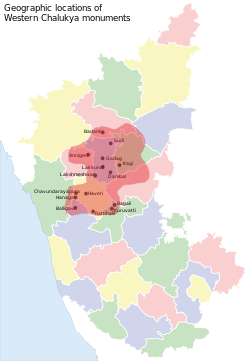
Core area of Western Chalukya architectural activity in modern Karnataka state, India
Western Chalukya architecture, also known as Kalyani Chalukya or Later Chalukya architecture and broadly classified under the Vesara Style, is the distinctive style of ornamented architecture that evolved during the rule of the Western Chalukya Empire in the Tungabhadra region of modern central Karnataka, India, during the 11th and 12th centuries. Western Chalukyan political influence was at its peak in the Deccan Plateau during this period. The centre of cultural and temple-building activity lay in the Tungabhadra region, where large medieval workshops built numerous monuments. These monuments, regional variants of pre-existing dravida (South Indian) temples, form a climax to the wider regional temple architecture tradition called Vesara or Karnata dravida. Temples of all sizes built by the Chalukyan architects during this era remain today as examples of the architectural style.
Most notable of the many buildings dating from this period are the Mahadeva Temple at Itagi in the Koppal district, the Kasivisvesvara Temple at Lakkundi in the Gadag district, the Mallikarjuna Temple at Kuruvatti in the Bellary district and the Kallesvara Temple at Bagali in the Davangere district. Other monuments notable for their craftsmanship include the Kaitabheshvara Temple in Kubatur and Kedareshvara Temple in Balligavi, both in the Shimoga district, the Siddhesvara Temple at Haveri in the Haveri district, the Amrtesvara Temple at Annigeri in the Dharwad district, the Sarasvati Temple in Gadag, and the Dodda Basappa Temple at Dambal, both in the Gadag district. (Full article...) -
Mother India is a 1957 Indian epic drama film, directed by Mehboob Khan and starring Nargis, Sunil Dutt, Rajendra Kumar and Raaj Kumar. A remake of Khan's earlier film Aurat (1940), it is the story of a poverty-stricken village woman named Radha (Nargis), who in the absence of her husband, struggles to raise her sons and survive against a cunning money-lender amidst many troubles.
The title of the film was chosen to counter American author Katherine Mayo's 1927 polemical book Mother India, which vilified Indian culture. Mother India metaphorically represents India as a nation in the aftermath of its independence in 1947, and alludes to a strong sense of Indian nationalism and nation-building. Allusions to Hindu mythology are abundant in the film, and its lead character has been seen as a metonymic representation of an Indian woman who reflects high moral values and the concept of what it means to be a mother to society through self-sacrifice. While some authors treat Radha as the symbol of women's empowerment, others see her cast in female stereotypes. The film was shot in Mumbai's Mehboob Studios and in the villages of Maharashtra, Gujarat, and Uttar Pradesh. The music by Naushad introduced global music, including Western classical music and orchestra, to Hindi cinema. (Full article...) -
The Marwari, also known as the Malani is a rare breed of horse from the Marwar region of Rajasthan, in north-west India. It is closely related to the Kathiawari breed of the Kathiawar peninsula of Gujarat, with which it shares the distinctive inward-curving ears. Marwari horses are found in all equine colours, including piebald and skewbald. It is a hardy riding horse and may exhibit a natural ambling gait.
The Rathores, traditional rulers of the Marwar region of western India, were the first to breed the Marwari. Beginning in the 12th century, they espoused strict breeding that promoted purity and hardiness. Used throughout history as a cavalry horse by the people of the Marwar region, the Marwari was noted for its loyalty and bravery in battle. The breed deteriorated in the 1930s, when poor management practices resulted in a reduction of the breeding stock, but today has regained some of its popularity. The Marwari is used for light draught and agricultural work, as well as riding and packing. In 1995, a breed society was formed for the Marwari horse in India. The exportation of Marwari horses was banned for decades, but between 2000 and 2006, a small number of exports were allowed. Since 2008, visas allowing temporary travel of Marwari horses outside India have been available in small numbers. Though they are rare they are becoming more popular outside of India due to their unique looks. (Full article...) -
India, officially the Republic of India, is a country in South Asia. It is the seventh-largest country by area; the most populous country since 2023; and, since its independence in 1947, the world's most populous democracy. Bounded by the Indian Ocean on the south, the Arabian Sea on the southwest, and the Bay of Bengal on the southeast, it shares land borders with Pakistan to the west; China, Nepal, and Bhutan to the north; and Bangladesh and Myanmar to the east. In the Indian Ocean, India is near Sri Lanka and the Maldives; its Andaman and Nicobar Islands share a maritime border with Myanmar, Thailand, and Indonesia.
Modern humans arrived on the Indian subcontinent from Africa no later than 55,000 years ago. Their long occupation, predominantly in isolation as hunter-gatherers, has made the region highly diverse. Settled life emerged on the subcontinent in the western margins of the Indus river basin 9,000 years ago, evolving gradually into the Indus Valley Civilisation of the third millennium BCE. By 1200 BCE, an archaic form of Sanskrit, an Indo-European language, had diffused into India from the northwest. Its hymns recorded the early dawnings of Hinduism in India. India's pre-existing Dravidian languages were supplanted in the northern regions. By 400 BCE, caste had emerged within Hinduism, and Buddhism and Jainism had arisen, proclaiming social orders unlinked to heredity. Early political consolidations gave rise to the loose-knit Maurya and Gupta Empires. Widespread creativity suffused this era, but the status of women declined, and untouchability became an organised belief. In South India, the Middle kingdoms exported Dravidian language scripts and religious cultures to the kingdoms of Southeast Asia. (Full article...) -
Nil Battey Sannata (lit. 'Zero Divided by Zero Equals Nothing'; slang for "Good for Nothing"), released internationally as The New Classmate, is a 2015 Indian Hindi-language comedy drama film directed by Ashwiny Iyer Tiwari in her feature debut. Produced by Aanand L. Rai, Ajay Rai, and Alan McAlex under the banners of Colour Yellow Productions and JAR Pictures, the film was co-written by Iyer, Neeraj Singh, Pranjal Choudhary, and Nitesh Tiwari. Swara Bhaskar starred as Chanda Sahay, a high-school drop-out household maid and single mother of a sullen young girl named Apeksha, played by Riya Shukla. The film's theme is a person's right to dream and change their lives, irrespective of social status.
Released in India on 22 April 2016, Nil Battey Sannata was distributed by Eros International and garnered critical and audience acclaim. Reviewers praised most aspects of the production, especially its narrative and realism, and the performances of the cast, Bhaskar's in particular. At the 62nd Filmfare Awards, Iyer won the Filmfare Award for Best Debut Director, while Bhaskar and Shukla won the Screen Awards for Best Actress (Critics) and Best Child Artist respectively. The film did well at the box-office, collecting a total of around ₹69 million (US$820,000) during its entire theatrical run. The same year, the film was remade in Tamil as Amma Kanakku, with Iyer returning to direct. The following year, it was remade in Malayalam as Udaharanam Sujatha. (Full article...) -
Arthur Edward Jeune Collins (18 August 1885 – 11 November 1914) was an English cricketer and soldier. He held, for 116 years, the record of highest score in cricket: as a 13-year-old schoolboy, he scored 628 not out over four afternoons in June 1899. Collins's record-making innings drew a large crowd and increasing media interest; spectators at the Old Cliftonian match being played nearby were drawn away to watch the junior school house cricket match in which Collins was playing. Despite this achievement, Collins never played first-class cricket. Collins's 628 not out stood as the record score until January 2016 when an Indian boy, Pranav Dhanawade, scored 1009 in a single innings.
Collins joined the British Army in 1902 and studied at the Royal Military Academy, Woolwich, before becoming an officer in the Royal Engineers. He served in France during the First World War, where he was killed in action in 1914 during the First Battle of Ypres. Collins had been mentioned in despatches and also represented the Royal Military Academy at cricket and rugby union. (Full article...) -
Osbert Guy Stanhope Crawford CBE FBA FSA (28 October 1886 – 28 November 1957) was a British archaeologist who specialised in the archaeology of prehistoric Britain and Sudan. A keen proponent of aerial archaeology, he spent most of his career as the archaeological officer of the Ordnance Survey (OS) and also wrote a range of books on archaeological subjects.
Born in Bombay, British India, to a wealthy middle-class Scottish family, Crawford moved to England as an infant and was raised by his aunts in London and Hampshire. He studied geography at Keble College, Oxford, and worked briefly in that field before devoting himself professionally to archaeology. Employed by the philanthropist Henry Wellcome, Crawford oversaw the excavation of Abu Geili in Sudan before returning to England shortly before the First World War. During the conflict he served in both the London Scottish Regiment and the Royal Flying Corps, where he was involved in ground and aerial reconnaissance along the Western Front. After an injury forced a period of convalescence in England, he returned to the Western Front, where he was captured by the German Army in 1918 and held as a prisoner of war until the end of the conflict. (Full article...) -
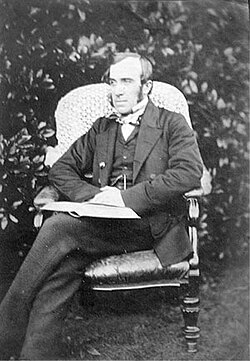
Monier Williams, elected as the second Boden Professor of Sanskrit in 1860; this photograph was taken by Lewis Carroll.
The election in 1860 for the position of Boden Professor of Sanskrit at the University of Oxford was a competition between two candidates offering different approaches to Sanskrit scholarship. One was Monier Williams, an Oxford-educated Englishman who had spent 14 years teaching Sanskrit to those preparing to work in British India for the East India Company. The other, Max Müller, was a German-born lecturer at Oxford specialising in comparative philology, the science of language. He had spent many years working on an edition of the Rig Veda (an ancient collection of Vedic Sanskrit hymns) and had gained an international reputation for his scholarship. Williams, in contrast, worked on later material and had little time for the "continental" school of Sanskrit scholarship that Müller exemplified. Williams regarded the study of Sanskrit as a means to an end, namely the conversion of India to Christianity. In Müller's opinion, his own work, while it would assist missionaries, was also valuable as an end in itself.
The election came at a time of public debate about British rule in India in the wake of the Indian Rebellion of 1857. Opinions were divided on whether greater efforts should be made to convert India or whether to remain sensitive to local culture and traditions. Both men battled for the votes of the electorate (the Convocation of the university, consisting of over 3,700 graduates) through manifestos and newspaper correspondence. Williams laid great stress in his campaign on the intention of the original founder of the chair, that the holder should assist in converting India through dissemination of the Christian scriptures. Müller's view was that his work on the Rig Veda was of great value for missionary work, and published testimonials accordingly. He also wanted to teach wider subjects such as Indian history and literature to assist missionaries, scholars, and civil servants – a proposal that Williams criticised as not in accordance with the original benefactor's wishes. The rival campaigns took out newspaper advertisements and circulated manifestos, and different newspapers backed each man. Although generally regarded as superior to Williams in scholarship, Müller had the double disadvantage (in the eyes of some) of being German and having liberal Christian views. Some of the newspaper pronouncements in favour of Williams were based on a claimed national interest of having an Englishman as Boden professor to assist with the work of governing and converting India. (Full article...) -

Virupaksha temple at Hampi, the sacred centre at Vijayanagara, the royal capital
Vijayanagara literature in Kannada is the body of literature composed in the Kannada language of South India during the ascendancy of the Vijayanagara Empire which lasted from the 14th through the 16th century. The Vijayanagara empire was established in 1336 by Harihara I and his brother Bukka Raya I. Although it lasted until 1664, its power declined after a major military defeat by the Shahi Sultanates in the battle of Talikota in 1565. The empire is named after its capital city Vijayanagara, whose ruins surround modern Hampi, now a World Heritage Site in Karnataka.
Kannada literature during this period consisted of writings relating to the socio-religious developments of the Veerashaiva and Vaishnava faiths, and to a lesser extent to that of Jainism. Writing on secular topics was popular throughout this period. Authorship of these writings was not limited to poets and scholars alone. Significant literary contributions were made by members of the royal family, their ministers, army commanders of rank, nobility and the various subordinate rulers. In addition, a vast body of devotional folk literature was written by musical bards, mystics and saint-poets, influencing society in the empire. Writers of this period popularised use of the native metres: shatpadi (six-line verse), sangatya (compositions meant to be sung to the accompaniment of a musical instrument), and tripadi (three-line verse). (Full article...) -
Enthiran (transl. Robot) is a 2010 Indian Tamil-language science fiction action film co-written and directed by Shankar. It is the first instalment in the Enthiran film series. The film stars Rajinikanth in dual lead roles as a scientist and the robot he created. Aishwarya Rai Bachchan, Danny Denzongpa, Santhanam and Karunas play supporting roles. The soundtrack album and background score were composed by A. R. Rahman while the dialogues, cinematography, editing and art direction were handled by Madhan Karky, R. Rathnavelu, Anthony and Sabu Cyril and action sequences was done by Peter Hein respectively. The story revolves around the struggle of a scientist named Vaseegaran to control his sophisticated android robot named Chitti, after Chitti's software is upgraded to give it the ability to comprehend and exhibit human emotions and to commission it to the Indian Army. The project backfires when Chitti falls in love with Vaseegaran's girlfriend Sana, and is manipulated by Vaseegaran's mentor Bohra into becoming homicidal.
After being stalled in the development phase for nearly a decade, the film's principal photography began in 2008 and lasted two years. The film marked the debut of Legacy Effects studio (which was responsible for the film's prosthetic make-up and animatronics) in Indian cinema. Enthiran was released worldwide on 1 October 2010. Produced by Kalanithi Maran, it was the most expensive Indian film at the time of its release. (Full article...)
![Image 1 Kapoor Khan in 2024 Kareena Kapoor Khan (pronounced [kəˈriːna kəˈpuːr xɑːn]; née Kapoor; born 21 September 1980) is an Indian actress. She has been known her leading roles in Hindi cinema since 2000. Kapoor is the recipient of several awards, including six Filmfare Awards, and as of 2024, is one of Hindi cinema's highest-paid actresses. Born into the Kapoor family, she is the daughter of actors Babita and Randhir Kapoor, and the younger sister of actress Karisma Kapoor. After making her acting debut in 2000 in Refugee, Kapoor established herself the following year with several roles, including in the top-grossing drama Kabhi Khushi Kabhie Gham. This was followed by a series of commercial failures and negative reviews for her repetitive roles. An against-type performance as a sex worker in the 2004 drama Chameli marked a turning point in her career. She earned critical recognition for her portrayal of a riot victim in the 2004 drama Dev and a character based on Desdemona in the 2006 crime film Omkara. Her performance as a loquacious woman in the romantic comedy Jab We Met (2007) earned her the Filmfare Award for Best Actress. (Full article...)](/wiki/File:Blank.png?lang=en)
.jpg?lang=en)


.jpg?lang=en)


Selected pictures
-
 Photo credit: Luc ViatourA fire breather in the "Jaipur Maharaja Brass Band" of India. Fire breathing, which is said to have originated in India, is the act of creating a large flame by spraying, with one's mouth, a flammable liquid upon an open flame. A number of legendary creatures are said to possess innate capabilities for fire breathing, most notably dragons.
 -
 Photograph: Muhammad Mahdi KarimAlstroemeria × hybrida, an Alstroemeria hybrid, at the Lal Bagh Botanical Gardens in Bangalore, India. The genus consists of some 120 species and is native to South America.
 -
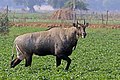 Photograph credit: Charles J. SharpThe nilgai or blue bull (Boselaphus tragocamelus) is the largest Asian antelope and is endemic to the Indian subcontinent. The sole member of the genus Boselaphus, the species was described and given its binomial name by German zoologist Peter Simon Pallas in 1766. The nilgai stands 1–1.5 metres (3.3–4.9 ft) at the shoulder; males weigh 109–288 kilograms (240–635 lb), and the lighter females 100–213 kilograms (220–470 lb). A sturdy thin-legged antelope, the nilgai is characterised by a sloping back, a deep neck with a white patch on the throat, a short crest of hair along the neck terminating in a tuft, and white facial spots. A column of pendant coarse hair hangs from the dewlap ridge below the white patch. Sexual dimorphism is prominent – while females and juveniles are orange to tawny, adult males have a bluish-grey coat. Only males possess horns, which are 15–24 centimetres (5.9–9.4 in) in length.
This picture shows a male nilgai in a potato field at Jamtra, in the Indian state of Madhya Pradesh. -
 Photograph credit: Augustus BinuPomegranate juice is a beverage made from the fruit of the pomegranate. It is used in cooking both as a fresh juice and as a concentrated syrup. The fruit originated in the region extending from Iran to northern India and has been cultivated since ancient times. The fruit has a hard outer husk and a spongy mesocarp in which the seeds in their fleshy seedcoats are embedded. Pomegranate juice can be sweet or sour, but most fruits are moderate in taste. The juice has long been a popular drink in Europe and the Middle East, and is now widely distributed in the United States and Canada.
 -
 Photograph: Muhammad Mahdi KarimThe Chota Imambara in Lucknow, Uttar Pradesh, India, is a mausoleum constructed by and for Muhammad Ali Shah, the third Nawab of Awadh, beginning in 1838.
 -
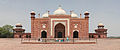 The mosque at the Taj Mahal complex in Agra, India. This red sandstone building, on the western side of the complex, faces the west side of the mausoleum. In the forefront is a howz, meant for ablution. On the eastern side of the complex is the jawab ("answer"), a mirror image of the mosque except for the missing mihrab and different floor pattern; this jawab was mainly intended for architectural balance. Both were constructed in 1643.
 -
 Photograph: Augustus BinuChandiroor Divakaran (b. 1946) is a Malayalam–language poet and folk song writer from Kerala, India. He has published numerous collections of poetry since his debut collection, Radha, in 1965.
 -
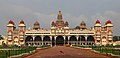 Photograph: Muhammad Mahdi KarimMysore Palace, the official residence and seat of the Wodeyars — the rulers of the Kingdom of Mysore. Located in southern India, the kingdom is traditionally believed to have been founded in 1399 as a vassal state to the Vijayanagara Empire before becoming independent in the 16th century.
 -
 Photograph: Muhammad Mahdi KarimAn Indian palm squirrel (Funambulus palmarum) photographed in Bangalore, India. In India these squirrels are associated with the Hindu deity Rama, an avatar of Vishnu, and as such are not to be harmed. However, in Western Australia they are considered pests and at times targeted for eradication.
 -
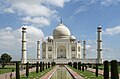 Photograph: Yann; edit: Jim CarterA view of the Taj Mahal from the south, featuring the Charbagh garden. The mausoleum complex also includes subsidiary tombs, waterworks infrastructure, the small town of Taj Ganji, and a "moonlight garden". Its origins and architecture have been extensively documented, covering both the circumstances of its commission and the cultural and historical influence of the Islamic Mughal Empire in India.
 -

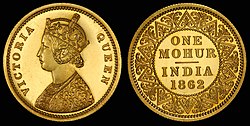 Coin design credit: East India Company and the Calcutta Mint; photographed by Andrew ShivaThe mohur is a gold coin that was formerly minted by several governments, including those of British India. It was usually equivalent in value to fifteen silver rupees. Gold mohurs issued by the British East India Company or the Crown are valuable collectors' items, and sell in auctions for high prices. The double mohur (minted between 1835 and 1918), with a value of thirty rupees, is the highest-denomination circulating coin ever issued in India. The 1835 two-mohur coin above was minted in the reign of King William IV, while the 1862 one-mohur coin below was minted in the reign of Queen Victoria; both are now part of the National Numismatic Collection at the National Museum of American History.
 -
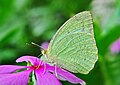 Photo: JoydeepCatopsilia pyranthe is a medium sized butterfly of the family Pieridae. It is found in South Asia, Southeast Asia and parts of Australia. This male was photographed in West Bengal, India.
 -
 Photograph credit: Prathyush ThomasMacrotyloma uniflorum, commonly known as horse gram, is a legume native to tropical southern Asia. The plant grows from a rhizome, sending up annual shoots to a height of 60 cm (24 in). The flowers are cream, yellow or pale green and are followed by short pods. The seeds, pictured here, have been consumed in India for at least 4,000 years and are used both for animal feed and human consumption, including Ayurvedic cuisine. In other tropical countries in southeastern Asia, and in northern Australia, the plant is grown mainly as a fodder crop and for use as green manure. It is a drought-tolerant plant, largely cultivated in areas with low rainfall.
 -
 Photograph: Muhammad Mahdi KarimA panoramic view of Bangalore from Corporation Circle, with UB City to the left and Richmond area to the right. Kanteerava Indoor Stadium is in the foreground. The third largest city in India, the city is known as the Silicon Valley of India for its numerous IT exports.
 -
 Photograph credit: Charles James SharpDanaus genutia, the common tiger or striped tiger, is a species of brush-footed butterfly found in Sri Lanka, India, Myanmar, south-eastern Asia and Australia. It prefers areas of moderate to heavy rainfall, and typical habitats include scrubby jungle, deciduous forests and fallow land near habitations. The insect sequesters toxins from plants, and advertises its unpalatability by having prominent markings and striking colour patterns. This adult male common tiger, of the subspecies D. g. genutia, was photographed in Kerala, India.


_male.jpg?lang=en)
.jpg?lang=en)


.jpg?lang=en)
.jpeg?lang=en)


_male_underside.jpg?lang=en)
Featured list –
-

Bhatt at an event for RRR in 2021
Alia Bhatt is a British actress of Indian descent who predominantly works in Hindi films. As a child, she played a minor role in her father Mahesh Bhatt's production Sangharsh (1999), as the younger version of star Preity Zinta's character. In 2012, Bhatt had her first lead role in Karan Johar's teen film Student of the Year, but her performance in it was not well received. Two years later, she gained praise for playing a kidnapping victim in the drama Highway (2014), winning the Filmfare Critics Award for Best Actress. In the same year, her starring roles in the commercially successful romances 2 States and Humpty Sharma Ki Dulhania, both produced under Johar's studio Dharma Productions, established her as a leading actress. She also sang the single "Samjhawan Unplugged" for the latter film's soundtrack.
In Bhatt's three film releases of 2016—Kapoor & Sons, Dear Zindagi, and Udta Punjab—she played young women in troubling circumstances. Her performance in the last of these won her the Filmfare Award for Best Actress. Following another romantic role in Badrinath Ki Dulhania (2017), she played a spy in the thriller Raazi (2018) and a volatile girlfriend in the musical drama Gully Boy (2019). She won two more Best Actress awards at Filmfare for the latter two. This was followed by two poorly received films, Kalank (2019) and Sadak 2 (2020). Bhatt gained further success in 2022 with a brief role in the Telugu period film RRR, and starring roles in the fantasy film Brahmāstra: Part One – Shiva and biopic Gangubai Kathiawadi, in which she starred as the titular prostitute; all three rank among the highest-grossing Indian films of the year. She won the National Film Award for Best Actress and her fourth Best Actress award at Filmfare for the last of these. She also produced and starred in the Netflix black comedy Darlings under her company Eternal Sunshine Productions, for which she received a Filmfare OTT Award. (Full article...) -

Haasan in 2014
Shruti Haasan is an Indian actress and singer who works in Telugu, Tamil and Hindi films. She started her career as a playback singer at the age of six in the 1992 Tamil film Thevar Magan. She had a brief role in her father, Kamal Haasan's Tamil-Hindi directorial Hey Ram (2000) as a child artist. Haasan's first major appearance was in the Hindi film Luck (2009), in which she played a dual role of a woman avenging her twin sister's death. She played the female lead in the films Anaganaga O Dheerudu and 7 Aum Arivu; both were released in 2011 and together earned her the Best Female Debut – South at the 59th Filmfare Awards South ceremony.
Haasan's subsequent releases Oh My Friend (2011) and 3 (2012) were commercially unsuccessful. The latter earned her a nomination for the Best Actress – Tamil at the 60th Filmfare Awards South ceremony. A turning point came in Haasan's career with Harish Shankar's commercially successful Telugu film Gabbar Singh (2012). The release was followed by a series of successful films such as Balupu (2013) and Yevadu (2014). She received her first Filmfare Award for Best Actress – Telugu for her performance in Race Gurram (2014). (Full article...) -

A flotilla led by destroyers of the Indian Navy during Exercise Tropex 2023
In naval terminology, a destroyer is a fast, manoueverable, long-distance warship intended to escort larger vessels in a fleet, convoy or battle group and defend them against smaller, short-range attackers. Seventeen destroyers have served, or currently serve, in the Indian Navy. The navy operates 13 guided-missile destroyers from four classes: Visakhapatnam class, Kolkata class, Delhi class, and Rajput class. Six other destroyers (three R class and three Hunt class) have been decommissioned and scrapped.
India did not have any destroyers of its own until 1949. The R-class INS Ranjit, built in the United Kingdom, was the first destroyer commissioned in the Indian Navy. Two more of the R-class were later commissioned. Three Hunt-class destroyers were commissioned in 1953 to succeed the R-class destroyers. These ships (all of which were built in the United Kingdom) were decommissioned by 1976, with the Hunt-class INS Godavari the last. (Full article...) -

Padukone in 2019
Indian actress Deepika Padukone primarily appears in Hindi films. Her first screen appearance was in Himesh Reshammiya's music video "Naam Hai Tera" in 2005. Padukone made her film debut by playing the title role in the Kannada-language film Aishwarya (2006). Her first Hindi film release came the following year with Farah Khan's melodrama Om Shanti Om, in which she played dual roles opposite Shah Rukh Khan. She won the Filmfare Award for Best Female Debut for it. Her sole film role in 2008 was as one of Ranbir Kapoor's love interests in Bachna Ae Haseeno. Padukone's first film release of 2009, the kung fu comedy Chandni Chowk to China, proved to be a box office flop, but her next release, Imtiaz Ali's romance Love Aaj Kal, opposite Saif Ali Khan, was a success. Of Padukone's five film releases in 2010, only the comedy Housefull was financially profitable. The series of poorly received films continued with both her 2011 releases, Aarakshan and Desi Boyz.
The acclaimed role of an impulsive party-girl in Homi Adajania's Cocktail (2012) proved to be a breakthrough for Padukone. The year 2013 was key for Padukone when all four of her films were box office hits. Among these were two of the highest-grossing Indian films—the romantic comedies Yeh Jawaani Hai Deewani and Chennai Express. She also won the Filmfare Award for Best Actress for playing a character based on Juliet in Sanjay Leela Bhansali's tragic romance Goliyon Ki Raasleela Ram-Leela (2013). In 2014, Padukone appeared in the Tamil animation film Kochadaiiyaan and played a bar dancer in the top-grossing heist film Happy New Year. The following year, she played a headstrong daughter in Shoojit Sircar's comedy-drama Piku, which earned Padukone her second Best Actress award at Filmfare, and portrayed the warrior Mastani in Bhansali's top-grossing historical romance Bajirao Mastani. (Full article...) -

Members of the Indian cricket team before a Women's World Twenty20 game in Sydney, 2009.
A women's Twenty20 International (WT20I) is a 20 overs-per-side cricket match played in a maximum of 150 minutes between two ICC member sides, and is played under the rules of Twenty20 cricket. The first such match was held in August 2004 between England and New Zealand. The India women's national cricket team played its first WT20I against England in August 2006; India won the match by eight wickets.
Since the team made its first WT20I appearance in 2006, 73 players—including five different captains—have represented India in the format. The list is arranged in the order in which each player won her first Twenty20 cap. Where more than one player won her first Twenty20 cap in the same match, those players are listed alphabetically by surname. (Full article...) -

Khan in 2017
Indian actor Aamir Khan first appeared on screen at the age of eight in a minor role in his uncle Nasir Hussain's film Yaadon Ki Baaraat (1973). In 1983, he acted in and worked as an assistant director on Paranoia, a short film directed by Aditya Bhattacharya, following which he assisted Hussain on two of his directorial ventures—Manzil Manzil (1984) and Zabardast (1985). As an adult, Khan's first acting project was a brief role in the 1984 experimental social drama Holi.
Khan's first leading role came opposite Juhi Chawla in the highly successful tragic romance Qayamat Se Qayamat Tak (1988). His performance in the film and in the thriller Raakh (1989) earned him a National Film Award – Special Mention. He went on to establish himself with roles in several lucrative films of the 1990s, including the romantic drama Dil (1990), the comedy-drama Hum Hain Rahi Pyar Ke (1993), and the romance Raja Hindustani (1996). He also played against type in the Deepa Mehta-directed Canadian-Indian co-production Earth (1998). In 1999, Khan launched a production company, Aamir Khan Productions, whose first release Lagaan (2001) was nominated for the Academy Award for Best Foreign Language Film, and earned him the National Film Award for Best Popular Film. Also in 2001, he starred alongside Saif Ali Khan and Akshaye Khanna in the acclaimed coming-of-age drama Dil Chahta Hai. Lagaan and Dil Chahta Hai are cited in the media as defining films of Hindi cinema. After a three-year hiatus, Khan portrayed the eponymous lead in Mangal Pandey: The Rising (2005), a period film that underperformed at the box office, after which he played leading roles in two top-grossing films of 2006—Fanaa and Rang De Basanti. (Full article...) -

The Padma Bhushan is the third-highest civilian award of the Republic of India. Instituted on 2 January 1954, the award is given for "distinguished service of a high order", without distinction of race, occupation, position, or sex. The recipients receive a Sanad, a certificate signed by the President of India and a circular-shaped medallion with no monetary association. The recipients are announced every year on Republic Day (26 January) and registered in The Gazette of India, a publication used for official government notices and released weekly by the Department of Publication, under the Ministry of Urban Development. The conferral of the award is not considered official without its publication in the Gazette. The names of recipients whose awards have been revoked or restored, both of which require the authority of the President, are archived, and recipients who are struck from the register are required to surrender their medals; none of the conferments of Padma Bhushan during 1990–1999 have been revoked or restored. The recommendations are received from all the state and the union territory governments, as well as from Ministries of the Government of India, the Bharat Ratna and the Padma Vibhushan awardees, the Institutes of Excellence, the Ministers, the Chief Ministers and the Governors of State, and the Members of Parliament including private individuals.
When instituted in 1954, the Padma Bhushan was classified as "Dusra Varg" (Class II) under the three-tier Padma Vibhushan awards, which were preceded by the Bharat Ratna in hierarchy. On 15 January 1955, the Padma Vibhushan was reclassified into three different awards as the Padma Vibhushan, the Padma Bhushan and the Padma Shri. The criteria included "distinguished service of a high order in any field including service rendered by Government servants", but excluded those working with the public sector undertakings with the exception of doctors and scientists. The 1954 statutes did not allow posthumous awards; this was subsequently modified in the January 1955 statute. The design was also changed to the form that is currently in use; it portrays a circular-shaped toned bronze medallion 1+3⁄4 inches (44 mm) in diameter and 1⁄8 inch (3.2 mm) thick. The centrally placed pattern made of outer lines of a square of 1+3⁄16 inches (30 mm) side is embossed with a knob carved within each of the outer angles of the pattern. A raised circular space of diameter 1+1⁄16 inches (27 mm) is placed at the centre of the decoration. A centrally located lotus flower is embossed on the obverse side of the medal and the text "Padma" is placed above and the text "Bhushan" is placed below the lotus written in Devanagari script. The State Emblem of India is displayed in the centre of the reverse side, together with the national motto of India, "Satyameva Jayate" (Truth alone triumphs) in Devanagari script, which is inscribed on the lower edge. The rim, the edges and all embossing on either side is of standard gold with the text "Padma Bhushan" of gold gilt. The medal is suspended by a pink riband 1+1⁄4 inches (32 mm) in width with a broad white stripe in the middle. It is ranked fifth in the order of precedence of wearing of medals and decorations of the Indian civilian and military awards. (Full article...) -
The high courts of India are the highest courts of appellate jurisdiction in each state and union territory of India. However, a high court exercises its original civil and criminal jurisdiction only if the subordinate courts are not authorized by law to try such matters for lack of peculiar or territorial jurisdiction. High courts may also enjoy original jurisdiction in certain matters, if so designated, especially by the constitution, a state law or union law.
The work of most high courts primarily consists of adjudicating on appeals from lower courts and writ petitions in terms of Articles 226 and 227 of the Constitution. Writ jurisdiction is also the original jurisdiction of a high court. (Full article...) -

Priyanka Chopra's performance in Mary Kom garnered her several awards and nominations
Mary Kom is a 2014 Indian biographical sports drama film directed by Omung Kumar and produced by Sanjay Leela Bhansali and Viacom 18 Motion Pictures. The film features Priyanka Chopra in the lead role as the boxer Mary Kom, with Darshan Kumar and Sunil Thapa in supporting roles as her husband and mentor, Onler Kom and M. Narjit Singh respectively. The film was written by Saiwyn Quadras, with the cinematography provided by Keiko Nakahara while Bhansali co-edited the film with Rajesh G. Pandey. The film follows Kom's journey of becoming a boxer to her victory at the 2008 World Boxing Championships in Ningbo, China.
Before its theatrical release on 5 September 2014, the film premiered at the 2014 Toronto International Film Festival, where it became the first Hindi film to be screened on the opening night of the film festival. The film received generally positive reviews from critics and was a commercial success. It grossed ₹1.05 billion (US$12 million) at the box-office against a budget of ₹150 million (US$1.8 million). Mary Kom has received various awards and nominations, with praise for its direction, Chopra's performance, screenplay, editing, background score, and costume design. As of August 2015, the film has won 20 awards. (Full article...) -
Members of the Indian cricket team before a Women's World Twenty20 game in Sydney, 2009
The India women's national cricket team represents India in international women's cricket. A full member of the International Cricket Council (ICC), the team is governed by the Board of Control for Cricket in India (BCCI). The India women's national cricket team first competed in 1976 when they played the West Indies in a six-match Test series at home. They recorded their first victory in the fourth match held at the Moin-ul-Haq Stadium, Patna; however, a loss in the sixth match led to the series being tied. India secured their first overseas victory in a one-off series against South Africa in 2002. As of October 2022[update], they have played 38 Test matches against five different opponents—Australia, England, South Africa, New Zealand and the West Indies. In terms of victories, they have been most successful against England and South Africa with two wins against each of them.
India played their first Women's One Day International cricket (WODI) match against England in the 1978 World Cup, which they hosted. They finished at the bottom of the table as they lost the remaining two games of the group stage. In the 1982 World Cup, they won their first ever WODI match when they beat the International XI by 79 runs at McLean Park, Napier. India's first overseas WODI series win came at the 1994–95 New Zealand Women's Centenary Tournament. They won the WODI series during their tour 1999 of England. They were the runner-up at the 2005 and the 2017 World Cup tournaments. As of October 2022[update], they have played 301 WODIs against twelve different opponents, and have the fourth highest number of victories (164) for any team in the format; They have recorded 81 wins and have been the fifth most successful team in the T20 format. Since their first Women's Twenty20 International (WT20I) against England in August 2006, India have played 151 matches. They have been most successful against Bangladesh with eleven wins against them. They were among the semi-finalists in the 2009 and 2010 ICC Women's World Twenty20 tournaments. (Full article...) -
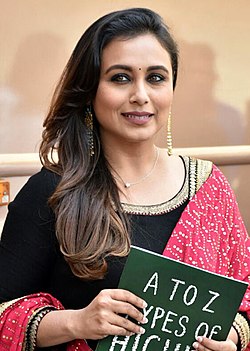
Mukerji in 2018
Hindi film actress Rani Mukerji made her screen debut in Biyer Phool (1996), a Bengali film directed by her father Ram Mukherjee. Her first leading role was that of a rape victim in the 1996 social drama Raja Ki Aayegi Baaraat. In 1998 she received wider recognition for her role alongside Aamir Khan in the action film Ghulam, and had her breakthrough as the romantic interest of Shah Rukh Khan's character in the romantic drama Kuch Kuch Hota Hai. The latter earned Mukerji her first Filmfare Award in the Best Supporting Actress category. She followed this by playing the leading lady in several films, including Hello Brother (1999) and Nayak: The Real Hero (2001), none of which helped propel her career forward.
Mukerji's career prospects improved in 2002 when she starred in Yash Raj Films' Saathiya, a romantic drama that gained her a Filmfare Critics Award for Best Actress. For her roles in the 2004 romantic comedy Hum Tum and the composite drama Yuva, Mukerji became the only actress to win both the Filmfare Award for Best Actress and Best Supporting Actress, respectively, in the same year. Also that year, she starred in Veer-Zaara—the highest-grossing Bollywood film of the year. In 2005, she received praise for portraying a blind, deaf and mute woman in the drama Black, and played a con woman in the crime comedy film Bunty Aur Babli. For her performance in Black, she was awarded the Best Actress and Best Actress (Critics) trophies at Filmfare. The following year, she played an unhappily married woman in the drama Kabhi Alvida Naa Kehna — the top-grossing Bollywood film in overseas at that point. (Full article...) -

The chief minister of Jharkhand is the chief executive of the Indian state of Jharkhand. In accordance with the Constitution of India, the governor is a state's de jure head, but de facto executive authority rests with the chief minister. Following elections to the legislative assembly, the state's governor usually invites the party (or coalition) with a majority of seats to form the government. The governor appoints the chief minister, whose council of ministers are collectively responsible to the assembly. Given the confidence of the assembly, the chief minister's term is for five years and is subject to no term limits.Chief Minister also serves as Leader of the House in the Legislative Assembly.
Seven people have served as the state's chief minister since Jharkhand's formation on 15 November 2000. Half of them, including the inaugural officeholder Babulal Marandi and Arjun Munda, represented the Bharatiya Janata Party (BJP). Hemant Soren, from the JMM, is the longest-serving chief minister. Three chief ministers, Shibu Soren, his son Hemant Soren, and Champai Soren, represented the Jharkhand Mukti Morcha (JMM). Shibu Soren's first term ended in just ten days, as he could not prove that he had the support of a majority of the house and was forced to resign. The state has also been governed by Madhu Koda, one of the few independents to become the chief minister of any state. In between their reigns, the state has also been under President's rule three times. Raghubar Das, of the BJP, was the first non-tribal and first chief minister to complete a full term in the state. Hemant Soren of the Jharkhand Mukti Morcha is the incumbent chief minister. (Full article...) -

Asin at a promotional event for Housefull 2 in 2012
Asin is a former Indian actress who is known for her work in Tamil, Telugu and Hindi language films. She made her acting debut at the age of 15 in the Malayalam-language satirical comedy-drama Narendran Makan Jayakanthan Vaka in 2001. Asin had her first commercial success with the Telugu film Amma Nanna O Tamila Ammayi (2003). For her performance as a Tamil girl in the film, she received the Filmfare Best Telugu Actress Award. In the same year she won the Santosham Best Actress Award for her role in Telugu film Sivamani. In her next two Telugu releases: Lakshmi Narasimha (2004) and Gharshana (2004), Asin played the love interest of a police officer. Lakshmi Narasimha was a commercial success, while Gharshana received mixed reviews from critics but later gained a cult following.
She made her debut in Tamil cinema in the 2004 sports drama M. Kumaran Son of Mahalakshmi, a commercial success. The 2005 action thriller Ghajini marked a turning point in her career. Her role as a vivacious young model named Kalpana won her the Filmfare Best Tamil Actress Award. This led to a series of lead roles in commercially successful films, including the action film Sivakasi (2005), the thriller Varalaru (2006), the action thriller Pokkiri (2007), the action drama Vel (2008) and the science fiction film Dasavathaaram (2008), which established her as a leading actress of Tamil cinema. (Full article...) -

Tabu at an event for De De Pyaar De in 2019
Indian actress Tabu appears primarily in Hindi films. Her first credited role came as a teenager in Dev Anand's Hum Naujawan (1985), and her first major role was in the Telugu film Coolie No. 1 (1991). In 1994, Tabu received the Filmfare Award for Best Female Debut for the Hindi action drama Vijaypath, which marked her first of many collaborations with co-star Ajay Devgn. The year 1996 was key for Tabu. Her performance as a young woman affected by the Punjab insurgency in Gulzar's Maachis proved to be a breakthrough, winning her the National Film Award for Best Actress. Also that year, Tabu won the Filmfare Award for Best Actress – Telugu for the romance Ninne Pelladata, and featured alongside Govinda in the comedy film Saajan Chale Sasural.
Tabu had a brief role in the war film Border, the highest-grossing Hindi film of 1997, and portrayed a village girl opposite Anil Kapoor in the Priyadarshan-directed drama Virasat. Among her 1999 releases were two of the top-grossing Bollywood films of the year—the comedy Biwi No.1, and the family drama Hum Saath-Saath Hain. She also starred as the rebellious daughter of a corrupt politician in Gulzar's critically praised drama Hu Tu Tu (1999). The following year, she starred in Kandukondain Kandukondain, a Tamil adaptation of Sense and Sensibility, and played a submissive homemaker in the bilingual drama Astitva. Tabu garnered a second National Film Award for Best Actress for portraying a bar dancer in Madhur Bhandarkar's crime drama Chandni Bar (2001). In 2003, she starred in the Bengali film Abar Aranye, and portrayed a character based on Lady Macbeth, in Maqbool—an adaptation of Macbeth from Vishal Bhardwaj. Following a few commercial failures, Tabu played triple roles in M. F. Husain's musical drama Meenaxi: A Tale of Three Cities. Tabu's first international project came with Mira Nair's adaptation of Jhumpa Lahiri's novel The Namesake. In R. Balki's Cheeni Kum (2007), Tabu starred alongside Amitabh Bachchan as a woman romantically involved with a much older man; the role earned her a record fourth Filmfare Critics Award for Best Actress. (Full article...) -
The Padma Bhushan is the third-highest civilian award of the Republic of India. Instituted on 2 January 1954, the award is given for "distinguished service of a high order", without distinction of race, occupation, position, or sex. The recipients receive a Sanad, a certificate signed by the President of India and a circular-shaped medallion with no monetary association. The recipients are announced every year on Republic Day (26 January) and registered in The Gazette of India—a publication used for official government notices and released weekly by the Department of Publication, under the Ministry of Urban Development. The conferral of the award is not considered official without its publication in the Gazette. The name of recipient, whose award have been revoked or restored, both of which require the authority of the President, is archived and they are required to surrender their medal when their name is struck from the register; none of the conferments of Padma Bhushan during 1970–1979 have been revoked or restored. The recommendations are received from all the state and the union territory governments, as well as from Ministries of the Government of India, the Bharat Ratna and the Padma Vibhushan awardees, the Institutes of Excellence, the Ministers, the Chief Ministers and the Governors of State, and the Members of Parliament including private individuals.
When instituted in 1954, the Padma Bhushan was classified as "Dusra Varg" (Class II) under the three-tier Padma Vibhushan awards, which were preceded by the Bharat Ratna in hierarchy. On 15 January 1955, the Padma Vibhushan was reclassified into three different awards as the Padma Vibhushan, the Padma Bhushan and the Padma Shri. The criteria included "distinguished service of a high order in any field including service rendered by Government servants", but excluded those working with the public sector undertakings with the exception of doctors and scientists. The 1954 statutes did not allow posthumous awards; this was subsequently modified in the January 1955 statute. The design was also changed to the form that is currently in use; it portrays a circular-shaped toned bronze medallion 1+3⁄4 inches (44 mm) in diameter and 1⁄8 inch (3.2 mm) thick. The centrally placed pattern made of outer lines of a square of 1+3⁄16-inch (30 mm) side is embossed with a knob carved within each of the outer angles of the pattern. A raised circular space of diameter 1+1⁄16 inches (27 mm) is placed at the centre of the decoration. A centrally located lotus flower is embossed on the obverse side of the medal and the text "Padma" is placed above and the text "Bhushan" is placed below the lotus written in Devanagari script. The State Emblem of India is displayed in the centre of the reverse side, together with the national motto of India, "Satyameva Jayate" (Truth alone triumphs) in Devanagari script, which is inscribed on the lower edge. The rim, the edges and all embossing on either side is of standard gold with the text "Padma Bhushan" of gold gilt. The medal is suspended by a pink riband 1+1⁄4 inches (32 mm) in width with a broad white stripe in the middle. It is ranked fifth in the order of precedence of wearing of medals and decorations of the Indian civilian and military awards. (Full article...) -

Vidya Balan's performance in Kahaani garnered her several awards and nominations
Kahaani (transl. Story) is a 2012 Indian mystery thriller film directed and co-produced by Sujoy Ghosh. The film stars Vidya Balan as the protagonist, and features Parambrata Chatterjee, Nawazuddin Siddiqui, and Saswata Chatterjee in supporting roles. The film was edited by Namrata Rao, with the cinematography provided by Setu. Set in the city of Kolkata during the festivities of Durga Puja, Kahaani follows the life of a pregnant woman, Vidya Bagchi (Vidya Balan), in search of her husband, a man whose existence is denied by the people she encounters.
Made on a budget of ₹80 million (US$950,000), Kahaani was released on 9 March 2012 and grossed over ₹1.04 billion (US$12 million) worldwide after a 50-day theatrical run. The film garnered awards and nominations in several categories, with particular praise for its direction and the performance of the lead actress. As of 2014, the film has won 28 awards. (Full article...) -
Madras is a 2014 Indian Tamil-language drama film written and directed by Pa. Ranjith. It was produced by K. E. Gnanavel Raja under his production company, Studio Green. The film features Karthi and Catherine Tresa in the lead roles, with Kalaiyarasan, Riythvika and Rama playing supporting roles. The film's story revolves around Kaali (Karthi), an impulsive and short-tempered IT professional who lives in the Vyasarpadi area of Chennai. His friend Anbu (Kalaiyarasan) is killed in the midst of a feud between two factions of a political party over a building wall at one of the housing board apartments in the area. When Kaali hears of this, he decides to avenge Anbu's death. The soundtrack and score were composed by Santhosh Narayanan while the cinematography and editing were handled by Murali G and Praveen K. L. respectively.
Released on 26 September 2014, the film garnered generally positive reviews and was a commercial success at the box office. It was included in The Hindu's top 20 Tamil-language films of the year. The film won 24 awards from 51 nominations; its direction, screenplay, performances of the cast members, music, and cinematography have received the most attention from award groups. (Full article...) -
Test cricket is the longest form of cricket. The women's variant of the game includes four innings to be completed over four days of play with eleven players in each side. The first women's Test was played between England and Australia in 1934. However, India did not play Test cricket until 1973 when the Women's Cricket Association of India was formed. The Indian women's team played their first Test match in 1976, against the West Indies. The Women's Cricket Association of India was merged with the Board of Control for Cricket in India in 2006 as part of the International Cricket Council's initiative to develop women's cricket.
India have played 41 Tests, starting with their first Test in 1976. They first won a Test in Patna (1976), in front of over 25,000 spectators, against the West Indies but did not win again until 2002, when they won against South Africa. The team has remained unbeaten since 2006, over the course of three Test matches. (Full article...) -

Kal Ho Naa Ho (transl. Tomorrow May Never Come) is a 2003 Indian Hindi-language romantic comedy-drama film directed by Nikkhil Advani. The film stars Jaya Bachchan, Shah Rukh Khan, Saif Ali Khan and Preity Zinta. Sushma Seth, Reema Lagoo, Lillete Dubey and Delnaaz Irani play supporting roles. The film's story focuses on Naina Catherine Kapur (Preity Zinta), an MBA student who falls in love with Aman Mathur (Shah Rukh Khan). He does not reciprocate her feelings as he is a terminally ill heart patient, a fact he hides from Naina. Aman does not wish to bring Naina any pain through his illness, and tries to make her fall in love with her friend and fellow MBA classmate Rohit Patel (Saif Ali Khan). The film's dialogues were written by Niranjan Iyengar while Karan Johar drafted the story and screenplay. The latter also co-produced the film with his father, Yash Johar, under the Dharma Productions banner. The soundtrack for Kal Ho Naa Ho was composed by Shankar–Ehsaan–Loy while Javed Akhtar wrote the lyrics for its songs. Anil Mehta and Sanjay Sankla handled the cinematography and editing respectively. Sharmishta Roy was in charge of the production design.
Produced on a budget of ₹280 million, Kal Ho Naa Ho was released on 27 November 2003 and received positive reviews from critics. It was a commercial success, grossing ₹860.9 million worldwide. The film won 35 awards from 78 nominations; its direction, story, screenplay, performances of the cast members, music and cinematography have received the most attention from award groups. (Full article...) -

Mohammad Azharuddin is a former international cricketer who represented and captained the India national cricket team. Considered to be one of the greatest batsman to emerge from Indian cricket, he was well known for his "wristy strokeplay". A right-handed middle order batsman, Azharuddin scored 29 international centuries before the Board of Control for Cricket in India (BCCI) accused him of match-fixing in 2000, which marked the end of his cricket career. In a career that spanned 15 years, he played 99 Tests and 334 One Day Internationals (ODI) accumulating 6,215 and 9,378 runs respectively. Azharuddin was the first cricketer to score 9,000 runs in ODI cricket and remained the leading run-scorer until October 2000. He was named the "Indian Cricket Cricketer of the Year" before being included by Wisden as one of their five Cricketers of the Year in 1991.
Azharuddin made his Test and ODI debuts during England's 1984–85 tour of India. In Tests, he made centuries against all nations except West Indies and Zimbabwe. In his first Test appearance Azharuddin made 110, thus becoming the eighth Indian player to score a century on debut. With scores of 105 and 122 in the subsequent matches of the series, he became the first player to score a century in each of his first three Tests. Azharuddin equalled the record of Kapil Dev for the fastest century by an Indian in Test cricket, when he scored a century from 74 balls against South Africa in 1996. His highest score of 199 came against Sri Lanka at Kanpur in 1986. Azharuddin's 22 Test centuries were made at fifteen cricket grounds, nine of which were outside India. He scored a century in his last Test innings—against South Africa—in March 2000. As of December 2025, he is joint thirty-first among all-time century makers in Test cricket, and sixth in the equivalent list for India. (Full article...) -
Padmaavat is a 2018 Indian Hindi-language epic period drama film directed and produced by Sanjay Leela Bhansali. The film stars Deepika Padukone as Rani Padmavati, Shahid Kapoor as Maharawal Ratan Singh and Ranveer Singh as Sultan Alauddin Khilji and features Aditi Rao Hydari, Jim Sarbh, Raza Murad, and Anupriya Goenka in supporting roles. The film's screenplay was written by Bhansali and Prakash Kapadia. Bhansali also composed the soundtrack of the film, with lyrics written by A. M. Turaz, Siddharth-Garima and Swaroop Khan. The original score of the film is composed by Sanchit Balhara. Padmaavat was edited by Rajesh G. Pandey while Sudeep Chatterjee is its cinematographer. Set in medieval Rajasthan in 1303 AD, Queen Padmavati of Mewar is married to a noble king and they live in a prosperous fortress with their subjects until an ambitious Sultan hears of Padmavati's beauty and becomes obsessed with having her.
Made on a budget of ₹2.15 billion (US$25 million), Padmaavat was released on 25 January 2018 in 2D, 3D and IMAX 3D formats, making it the first Indian film to be released in IMAX 3D. Despite not being released in some states of India, it grossed over ₹5.85 billion (US$69 million) at the box office, becoming a commercial success and one of the highest-grossing Indian films of all time. The film won 25 awards from 68 nominations; its music, and the performance of Singh have received the most attention from award groups. (Full article...) -

Location of Tripura (highlighted in red) within India
The Tripura Legislative Assembly is the unicameral legislature of the state of Tripura, in Northeast India. The seat of the legislative assembly is at Agartala, the capital of the state. The assembly sits for a term of five years, unless it is dissolved early. Tripura is the third-smallest state in India, covering 10,491 km2 (4,051 sq mi); and the seventh-least populous state with a population of 3.67 million. The Tripura Legislative Assembly has existed since 1963, when it had 30 constituencies. Since 1972, it has had 60 single-seat constituencies, each of which directly elects a representative.
Since the independence of India, the Scheduled Castes (SC) and Scheduled Tribes (ST) have been given reservation status, guaranteeing political representation, and the Constitution lays down the general principles of positive discrimination for SCs and STs. The 2011 census of India stated that indigenous people constitute 32% of the state's total population. The Scheduled Tribes have been granted a reservation of 20 seats in the assembly, while 10 constituencies are reserved for candidates of the Scheduled Castes. (Full article...) -

The Goa Legislative Assembly is the unicameral legislature of the state of Goa on the west coast of India. Its seat is at Porvorim, and it sits for a term of five years unless it is dissolved early. Goa is India's smallest state by area and fourth-smallest by population. The Goa Legislative Assembly has existed since 1963. As of the 2022 election, it comprises 40 constituencies.
The Constitution of India lays down the general principles of positive discrimination for the Scheduled Castes (SC) and Scheduled Tribes (ST). Since the transition of India from a United Kingdom dominion to an independent republic in 1950, the SCs and STs have been given reservation status—guaranteeing political representation—and after Goa was annexed from Portugal in 1961, the same principles applied to it as well. The 2011 census of India found that, within Goa, the population of the Scheduled Castes was 1.74% of the total. Accordingly, one constituency (Pernem) in the assembly is reserved for candidates of the Scheduled Castes. (Full article...) -
The Kerala State Film Award for Best Director is an honour presented annually at the Kerala State Film Awards of India since 1969. It is given to a film director who has exhibited outstanding direction while working in the Malayalam film industry. Until 1997, the awards were managed directly by the Department of Cultural Affairs of the Government of Kerala. Since 1998, the Kerala State Chalachitra Academy, an autonomous non-profit organisation functioning under the Department of Cultural Affairs, has been exercising control over the awards. The recipients are decided by an independent jury formed by the academy. They are declared by the Minister for Cultural Affairs and are presented by the Chief Minister.
The first Kerala State Film Awards ceremony was held in 1970 with cinematographer-director A. Vincent receiving the Best Director award for his work in Nadhi (1969). Throughout the years, accounting for ties and repeat winners, the Government of Kerala has presented a total of 50 best director awards to 25 different filmmakers. The recipients receive a figurine, a certificate, and a cash prize of ₹2 lakh (US$2,400). (Full article...) -
The Pampa Award (or Pampa Prashasti) is a literary award in the Indian state of Karnataka. The award was established in 1987 by the government of Karnataka. It is the highest literary honor conferred by the Department of Kannada and Culture, Government of Karnataka State, and recognises works written in the Kannada language (1 of the 22 official languages of India).
The award is named after the first Kannada poet Adikavi Pampa. The award originally comprised a cash prize of ₹1 lakh (US$1,200), a shawl, a citation and a memento. The cash prize was increased to ₹3 lakh (US$3,500) in 2008. Prior to 1996, the awards were given for a best single work by a Kannada writer. Since then, the award has been given to writers for their lifetime contribution to the Kannada literature. The Pampa Prashasti is presented by the Chief Minister, during the Kadambotsava, a cultural festival held annually in Pampa's hometown of Banavasi in Uttara Kannada district. (Full article...)
.jpg?lang=en)


_2.jpg?lang=en)


.jpg?lang=en)


.jpg?lang=en)


 Good article –

-
Alchi Monastery (Tibetan: ཨ་ལྕི་ཆོས་འཁོར།) or Alchi Gompa (Tibetan: ཨ་ལྕི་དགོམ་པ།, also Alci) is a Tibetan Buddhist monastery, known more as a monastic complex (chos-'khor) of temples in Alchi village in the Leh District, under the Ladakh Autonomous Hill Development Council of the Union Territory of Ladakh, India. The complex comprises four separate settlements in the Alchi village in the lower Ladakh region with monuments dated to different periods. Of these four hamlets, Alchi monastery is said to be the oldest and most famous. It is administered by the Likir Monastery. It is 60 west of Leh on Leh-Kargil Highway.
Alchi is also part of the three villages (all in lower Ladakh region) which constitute the ‘Alchi group of monuments’; the other two villages adjoining Alchi are the Mangyu and Sumda Chun. The monuments in these three villages are stated to be of "unique style and workmanship’, but the Alchi monastic complex is the best known. (Full article...) -
Eurekha! is a biography of the actress Rekha by the columnist and author Mohan Deep. The book details her Hindi film acting career and her short-term marriage with the industrialist Mukesh Aggarwal. It was published on 17 December 1999 by Shivani Publications and later reprinted in a number of Indian languages, including a serialisation in the magazine Anandalok. It received negative reviews from critics, who panned Deep's writing and the book's contents. Rekha herself was critical of the book due to its misinformation. (Full article...)
-
Lalji Singh (5 July 1947 – 10 December 2017) was an Indian scientist who worked in the field of DNA fingerprinting technology in India and pioneer of Assisted reproductive technology, where he was popularly known as the "Father of Indian DNA fingerprinting". Singh also worked in the areas of molecular basis of sex determination, wildlife conservation forensics and evolution and migration of humans. In 2004, he received the Padma Shri in recognition of his contribution to Indian science and technology.
Singh founded various institutes and laboratories in India, including the Centre for DNA Fingerprinting and Diagnostics in 1995, Laboratory for the Conservation of Endangered Species (LaCONES) in 1998, and Genome Foundation in 2004, aiming to diagnose and treat genetic disorders affecting the Indian population, in particular the under-privileged people residing in rural India. (Full article...) -
Mullum Malarum (transl. 'The Thorn and the Flower' or 'Even a Thorn Will Bloom'; pronounced [muɭɭum maɭaɾum]) is a 1978 Indian Tamil-language drama film written and directed by Mahendran. Produced by Venu Chettiar and V. Mohan, the film stars Rajinikanth, Sarath Babu, Jayalaxmi and Shoba. It marks Mahendran's directorial debut and is partly based on Uma Chandran's novel of the same name, which was serialised in the Tamil magazine Kalki in 1966. Mullum Malarum tells the story of Kali (Rajinikanth), a winch operator of a cable trolley who dotes on his sister Valli (Shoba) since they were orphaned, and clashes with his boss Kumaran (Sarath Babu).
Mahendran read only part of the novel, and developed the screenplay as he wanted, making a visually focused film without formulaic Tamil cinema conventions he disliked such as melodrama, overacting, excessive dialogue and duets. Since Mahendran had no previous directing experience, cinematographer Balu Mahendra, who was already an established director, assisted him with the screenplay, dialogue, camera angles, casting and editing. Principal photography lasted for about 30 days, taking place primarily in Sringeri, Karnataka, though some scenes were also filmed in Ooty, Tamil Nadu. The film was edited by D. Vasu, and the soundtrack was composed by Ilaiyaraaja. (Full article...) -

The route of the 1870s Inland Customs Line (red) and Great Hedge (green)
The Inland Customs Line, incorporating the Great Hedge of India (or Indian Salt Hedge), was a customs barrier built by the British colonial rulers of India to prevent smuggling of salt from coastal regions in order to avoid the substantial salt tax.
The customs line was begun under the East India Company and continued into direct British rule. The line had its beginnings in a series of customs houses established in Bengal in 1803 to prevent the smuggling of salt to avoid the tax. These customs houses were eventually formed into a continuous barrier that was brought under the control of the Inland Customs Department in 1843. (Full article...) -
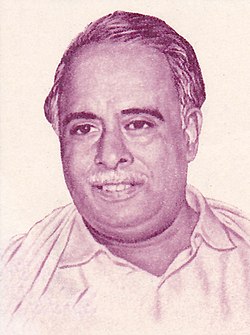
The fourth legislative assembly election of Madras State (later renamed as Tamil Nadu) was held in February 1967. The Dravida Munnetra Kazhagam (DMK) led coalition under the leadership of C.N. Annadurai won the election defeating the Indian National Congress (Congress). Anti-Hindi agitations, the rising prices of essential commodities, and a shortage of rice were the dominant issues. K. Kamaraj's resignation as the Chief Minister in 1963, to concentrate on party affairs, along with persistent rumors of corruption had weakened the incumbent Congress Government. This was the first time that a non-congress party had gained a single simple majority in a state assembly in India, second time after Communist Party of India winning Kerala assembly elections in 1957 for a non-Congress party alliance to gain the majority in a state in India, and the last time that Congress held power in Tamil Nadu. It marked the beginning of Dravidian dominance in the politics of Tamil Nadu. Annadurai, who became the first non-Congress chief minister of post-independence Tamil Nadu, died in office in 1969 and V.R. Nedunchezhiyan took over as acting chief minister. Since then, except for brief months of President's rule, only Dravida Munnetra Kazhagam and its splitaway Anna Dravida Munnetra Kazhagam have formed cabinets in the State. (Full article...) -
Conversations with Waheeda Rehman is a biography by the producer of television documentaries and author Nasreen Munni Kabir, documenting Kabir's extensive conversations with the actress Waheeda Rehman about the actress' life and career. The biography details Rehman's birth in 1938 in Chingleput (present-day Chengalpattu), her 54-year-long film career, and her 1974 marriage to the actor Kamaljeet, with whom she has two children. It was published on 19 February 2014 by Penguin Books. The book generated positive reviews from book critics; most of the praise was directed towards the book's question-and-answer format, and Kabir's and Rehman's style in questioning and answering, respectively.
In 1988, Kabir met Rehman while researching on Guru Dutt's life. She met Rehman—his then frequent collaborator—to find more information about him for a documentary releasing the next year, In Search of Guru Dutt. During these interactions, Kabir conceived the idea to write a book on the actress which later became Conversations with Waheeda Rehman. Over the next decades, Kabir tried persuading Rehman to get involved in the book but was always rejected since Rehman believed her life was not interesting enough. While Kabir was nearly about to give up of the project, Rehman finally agreed to do so in 2012. Writing took place in Bandra from December 2012 to November 2013. (Full article...) -
Subedar and Honorary Captain Karam Singh PVC, MM (15 September 1915 – 20 January 1993) was an Indian soldier and a recipient of the Param Vir Chakra (PVC), India's highest award for gallantry. Singh joined the army in 1941, and took part in the Burma Campaign of World War II, receiving the Military Medal for his actions during the Battle of the Admin Box in 1944. He also fought in the Indo-Pakistani War of 1947, and was awarded the PVC for his role in saving a forward post at Richhmar Gali, south of Tithwal. He was also one of the five soldiers chosen to raise the Indian flag for the first time after independence in 1947. Singh later rose to the rank of subedar, and was conferred the rank of honorary captain before his retirement in September 1969. (Full article...) -

Bhatura (pl. bhature; also spelled bhatooru) is a puffed, deep-fried, sourdough leavened flatbread commonly served for breakfast. Originating in North Indian cuisine, it is also eaten in other regions. Similar to naan, it is made with maida flour and leavened using yogurt, which produces lactic acid bacteria. It puffs up when fried and has a soft, fluffy texture. It is sometimes eaten as street food or as festival food. Paired with chickpea curry, it forms a dish called chole bhature. (Full article...) -
Mahendra Singh Dhoni ([məˈɦeːnd̪ɾə ˈsɪŋɡʱ ˈd̪ʱoːniː] ⓘ; born 7 July 1981) is an Indian professional cricketer who plays as a right-handed batter and a wicket-keeper. Widely regarded as one of the most prolific wicket-keeper batsmen and captains, he represented the Indian cricket team and was the captain of the side in limited overs formats from 2007 to 2017 and in Test cricket from 2008 to 2014. Dhoni has captained the most international matches and is the most successful Indian captain. He has led India to victory in the 2007 ICC World Twenty20, the 2011 Cricket World Cup, and the 2013 ICC Champions Trophy, being the only captain to win three different limited overs ICC tournaments. He also led the teams that won the Asia Cup in 2010 and 2016, and he was a member of the title winning squad in 2018.
Born in Ranchi, Dhoni made his first class debut for Bihar in 1999. He made his debut for the Indian cricket team on 23 December 2004 in an ODI against Bangladesh and played his first test a year later against Sri Lanka. In 2007, he became the captain of the ODI side before taking over in all formats by 2008. Dhoni retired from Test cricket in 2014 but continued playing in limited overs cricket till 2019. He has scored 17,266 runs in international cricket including 10,000 plus runs at an average of more than 50 in ODIs. (Full article...) -
"Within You Without You" is a song by the English rock band the Beatles from their 1967 album Sgt. Pepper's Lonely Hearts Club Band. Written by lead guitarist George Harrison, it was his second composition in the Indian classical style, after "Love You To", and inspired by his stay in India in late 1966 with his mentor and sitar teacher Ravi Shankar. Recorded in London without the other Beatles, it features Indian instrumentation such as sitar, tambura, dilruba and tabla, and was performed by Harrison and members of the Asian Music Circle. The recording marked a significant departure from the Beatles' previous work; musically, it evokes the Indian devotional tradition, while the overtly spiritual quality of the lyrics reflects Harrison's absorption in Hindu philosophy and the teachings of the Vedas.
The song was Harrison's only composition on Sgt. Pepper, although his endorsement of Indian culture was further reflected in the inclusion of yogis such as Paramahansa Yogananda among the crowd depicted on the album's cover. With the worldwide success of the album, "Within You Without You" presented Indian classical music to a new audience in the West and contributed to the genre's peak in international popularity. It also influenced the philosophical direction of many of Harrison's peers during an era of utopian idealism marked by the Summer of Love. The song has traditionally received a varied response from music critics, some of whom find it lacklustre and pretentious, while others admire its musical authenticity and consider its message to be the most meaningful on Sgt. Pepper. Writing for Rolling Stone, David Fricke described the track as "at once beautiful and severe, a magnetic sermon about materialism and communal responsibility in the middle of a record devoted to gentle Technicolor anarchy". (Full article...) -
The Jabala Upanishad (Sanskrit: जाबाल उपनिषद्, IAST: Jābāla Upaniṣad), also called Jabalopanisad, is a minor Upanishad of Hinduism. The Sanskrit text is one of the 20 Sannyasa Upanishads, and is attached to the Shukla Yajurveda.
The Jabala Upanishad is an ancient text, composed before 300 CE and likely around the 3rd century BCE. It is among the oldest Upanishads that discuss the subject of renouncing the worldly life for the exclusive pursuit of spiritual knowledge. The text discusses the city of Banaras in spiritual terms, as Avimuktam. It describes how that city became holy, then adds that the holiest place to revere is one within – the Atman (soul, self). (Full article...) -
Malik Hasan Bahri (died 1486) or Nizam-ul-Mulk Bahri was a noble of the Bahmani Sultanate in India who served as the prime minister from 1481 until his murder in 1486. He was the father of Malik Ahmad Nizam Shah I, founder of the Ahmadnagar Sultanate, one of the secessionist kingdoms from the Bahmani Sultanate, and its ruling dynasty's primogenitor.
Originally a Hindu Brahmin, he was taken captive by Bahmani forces in the 1420s and converted to Islam. He entered the service of the sultanate as a military slave and was given further education. In 1471, he led the conquest of forts of the Gajapati Empire after he had been sent to influence a succession conflict in the state, and was given governorship over the Bahmani province of Telangana. As the leader of the Deccani faction in the conflict between them and those not native to South Asia, he helped plot the execution of Mahmud Gawan in 1481, the foreign prime minister at the time and Malik Hasan's predecessor. He then adopted the role, and in 1482 became the sole regent of Mahmood Shah, where throughout his ministership he had effective control of the state. In 1486, he was killed amidst continual internal strife. (Full article...) -
Ardhanarishvara (Sanskrit: अर्धनारीश्वर, romanized: Ardhanārīśvara, lit. 'the half-female Lord') is a form of the Hindu deity Shiva combined with his consort Parvati. Ardhanarishvara is depicted as half-male and half-female, equally split down the middle.
Ardhanarishvara represents the synthesis of masculine and feminine energies of the universe (Purusha and Prakriti) and illustrates how Shakti, the female principle of God, is inseparable from (or the same as, according to some interpretations) Shiva, the male principle of God, and vice versa. The union of these principles is exalted as the root and womb of all creation. Another view is that Ardhanarishvara is a symbol of Shiva's all-pervasive nature. The right half is usually the male Shiva, illustrating his traditional attributes. (Full article...) -
The gharial (Gavialis gangeticus), also known as gavial or fish-eating crocodile, is a crocodilian in the family Gavialidae and among the longest of all living crocodilians. Mature females are 2.6 to 4.5 m (8 ft 6 in to 14 ft 9 in) long, and males 3 to 6 m (9 ft 10 in to 19 ft 8 in). Adult males have a distinct boss at the end of the snout, which resembles an earthenware pot known as a ghara, hence the name "gharial". The gharial is well adapted to catching fish because of its long, narrow snout and 110 sharp, interlocking teeth.
The gharial probably evolved in the northern Indian subcontinent. Fossil gharial remains were excavated in Pliocene deposits in the Sivalik Hills and the Narmada River valley. It currently inhabits rivers in the plains of the northern part of the Indian subcontinent. It is the most thoroughly aquatic crocodilian, and leaves the water only for basking and building nests on moist sandbanks. Adults mate at the end of the cold season. Females congregate in spring to dig nests, in which they lay 20–95 eggs. They guard the nests and the young, which hatch before the onset of the monsoon. The hatchlings stay and forage in shallow water during their first year, but move to sites with deeper water as they grow. (Full article...) -

The Alchon Huns, (Bactrian: αλχον(ν)ο Alkhon(n)o or αλχαν(ν)ο Alkhan(n)o) also known as the Alkhan, Alchono, Alxon, Alkhon, Alakhana, and Walxon, were a nomadic people who established states in Central Asia and the Indian subcontinent during the 4th and 6th centuries CE. They were first mentioned as being located in Paropamisus, and later expanded south-east, into the Punjab and Central India, going as far as Eran and Kausambi. The Alchon invasion of the Indian subcontinent eradicated the Kidarite Huns who had preceded them by about a century, and contributed to the fall of the Gupta Empire, in a sense bringing an end to Classical India.
The invasion of India by the Huna peoples follows invasions of the subcontinent in the preceding centuries by the Yavana (Indo-Greeks), the Saka (Indo-Scythians), the Pahlava (Indo-Parthians), and the Kushana (Yuezhi). The Alchon Empire was the second of four major Huna states established in Central Asia and the Indian subcontinent. The Alchon were preceded by the Kidarites and succeeded by the Hephthalites and Nezak Huns in Bactria and the Hindu Kush respectively. The names of the Alchon kings are known from their extensive coinage, Buddhist accounts, and a number of commemorative inscriptions throughout the Indian subcontinent. (Full article...) -
Rang De Basanti (transl. Paint Me Saffron) is a 2006 Indian Hindi-language coming-of-age political action film written, produced, and directed by Rakeysh Omprakash Mehra. The film stars an ensemble cast including Aamir Khan, Siddharth (in his Hindi debut), Atul Kulkarni, Sharman Joshi, Kunal Kapoor, British actress Alice Patten (in her Hindi debut), Waheeda Rehman, and Soha Ali Khan. It follows a British film student traveling to India to document the story of five freedom fighters of the Indian revolutionary movement. She befriends and casts five young men in the film, which inspires them to fight against the evils of their own present-day government.
Shot primarily in New Delhi, Rang De Basanti was released globally on 26 January 2006. Upon release, the film broke all opening box office records in India, becoming the country's highest-grossing film in its opening weekend and holding the highest opening-day collections for a Hindi film. It eventually became the seventh highest grossing Hindi film of 2006. It received critical acclaim, winning the National Film Award for Best Popular Film, and being nominated for Best Foreign Language Film at the 2007 BAFTA Awards. The film was chosen as India's official entry for the Golden Globe Awards and the Academy Awards in the Best Foreign Language Film category, though it did not ultimately yield a nomination for either award. A. R. Rahman's soundtrack, which earned positive reviews, had two of its tracks considered for an Academy Award nomination. (Full article...) -
Thillana Mohanambal (transl. The Dance Queen Mohanambal) is a 1968 Indian Tamil-language romantic musical dance film written, directed and produced by A. P. Nagarajan. The film stars Sivaji Ganesan, Padmini and T. S. Balaiah, with A. V. M. Rajan, Nagesh and Manorama in supporting roles. It tells the story of Shanmugasundaram, a nadaswaram player who falls in love with Mohanambal, a Bharatanatyam dancer who reciprocates his feelings, but unfortunate circumstances and their egoistic nature prevents them from confessing their love for one another. How they overcome their self-created obstacles and those created by the people around them forms the rest of the story.
The film was adapted from Kothamangalam Subbu's novel of the same name, which was serialised in the Tamil magazine Ananda Vikatan in 1957–58. The film was mostly shot in Thanjavur, Thiruvarur and Madurai. Its original soundtrack was composed by K. V. Mahadevan, and songs like "Nalandhana", "Maraindhirundhu" and "Pandian Naanirukka" became immensely popular among the Tamil diaspora. (Full article...) -
Dabangg (transl. Unputdownable) is a 2010 Indian Hindi-language action comedy film directed by Abhinav Singh Kashyap and produced by Malaika Arora and Arbaaz Khan under Arbaaz Khan Productions with Dhilin Mehta under Shree Ashtavinayak Cine Vision. The film stars Salman Khan, Sonakshi Sinha, Arbaaz Khan and Sonu Sood in the lead roles, while Om Puri, Dimple Kapadia, Vinod Khanna, Anupam Kher, Mahesh Manjrekar and Mahie Gill feature in supporting roles. The film marks the debut of Sinha as an actress, Arbaaz Khan as a producer and Kashyap as a director. Arora makes a special appearance in the song "Munni Badnaam Hui".
Dabangg is set in the Indian state of Uttar Pradesh. It was made with a budget of ₹30 crore and marketed at ₹12 crore. The film was shot primarily in the town of Wai in Maharashtra, while other major scenes were shot in the United Arab Emirates. (Full article...) -

Tipu's Tiger in the V&A Museum, London showing the helpless European being attacked
Tipu's Tiger, Tippu's Tiger or Tipoo’s Tiger is an 18th-century automaton created for Tipu Sultan, the ruler of the Kingdom of Mysore (present day Karnataka) in India. The carved and painted wood casing represents a tiger mauling a near life-size European man. Mechanisms inside the tiger and the man's body make one hand of the man move, emit a wailing sound from his mouth and grunts from the tiger. In addition a flap on the side of the tiger folds down to reveal the keyboard of a small pipe organ with 18 notes.
The automaton incorporates Tipu's emblem, the tiger, and expresses his hatred of his enemy, the British of the East India Company. It was taken from his summer palace when East India Company troops stormed Tipu's capital in 1799. The Governor General, Lord Mornington, sent the tiger to Britain initially intending it to be an exhibit in the Tower of London. First exhibited to the London public in 1808 in East India House, then the offices of the East India Company in London, it was transferred to the Victoria and Albert Museum in 1880. It now forms part of the permanent exhibit on the "Imperial courts of South India". From the moment it arrived in London to the present day, Tipu's Tiger has been a popular attraction to the public. (Full article...) -
The Padma Bhushan (IAST: Padma Bhūṣaṇa, lit. 'Lotus Decoration') is the third-highest civilian award in the Republic of India, preceded by the Bharat Ratna and the Padma Vibhushan and followed by the Padma Shri. Instituted on 2 January 1954, the award is given for "distinguished service of a high order ... without distinction of race, occupation, position or sex". The award criteria includes "service in any field including service rendered by Government servants" including doctors and scientists, but exclude those working with the public sector undertakings. As of 2025[update], the award has been bestowed on 1341 individuals, including 38 posthumous and 101 non-citizen recipients.
The Padma Awards Committee is constituted every year by the Prime Minister of India and the recommendations for the award are submitted between 1 May and 15 September. The recommendations are received from all the state and the union territory governments, as well as from Ministries of the Government of India, Bharat Ratna and Padma Vibhushan awardees, the Institutes of Excellence, Ministers, Chief Ministers and Governors of States, Members of Parliament, and private individuals. The committee later submits their recommendations to the Prime Minister and the President of India for further approval. The award recipients are announced on 26 January, the Republic Day of India. (Full article...) -

The Bharat Ratna (Hindi pronunciation: [bʱaːɾət̪ ɾət̪n̪(ᵊ)]; lit. 'Jewel of India') is the highest civilian award of the Republic of India. Instituted on 2 January 1954, the award is conferred in recognition of "exceptional service/performance of the highest order", without distinction of race, occupation, position or gender. The award was originally limited to achievements in the arts, literature, science, and public services, but the Government of India expanded the criteria to include "any field of human endeavor" in December 2011. The recipients receive a Sanad (certificate) signed by the president and a peepal leaf-shaped medallion. Bharat Ratna recipients rank seventh in the Indian order of precedence.
The first recipients of the Bharat Ratna were: the former governor-general of the Union of India C. Rajagopalachari, the former president of the Republic of India Sarvepalli Radhakrishnan; and the Indian physicist C. V. Raman, who were honoured in 1954. Since then, the award has been bestowed upon 53 individuals, including 18 who were awarded posthumously. The original statutes did not provide for posthumous awards but were amended in January 1966 to permit them to honor former prime minister Lal Bahadur Shastri, the first individual to be honored posthumously. In 2014, cricketer Sachin Tendulkar, then aged 40, became the youngest recipient, while social reformer Dhondo Keshav Karve was the oldest recipient when he was awarded on his 100th birthday. Though usually conferred on India-born citizens, the award has been conferred on one naturalized citizen, Mother Teresa, and on two non-Indians: Abdul Ghaffar Khan (born in British India and later a citizen of Pakistan) and Nelson Mandela, a citizen of South Africa. (Full article...) -
The Badami cave temples are a complex of Buddhist, Hindu and Jain cave temples located in Badami, a town in the Bagalkot district in northern part of Karnataka, India. The caves are important examples of Indian rock-cut architecture, especially Badami Chalukya architecture, and the earliest date from the 6th century. Badami is a modern name and was previously known as "Vataapi", the capital of the early Chalukya dynasty, which ruled much of Karnataka from the 6th to the 8th century. Badami is situated on the west bank of a man-made lake ringed by an earthen wall with stone steps; it is surrounded on the north and south by forts built during Early Chalukya and in later times.
The Badami cave temples represent some of the earliest known examples of Hindu temples in the Deccan region. They along with the temples in Aihole transformed the Mallaprabha River valley into a cradle of temple architecture that influenced the components of later Hindu temples elsewhere in India. (Full article...) -
Gaalipata (pronunciation transl. Kite) is a 2008 Indian Kannada-language romantic comedy drama film written and directed by Yogaraj Bhat. It features an ensemble cast consisting of Ganesh, Anant Nag, Rajesh Krishnan, Diganth, Daisy Bopanna, Neethu and Bhavana Rao. The plot revolves around three friends who, debilitated of city life, decide to spend some time in the paternal house of one of them, at a picturesque location atop a hill station. Spending a gala time there, they become romantically involved with the three daughters of an avid hunter.
The film was produced by Suryaprakash Rao of SPR Entertainment Pvt Ltd., and was made on a budget ₹60 million. The cinematography was done by R. Rathnavelu, and the film was edited by Suresh Urs. The film score and soundtrack were composed by V. Harikrishna. Gaalipata was the first in Kannada to be shot in Super 35 format. (Full article...) -
The Transgender Persons (Protection of Rights) Act, 2019 is an act of the Parliament of India for protection of rights of transgender people, their welfare, and other related matters. The act was introduced in the Lok Sabha, the lower house of the Indian Parliament, on 19 July 2019 by the Minister of Social Justice and Empowerment, Thawar Chand Gehlot, in light of the lapse of the Transgender Persons (Protection of Rights) Bill, 2018 (Bill No. 210-C of 2016). The 2019 act and the immediately preceding 2018 bill, were both preceded by a 2016 version. They were met with protests and criticism by some transgender people, lawyers, and activists in India. The 2016 bill was sent to a standing committee which submitted its report in July 2017. Following this, the Lok Sabha tabled and passed a newer version of the bill in December 2018. However, it did not incorporate many of the committee's recommendations. Although members of the opposition criticised the 2019 act and assured activists that they would not vote in favour of it, it was passed by the Lok Sabha on 5 August 2019 and by the Rajya Sabha, the upper house of the Parliament, on 26 November 2019. The president assented to it on 5 December 2019, upon which the act was published in the Gazette of India. It has been in effect since 10 January 2020 following a notification of the same in the Gazette on the same day.
Following protests by the queer community against the 2016 and 2018 bills, the 2019 act has done away with some of the severely criticised provisions of the 2018 bill, such as the criminalisation of begging and the establishment of a district screening committee to process applications for issuance of transgender person certificates. However, it fails to incorporate yet other principles in line with the Supreme Court judgment in National Legal Services Authority v. Union of India (NALSA v. UOI) in 2014, such as the right of transgender people to declare their self-perceived gender identity without undergoing sex reassignment surgery, and reservations in jobs and educational institutions. The act has also been criticised for imposing less punishment for crimes against transgender people compared with punishment for crimes against cisgender people. On 27 January 2020, the Supreme Court issued a notice to the central government in a petition challenging the constitutionality of the act. (Full article...)


.jpg?lang=en)


_male.jpg?lang=en)


News
- 9 December 2025 – 2025 IndiGo disruption
- The Directorate General of Civil Aviation of India orders IndiGo, the country's largest airline, to reduce its flights by 5% following a scheduling crisis last week that caused thousands of cancellations. (DW)
- 7 December 2025 – 2025 North Indian Ocean cyclone season
- Cyclone Ditwah
- The death toll from the floods and landslides caused by heavy rains in Sri Lanka increases to 618. (Al Jazeera)
- Cyclone Senyar
- The death toll from the floods in Indonesia increases to 908, while 410 people remain missing. In Thailand, at least 216 people are also confirmed killed. (Al Jazeera)
Did you know...
- ... that Saraswati enthroned has been described as "a pinnacle of Indian art"?
- ... that Phomen Singh, an early Indian migrant to New Zealand, sold sweets and chutneys out of a suitcase?
- ... that a Bangladeshi diplomatic mission in India was attacked by Hindu extremists protesting the arrest of a Hindu monk?
- ... that because the Green Bay Packers were named after a canned meat company, PETA called on the team to change their name?
- ... that of the 146 Conestoga wagons employed by the Braddock Expedition in the French and Indian War, only one remained intact by the campaign's end?
- ... that a viral video by an Indian influencer resulted in the sugar content of Bournvita being cut by almost 15 percent?
Topics related to India
Timeline of Indian history, Indus Valley Civilisation, Dholavira, Science and technology in ancient India, Meluhha, Aryan invasion theory, Out of India theory, Greek conquests in India, Indian maritime history, Maurya Empire, Ashoka, Shunga Empire, Hoysala Empire, Vijayanagara, Satavahana dynasty, Indo-Greek Kingdom, Indo-Scythians, Indo-Parthian Kingdom, Kushan Empire, Western Satraps, Gupta Empire, Chola dynasty, Pala Empire, Islamic incursions in India, Mughal Empire, Maratha Empire, British Raj, East India Company, Governor-General, Viceroy, War of Independence, 1857, Indian independence movement, Indian National Army, Azad Hind, Quit India Movement, Partition of India, History of Republic of India, Non-Aligned Movement, Sino-Indian War, Indo-Pakistani War of 1947–1948, Indo-Pakistani War of 1965, Indo-Pakistani War of 1971, Kargil War, 2001–02 India–Pakistan standoff, Military, Demographic
Law, Hindu law, Constitution, Political parties (Indian National Congress, Bharatiya Janata Party), Foreign relations, Elections, Political divisions, Reservation in India
Government agencies, Legislative branch (Lok Sabha, Rajya Sabha) Executive branch (President & Vice President, Prime Minister & Deputy Prime Minister, Cabinet Ministers, Cabinet Secretary, Election Commission, Foreign Minister; Law enforcement: CBI, CID, Intelligence: IB, RAW), Directorate General of Income Tax Investigation Judicial branch (Supreme Court), Armed Forces (Army, Navy, Air Force, Border Security Force, Coast Guard)
Himalayas, Western Ghats, Eastern Ghats, Indo-Gangetic Plain, Deccan Plateau, Thar Desert, Ganges, Rann of Kutch, Brahmaputra River, Northeast India; Mountains, Valleys, Islands, Rivers; States and union territories, Cities, Districts, Regions, Fauna, Flora
Rupee, Bombay Stock Exchange, National Stock Exchange, Standard of living, Companies, Reserve Bank of India, Energy policy (Solar, Wind, Nuclear), Tourism, Transport (Expressways, Rail transport, Auto rickshaw),
Languages, Standard of living, Religion
Music (Carnatic, Hindustani, Indi-pop), Dance, Languages, Literature, Architecture, Film & TV, Cuisine, Holidays, Folklore, Education, Media, Indian martial arts
Indian Council of Agricultural Research (ICAR), Indian Institute of Astrophysics, National Centre for Software Technology, AIIMS, IISc, IIT, NIT, BITS-Pilani, INRegistry, Indian numbering system, Indian Space Research Organisation, National Internet Exchange of India, ICRISAT, International Institute of Information Technology, Hyderabad
Indian English, Indian nationality law, Numbering system, Indian Space Research Organisation, Telecommunications, National Highways Development Project, Flag, Vehicle registration plates, Indian nationalism, Metrication in India
Categories

Related portals


.svg?lang=en)

Religions in India


.svg?lang=en)

Indian Subcontinent


Other countries


_in_Amritsar,_India.jpg?lang=en)


Wikipedias in Indian languages
- অসমীয়া (Assamese)
- বাংলা (Bengali)
- भोजपुरी (Bhojpuri)
- বিষ্ণুপ্রিয়া মণিপুরী (Bishnupriya Manipuri)
- गोंयची कोंकणी / Gõychi Konknni (Konkani)
- ગુજરાતી (Gujarati)
- हिन्दी (Hindi)
- ಕನ್ನಡ (Kannada)
- कॉशुर/كشميري (Kashmiri)
- मैथिली (Maithili)
- മലയാളം (Malayalam)
- मराठी (Marathi)
- नेपाली (Nepali)
- नेपाल भाषा
- (Newari)
- ଓଡ଼ିଆ (Odiya)
- ਪੰਜਾਬੀ (Punjabi)
- पालि (Pali)
- संस्कृत (Sanskrit)
- ᱥᱟᱱᱛᱟᱲᱤ (Santali)
- سنڌي (Sindhi)
- தமிழ் (Tamil)
- తెలుగు (Telugu)
- ತುಳು (Tulu)
- اردو (Urdu)
Associated Wikimedia
The following Wikimedia Foundation sister projects provide more on this subject:
-
 Commons
Free media repository -
 Wikibooks
Free textbooks and manuals -
 Wikidata
Free knowledge base -
 Wikinews
Free-content news -
 Wikiquote
Collection of quotations -
 Wikisource
Free-content library -
 Wikiversity
Free learning tools -
 Wikivoyage
Free travel guide -
 Wiktionary
Dictionary and thesaurus


