


Talk:Baudot code


 | This article is based on material taken from the Free On-line Dictionary of Computing prior to 1 November 2008 and incorporated under the "relicensing" terms of the GFDL, version 1.3 or later. |

Underlined superscripted letters in "Original Baudot, Continental European"?
[edit]Does anybody know what the characters shown as superscripted, double-underlined letters in the left-hand chart of "Fig 1. The Baudot code" of the reference for the charts in "Original Baudot, Continental European" are? The letters appear to be capital "F", capital "H", capital or lower-case "O"/"o", and lower-case "t". I tried some Web searching, but didn't find anything obvious. Guy Harris (talk) 05:34, 2 October 2020 (UTC)
- The French Wiki page has this source with a table that matches the double underlined "t" (there it is a capitalized but small "T") with a period "." character as secondary meaning. The code is the same from the patent and a regular capital letter "T" is also present on the listing. May indicate end of message (transmis/transmitted) (tout/all) or perhaps underline. Other letters having it suggests a convention perhaps of a control character usage. 24.240.218.117 (talk) — Preceding undated comment added 00:20, 28 September 2023 (UTC)

Inland & Continental: British order?
[edit]While continental order looks rather logical to code both vowels and consonants in their natural order on 5 bits (31 values), what is supposed to be the inland/British logic?
Is it more an order for coding numbers on 4 bits (15 values)? a reuse of any previous code? — Preceding unsigned comment added by 86.67.202.154 (talk • contribs) 22:45, 18 August 2021 (UTC)
Table cleanup
[edit]People have already mentioned problems with accessibility of the table's backend code... but the table layout itself is inaccessible even to sighted, first-language-English readers, let alone blind or ESL ones.
How is someone using a screen reader meant to be able to understand the bit patterns, from this table? There's no earthly way! How does a screen reader read a blank column? A column containing nothing but a bulletpoint?
What's the rationale for having Gray code be the default ordering? For ordering by Gray code at all? For having each of the value columns twice? For having each bit of the value in a separate column? For having the value columns randomly positioned within the table? For bulletpoints and spaces instead of either the traditional plusses and minuses to indicate telegraph wire polarity, or modern 1s and 0s? For having "Let" and "Fig" headings in the UK but not Eur side? For not having those columns sortable? For splitting the "sort keys" columns? For even having the "sort keys" columns in the first place? For inconsistently calling it "Europe" in one place, "Continental" in another? For abbreviating items on the UK side only? Why are the erasure codes incorrectly marked as asterisks in the UK side? Why are the underlined "F H O T" in Eur displayed in lowercase, rather than the more canonical uppercase? Why is the Fig by "V" marked as a superscript "1" rather than an apostrophe "'"? ...
As someone who knows nothing, and who comes to an encyclopaedia for answers, none of this made any sense. So I dug into it for a few hours, and my proposal is below. I have not "been bold" and made the change, as I accept that I am a complete ignoramus in this area, and I have likely made at least a few egregious errors.
Rationale
[edit]- Addresses at least the wilder things from the list above.
- That lengthy introductory paragraph can go.
- Infinitely more accessible to screen readers.
- Also more accessible to human eyeballs.
- Few abbreviations, so translation can have a fighting chance.
- The "Binary" column for "code" has the bits in binary order, because that's the sanest for accessibility; and it sorts in binary order.
- The "Keyboard" column is in the bit order "54:123", as this table previously tried to show. The sort is set as Gray, but only because I assume that's of some academic interest... I can't guess what, though. I don't see any more use to this ordering than to Pendry's "plan".
- The "Type-Wheel" column is in transmission bit order ("12345": little-endian). I also have this set as the default sort order, because (completely arbitrarily!) I felt it's the nicest looking, and most historically interesting. Also, since it appears randomish, it encourages people to experiment with the sort buttons :)
- I've also set some characters (control codes, funky numbers) to have a custom sort order, for sanity's sake.
Further work needs to be done
[edit]I am far from qualified to do any of this. I know nothing, and Googling around the matter for hours has failed me.
- Find something better than numbered dots for the "keyboard" and 'type-wheel' columns. There's some unfortunate markup in the table to make the numbered balls be the same size, and large enough to read. Also, in dark mode, it's likely that people will read it the opposite to the intended way, maybe. "10:110", "☑☐:☐☑☑", "+-:-++", "+-:-++", "☑☐:☐☑☑" (that one's kinda nice, but again, dark mode?) ...? What's something that doesn't look too awful, is visible on most systems, works in dark mode, and is not as egregiously inaccessible as "● : ●●"?"
- Maybe remove one or both of the keyboard and type-wheel columns. But they do both have historical relevance.
- A textual section on "traditional formatting" should be added to describe punched-tape layout, sprocket-spacing after the second character, the fact that the original print wheel sorted by a code of diagonal lines (not a Gray code, despite what that wiki page claims!), that the endianness of the transmission order was never specified, etc.
- Explain what the "f h o t" characters in Eur meant, and maybe replace with "F H O T" or even "F H O T", which seems closest to the various early sources I can find.
- Explain why the values "1/ 3/ 5/ 7/ 9/" were included in the UK - at first glance they seem like shilling values, or the top of fractions, but if so, why only odd numbers?
- Explain why the values "1" and "2" were included in the UK. Perhaps they were footnotes in the original source, but they don't seem to be, in Google's scan of either edition of Pendry.
- More of the characters, especially in the Figs columns, need custom sort orders.
Proposal
[edit]| code | Europe | UK | ||||
|---|---|---|---|---|---|---|
| binary | keyboard | type-wheel | LTRS | FIGS | LTRS | FIGS |
| 00000 | ④⑤:①②③ |
①②③④⑤ |
Undefined | Undefined | Undefined | Undefined |
| 00001 | ④⑤:❶②③ |
❶②③④⑤ |
A | 1 | A | 1 |
| 00010 | ④⑤:①❷③ |
①❷③④⑤ |
E | 2 | E | 2 |
| 00100 | ④⑤:①②❸ |
①②❸④⑤ |
Y | 3 | Y | 3 |
| 01001 | ❹⑤:❶②③ |
❶②③❹⑤ |
J | 6 | J | 6 |
| 10010 | ④❺:①❷③ |
①❷③④❺ |
X | , | X | 9/ |
| 00101 | ④⑤:❶②❸ |
❶②❸④⑤ |
U | 4 | U | 4 |
| 01010 | ❹⑤:①❷③ |
①❷③❹⑤ |
G | 7 | G | 7 |
| 10101 | ④❺:❶②❸ |
❶②❸④❺ |
T | ! | T | ² |
| 01011 | ❹⑤:❶❷③ |
❶❷③❹⑤ |
H | h | H | ¹ |
| 10110 | ④❺:①❷❸ |
①❷❸④❺ |
W | ? | W | ? |
| 01101 | ❹⑤:❶②❸ |
❶②❸❹⑤ |
C | 9 | C | 9 |
| 11010 | ❹❺:①❷③ |
①❷③❹❺ |
M | ) | M | ) |
| 10100 | ④❺:①②❸ |
①②❸④❺ |
S | ; | S | 7/ |
| 01000 | ❹⑤:①②③ |
①②③❹⑤ |
Figure | Blank | Figure | Blank |
| 10001 | ④❺:❶②③ |
❶②③④❺ |
t | . | – | . |
| 00011 | ④⑤:❶❷③ |
❶❷③④⑤ |
É | & | / | 1/ |
| 00110 | ④⑤:①❷❸ |
①❷❸④⑤ |
I | o | I | 3/ |
| 01100 | ❹⑤:①②❸ |
①②❸❹⑤ |
B | 8 | B | 8 |
| 11001 | ❹❺:❶②③ |
❶②③❹❺ |
K | ( | K | ( |
| 10011 | ④❺:❶❷③ |
❶❷③④❺ |
Z | : | Z | : |
| 00111 | ④⑤:❶❷❸ |
❶❷❸④⑤ |
O | 5 | O | 5 |
| 01111 | ❹⑤:❶❷❸ |
❶❷❸❹⑤ |
D | 0 | D | 0 |
| 11111 | ❹❺:❶❷❸ |
❶❷❸❹❺ |
P | % | P | + |
| 11110 | ❹❺:①❷❸ |
①❷❸❹❺ |
N | N° | N | £ |
| 11101 | ❹❺:❶②❸ |
❶②❸❹❺ |
Q | / | Q | / |
| 11011 | ❹❺:❶❷③ |
❶❷③❹❺ |
L | = | L | = |
| 10111 | ④❺:❶❷❸ |
❶❷❸④❺ |
V | ' | V | ' |
| 01110 | ❹⑤:①❷❸ |
①❷❸❹⑤ |
F | f | F | 5/ |
| 11100 | ❹❺:①②❸ |
①②❸❹❺ |
R | – | R | – |
| 11000 | ❹❺:①②③ |
①②③❹❺ |
Erasure | Erasure | Erasure | Erasure |
| 10000 | ④❺:①②③ |
①②③④❺ |
Blank | Letter | Blank | Letter |
DewiMorgan (talk) 03:51, 8 October 2022 (UTC)
- I agree that the sort keys in the table are not helpful. Gray code is not relevant to this application. I can't even work out what the "Continental" and "UK" sort keys are even doing – it's almost, but not quite, a binary sort. I would be happy to see the sort key columns removed altogether. Having said that, I don't think your reworked table is much of an improvement. Sorting by binary value is not an especially good choice for the default. That is only helpful to someone trying to manually read a punched tape (ie reverse translation) which is not something that many readers are going to want to do. In any case, it is quite arbitrary which bit is considered the MSB in a code which (I think) was never stored digitally, so historically never had a representation as a number. Thus, it is WP:OR to have a binary column at all.
- The "keyboard" column is numbered in the wrong order. The numbering goes from the central black key outwards – 1,2,3 to the right and 4,5 to the left. That is, 4 and 5 are the wrong way round. I'm not sure what you mean by "type-wheel" code. This is actually showing the transmission order of the bits (which I agree is a useful column to have). The type-wheel has a definite order of characters, but it doesn't amount to a different code. It's just a different ordering, so shouldn't show any coding. It should just reorder the other columns. Very oddly, I have to click the type-wheel column three times before it sorts into typewheel order (A,E,Y,J,X...).
- I really don't like the fussy little numbers in circles. It would be much clearer to have the bit numbers as headings and show the coding as plain black dots. SpinningSpark 12:31, 8 October 2022 (UTC)
- By the way, the article does not even mention "typewheel" so some explanation of that column would be required if it is retained. SpinningSpark 09:30, 9 October 2022 (UTC)
- You said "Sorting by binary value is not an especially good choice for the default. That is only helpful to someone trying to manually read a punched tape" but that is actually not the only use case, nor is it the most likely case. In fact, except for the rare person who reads this article just out of curiosity about the historic technology, the actual MOST LIKELY reason someone is reading this article is because they are trying to implement a Baudot Code encoder or decoder software. And in that case they certainly WILL want the codes listed and sorted by value, that is the code with the lowest value represented by the bits should go first, and the code with the highest value represented by the bits should go last. And yes there IS a logical order to the bit arrangement, to figure out the numeric value of the code. Typically when transmitted, binary data is sent least significant bit first, and when stored in memory or on disk it is stored most significant bit first. Therefore there IS a proper ordering to it, and each code should NOT be thought of just as a combination of bits, but rather the binary representation of a number. And to figure out which is the least significant bit, just figure out which bit is SENT FIRST. The bit sent first will always be the least significant bit for Baudot (just like it is with ASCII code sent over RS232 serial cable, just that Baudot has fewer bits than ASCII, and it maps differently between the code's value and the character represented). And the Baudot codes should be in an easy to find table on Wikipedia, sorted based on the numeric value of the code, for anybody who may need to access this info for technical reasons (such as writing software for encoding/decoding the Baudot code). And by the way there actually is a table directly on one of the websites that this Wikipedia article cites as a source, which has all the Baudot codes listed in numerical order. Specifically https://www.dataip.co.uk/technical-information/the-baudot-code/ is the website. Benhut1 (talk) 22:32, 18 December 2025 (UTC)
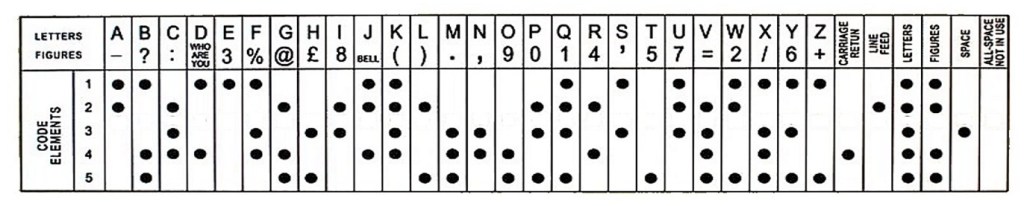
- Another possible way to do it (and also have it be practical to those attempting to write software that encodes/decodes Baudot Code) is to list the codes in alphabetical order. All the codes in Baudot can represent either a letter or a figure (number or symbol), so if you take what letter they represent, you can simply order them alphabetically. Then just show the code value, which letter it represents, which figure it represents in figure mode, and for the remaining codes that are control codes (which are the same regardless of letters or figures mode), just list them at the end of the table like done in the table on this website https://thisisamateurradio.com/p167-radioteletype/ and here's a link directly to the table image https://thisisamateurradio.com/wp-content/uploads/2024/07/baudot-code.jpg?w=1024 Benhut1 (talk) 22:44, 18 December 2025 (UTC)
- There are also several tables like that already in this article.
- Unless there is actual historical precedence for making tables in Gray encoding (or other suggestions) they should not be used IMHO. I agree that the simple 32-entry 2x16 grids are much easier to figure out. Spitzak (talk) 13:32, 19 December 2025 (UTC)
Baudot-Murray code
[edit]Baudot-Murray code targets #Murray code, but it seems like it may more commonly reference #ITA2. Are there any WP:RS claiming either, here maybe? At least, a note in #Nomenclature could be helpful. Tule-hog (talk) 05:57, 25 March 2025 (UTC)