


Open defecation
.png?lang=simple)
Open defecation is the human practice of defecating outside ("in the open") rather than into a toilet. People may choose fields, bushes, forests, ditches, streets, canals, or other open spaces for defecation. They do so either because they do not have a toilet readily accessible or due to archaic traditional cultural practices.[3] The practice is common where sanitation infrastructure and services are not available. Even if toilets are available, behavior change efforts may still be needed to promote the use of toilets. 'Open defecation free' (ODF) is a term used to describe communities that have shifted to using toilets instead of open defecation. This can happen, for example, after community-led total sanitation programs have been implemented.
Open defecation can pollute the environment and cause health problems and diseases. High levels of open defecation are linked to high child mortality, poor nutrition, poverty, and large disparities between rich and poor.[4] Ending open defecation is an indicator being used to measure progress towards the Sustainable Development Goal Number 6. Extreme poverty and lack of sanitation are statistically linked. Therefore, eliminating open defecation is thought to be an important part of the effort to eliminate poverty.[5]
In 2022, 420 million people (5.25% of the global population) were practicing open defecation, a significant decline from about 1.31 billion (21.42%) in 2000, representing a reduction of 890 million people or 16.17% points over 22 years. Of those practicing open defecation, 275 million (65.6%) were living in just seven countries. In India, for example, the number had decreased by 62% (73% in 2000 to 11% in 2022), showcasing the country's significant efforts to achieve Sustainable Development Goals by 2030.[6][7] However, despite the progress, India still had the largest number of people practicing open defecation, followed by Nigeria, Ethiopia, Niger, Pakistan and Indonesia.[8]
Overview
[change | change source]In ancient times, there were more open spaces and less population pressure on land, open defecation was a common practice which brought fewer health and hygiene problems. With development and urbanization, open defecating started becoming a challenge and thereby an important public health issue, and an issue of human dignity.[9] With the increase in population in smaller areas, such as cities and towns, more attention was given to hygiene and health. As a result, there was an increase in global attention towards reducing the practice of open defecation.[10] Open defecation perpetuates the vicious cycle of disease and poverty and is widely regarded as an affront to personal dignity.[4] The countries where open defecation is most widely practiced have the highest numbers of deaths of children under the age of five, as well as high levels of undernutrition, high levels of poverty, and large disparities between people of means and the poor.[4]
 Indiscriminate waste dumping and open defecation (from animals), Shadda, Cap-Haitien, Haiti
 Evidence of open defecation along a riverbank in Bujumbura, Burundi
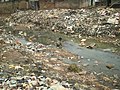 Child defecating in the open in a canal in the slum of Gege in the city of Ibadan, Nigeria
 Open defecation, Tirin Kowt bazaar, Afghanistan

.jpg?lang=simple)
.jpg?lang=simple)
.jpg?lang=simple)
See also
[change | change source]Notes
[change | change source]References
[change | change source]- ↑ "Sanitation facilities usage, World". Our World in Data. 6 January 2024. Retrieved 12 September 2024.
- ↑ Max Roser; Hannah Ritchie; Fiona Spooner (17 January 2024). "Sanitation". Our World in Data. Archived from the original on 12 September 2024. Retrieved 12 September 2024.
- ↑ Clasen T, Boisson S, Routray P, Torondel B, Bell M, Cumming O, et al. (November 2014). "Effectiveness of a rural sanitation program on diarrhea, soil-transmitted helminth infection, and child malnutrition in Odisha, India: a cluster-randomized trial". The Lancet. Global Health. 2 (11): e645-53. doi:10.1016/S2214-109X(14)70307-9. PMID 25442689.
- 1 2 3 Progress on drinking water and sanitation, 2014 Update. WHO/UNICEF Joint Monitoring Programme for Water Supply and Sanitation (JMP). 2014. ISBN 978-92-4-150724-0. Archived from the original on 2 April 2015. Retrieved 12 March 2015.
- ↑ Junaid Ahmad (30 October 2014). "How to eliminate open defecation by 2030". Devex. Archived from the original on 1 June 2016. Retrieved 2 May 2016.
- ↑ Cite error: The named reference
:8was used but no text was provided for refs named (see the help page). - ↑ "Sustainable Development Goals National Indicator Framework" (PDF). Ministry of Statistics and Programme Implementation. 29 June 2024. Archived (PDF) from the original on 30 June 2024. Retrieved 2 September 2024.
- ↑ Cite error: The named reference
:2was used but no text was provided for refs named (see the help page). - ↑ O'Reilly K (1 January 2016). "From toilet insecurity to toilet security: creating safe sanitation for women and girls". Wiley Interdisciplinary Reviews: Water. 3 (1): 19–24. Bibcode:2016WIRWa...3...19O. doi:10.1002/wat2.1122. ISSN 2049-1948. S2CID 109965522.
- ↑ "Nearly a Billion People Still Defecate Outdoors. Here's Why". 25 July 2017. Archived from the original on 5 October 2017. Retrieved 4 October 2017.