


Nelumbo lutea
| Nelumbo lutea | |
|---|---|
 | |
| Lotus flower | |
| Scientific classification | |
| Domain: | |
| Kingdom: | |
| Division: | |
| Order: | |
| Family: | |
| Genus: | |
| Species: | N. lutea |
| Binomial name | |
| Nelumbo lutea (Willd.) Pers. | |
Nelumbo lutea, also known as the American lotus, yellow lotus, or volée, is a plant in the genus Nelumbo. It is found in North America.
Description
[change | change source]The American lotus, like the Sacred Lotus, is an aquatic plant whose roots sink into the mud, while the flower and leaves emerge from the surface of the water. It grows in lakes and swamps, as well as areas prone to floods.
Flowering begins in late spring and may continue into the summer. The specific name means "yellow" in Latin and refers to the flowers, which may be white to pale yellow. The flowers measure 18–28 cm (7.1–11.0 in) in diameter and have 22-25 petals.[1]
Distribution
[change | change source]The native distribution of the American lotus is Minnesota to Oklahoma, Florida, Mexico, Honduras, and the Caribbean.
Ecology
[change | change source]It is the larval host plant of the American lotus borer, Ostrinia penitalis.[2]
Gallery
[change | change source]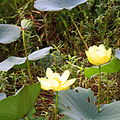
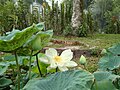

 another flower
_02.jpg?lang=simple)


_01.jpg?lang=simple)
Related pages
[change | change source]- Nelumbo nucifera — a more iconic lotus native to much of Asia
- Nelumbo aureavallis — an extinct species of lotus
- Nelumbo
References
[change | change source]

- ↑ Slocum, Perry D. (2005). Waterlilies and Lotuses: Species, Cultivars, and New Hybrids. p. 236. ISBN 978-0-88192-684-2.
- ↑ "Species Ostrinia penitalis - American Lotus Borer - Hodges#4946 - BugGuide.Net". bugguide.net. Retrieved 2019-09-26.