


Heijō Shrine
 | This article may be expanded with text translated from the corresponding article in Japanese. (May 2018) Click [expand] for important translation instructions.
|
 | The English used in this article or section may not be easy for everybody to understand. |
 | It has been suggested that Heijō Shrine be renamed as Pyongyang Shrine. Please discuss it on the talk page. |
| Heijō Shrine | |
|---|---|
 The shrine (date unknown) | |
| Religion | |
| Affiliation | Shinto |
| Deity | Kunitama Okami Amaterasu Okami |
| Location | |
| Location | Pyongyang, Korea, Empire of Japan |
| Geographic coordinates | 39°02′07″N 125°45′19″E / 39.03534°N 125.7552°E |
| Architecture | |
| Completed | 1913 |
| Demolished | August 16, 1945 |
 Glossary of Shinto Glossary of Shinto | |
Heijō Shrine (Japanese: 平壌神社, Hepburn: Heijō jinja; Hangul: 평양신사) was a Shinto shrine in Pyongyang while Korea was under Japanese colonial rule. The shrine was named after the Japanese name for Pyongyang. It was built in 1913[1] and ceased to exist after 1945.[2] The shrine's main festival was celebrated every year on October 2nd.
In the Modern system of ranked Shinto Shrines, Heijō Shrine was a national shrine of the third rank, also known as kokuhei shōsha.
Today, the location where Heijō Shrine once stood has been turned into a park. A statue of Kim Il-Sung was built where the shrine used to be
Gallery
[change | change source] Map of layout of the shrine (1942)
 Side of the shrine (1942)
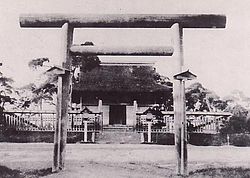 Another view of the shrine


References
[change | change source]- ↑ "平壌神社 | 海外神社(跡地)に関するデータベース 神奈川大学非文字資料研究センター". www.himoji.jp. Retrieved 2023-10-09.
- ↑ "神社참배 거부 18개교 日帝, 가차 없이 폐교|주간동아". 주간동아 (in Korean). Retrieved 2023-09-17.