


Heart Nebula

| Emission nebula | |
|---|---|
| H II region | |
.jpg?lang=en) Heart Nebula, with the Fish Head Nebula on the top right corner, narrowband image captured on a 70 mm scope | |
| Observation data: J2000.0 epoch | |
| Right ascension | 02h 33m 22s |
| Declination | +61° 26′ 36″ |
| Distance | 7000 [1] ly (2100 pc) |
| Apparent magnitude (V) | 6.5 |
| Apparent dimensions (V) | 150' x 150' |
| Constellation | Cassiopeia |
| Physical characteristics | |
| Radius | 165 ly |
| Absolute magnitude (V) | -5.1 |
| Designations | NGC 896, IC1805, Sh 2-190, Westerhout 4 (W4) |

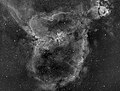
The Heart Nebula (also known as the Running Dog Nebula, Sharpless 2-190) is an emission nebula, 7,500 light-years (2,300 pc) away from Earth and located in the Perseus Arm of the Galaxy in the constellation Cassiopeia. It was discovered by William Herschel on 3 November 1787.[2] In 1958, it was identified as a radio source by Gart Westerhout and is therefore also referred to as Westerhout 4 (or W4) [3]. It displays glowing ionized hydrogen gas and darker dust lanes.[4]
The brightest part of the nebula (a knot at its western edge) is separately classified as NGC 896, because it was the first part of the nebula to be discovered. The nebula's intense red output and its morphology are driven by the radiation emanating from a small group of hot stars near the nebula's center. This open cluster of stars, known as Collinder 26, Melotte 15, or IC 1805, contains a few bright stars nearly 50 times the mass of the Sun, and many more dim stars that are only a fraction of the Solar mass.[2]
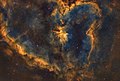
The Heart Nebula is also made up of ionized oxygen and sulfur gasses, which are responsible for the rich blue and orange colors seen in narrowband images. The nebula also spans almost 2 degrees in the sky, covering an area four times that of the diameter of the full moon.[5]
The Heart Nebula belongs to a larger structure known as the W3/W4/W5 complex. It is also the brightest part of a superbubble known as the W4 superbubble [6], sometimes referred to as the W4 chimney, as it is believed that hot gas is transferred from the galactic disk to the halo through this structure. [7]
Gallery
[edit]-
-
 Image composed of 7 hours of RGB data collected in Escanaba, Michigan, United States
 -
-
 Capture on AT80ED on ASI294MC Pro with dualband filter in North Carolina
 -
 Heart Nebula captured on an ASI2600mc-pro with a Triad Narrowband Filter
 -
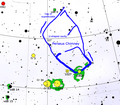 Heart Nebula as a part of a chimney candidate
 -
 Melotte 15 is part of Heart Nebula. There are several bright stars here, some of them nearly 50 times mass of the Sun.
 -
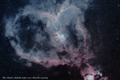 Captured from Manchester in September 2022
 -
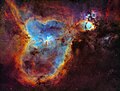 32 hours of Narrowband Exposure captured over 5 nights from Utica, Michigan, United States
 -
 Heart nebula in HOO (hydrogen-oxygen-oxygen) where hydrogen is red and oxygen is blue, approximating true color


See also
[edit]References
[edit]- ^ Vallenari, A.; et al. (Gaia collaboration) (2023). "Gaia Data Release 3. Summary of the content and survey properties". Astronomy and Astrophysics. 674: A1. arXiv:2208.00211. Bibcode:2023A&A...674A...1G. doi:10.1051/0004-6361/202243940. S2CID 244398875. Gaia DR3 record for this source at VizieR.
- ^ a b "New General Catalog Objects: NGC 850 - 899". cseligman.com. Retrieved 2017-12-19.
- ^ Westerhout, Gert (1958). "A survey of the continuous radiation from the Galactic System at a frequency of 1390 Mc/s". Bulletin of the Astronomical Institutes of the Netherlands. 14: 215.
- ^ "astronomy-mall.com/Adventures.In.Deep.Space/NGC%201-7840%20complete.htm". astronomy-mall. Archived from the original on 2013-02-06. Retrieved 2017-12-19.
- ^ "The Heart Nebula in Hydrogen, Oxygen, and Sulfur | Science Mission Directorate". science.nasa.gov. Archived from the original on 2021-12-30. Retrieved 2021-12-30.
- ^ Basu, Shantanu; Johnstone, Doug; Martin, P. G. (1999-05-10). "Dynamical Evolution and Ionization Structure of an Expanding Superbubble: Application to W4". The Astrophysical Journal. 516 (2): 843–862. doi:10.1086/307125. ISSN 0004-637X.
- ^ Lagrois, Dominic; Joncas, Gilles (2009-03-01). "ON THE DYNAMICAL EVOLUTION OF H II REGIONS: AN INVESTIGATION OF THE IONIZED COMPONENT OF W4, A GALACTIC CHIMNEY CANDIDATE. II. KINEMATICS AND DYNAMICS IN THE LATITUDE RANGE 3° < b ⩽ 7°". The Astrophysical Journal. 693 (1): 186–206. doi:10.1088/0004-637X/693/1/186. ISSN 0004-637X.
External links
[edit]
- Heart Nebula Data download & Processing Guide
- Heart Nebula at Atlas of the Universe
- NASA Astronomy Picture of the Day: Heart Nebula (14 February 2009)
