


Fustanella

Fustanella (Greek: φουστανέλλα; Albanian: fustanellë/fustanella; Aromanian: fustanelã; Bulgarian: фустанела, romanized: fustanela; Macedonian: фустан, romanized: fustan) is a pleated, or folded, skirt like a Scottish kilt. It is worn by men from different countries in Southeast Europe.
History
[change | change source]

Some researchers think that the fustanella comes from ancient Greek clothing like the chiton (or tunic) and the chitonium (or short military tunic).[2] An ancient Greek statue in Attica shows a stonecutter named Archedemus wearing a folded skirt like the fustanella.[3] However, no ancient Greek clothing has been found that helps show that the fustanella come from the pleated garments or chitons worn by men in Classical Athens.[4] The ancient Roman toga may have also impacted the development of the fustanella.[5]
In the Byzantine Empire, the fustanella was worn and called the podea (Greek: ποδέα).[6][7] It was commonly used in Greek lands as early as the 12th century AD.[1] In Byzantine art and music, the wearer of the podea was either a hero or a Greek warrior defending the empire's borders.[7][8] The fustanella was part of a military outfit consisting of bows, swords, battle-axes and armor (corselet or chain mail).[1][5] In the Ottoman Empire, the fustanella was worn by Greek guerillas like the klephts and the armatoloi.[9] In Albania, the fustanella is first mentioned in 1335 in a list of items taken from a sailor at the port of the Drin River.[10]
The Albanian fustanella is based on the Greek fustanella.[11] But the difference is in the number of pleats. The "Bridegroom's coat" is a Greek fustanella with two-hundred pleats that a bride would buy as a wedding gift for her groom.[12] The Albanian fustanella has around sixty pleats or usually a moderate amount of folds.[13]
Gallery
[change | change source] Statue of a young man wearing a chiton; Roman copy of a Greek original (4th century BC).
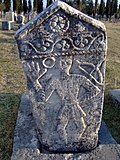 Gravestone depiction of an Aromanian wearing a fustanella (15th century AD).
 Lord Byron in Albanian Dress painted by Thomas Phillips (1813).
 Souliote Warrior painted by Louis Dupré (1820).
 A Souliot in Corfu Nikolos Pervolis painted by Louis Dupré (1827).
 Greek general of the Royal Phalanx in full dress uniform (1835).
 At the Carnival in Venice painted by Mikhail Scotti (1839).
 A group of upper-class Albanians in typical dress (circa 1850–1900).
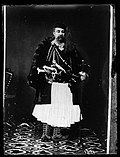 Albanian leader Hamza Kazazi (circa 1858).
 Greek Warrior painted by Carl Haag (1861).
 Russian picture of a Greek and an Albanian (1862).
 Arnaut Smoking in Cairo, Egypt painted by Jean-Léon Gérôme (1865).
 Ilyo Voyvoda, a Bulgarian Macedonian revolutionary (1867).
 Albanian in Cairo by Jean-Léon Gérôme (circa 1880).
 Albanian Officer painted by Jean-Léon Gérôme (1894).
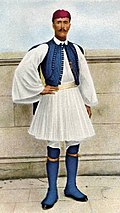 Spiridon Louis, Olympic marathon champion (1896).
 Vlach shepherd in traditional attire (early 1900s).
 Aromanian leader Ioryi Mucitano (early 1900s).
 Ioannis Ramnalis, a Greek Macedonian revolutionary (after 1908).
 Old man wearing the fustanella in Arcadia, Greece (circa 1920s).
 Royal Guard of Albania (1921).
 Sarakatsani, or Greek nomads, in Western Macedonia, Greece (1935).
 Sarakatsani, or Greek nomads, in Thrace (1938).
 Changing of the guards at the Tomb of the Unknown Soldier (2005).
 Greek Presidential Guard officer, Athens (2007).


,_1894.jpg?lang=simple)


Related pages
[change | change source]References
[change | change source]Citations
[change | change source]- 1 2 3 Morgan 1942, pp. 132–133.
- ↑ Smithsonian Institution & Mouseio Benakē 1959, p. 8; Fox 1977, p. 56.
- ↑ Weller 1903, pp. 271–273.
- ↑ Skafidas 2009, p. 148.
- 1 2 Notopoulos 1964, p. 114.
- ↑ Notopoulos 1964, pp. 110, 122.
- 1 2 Kazhdan 1991, "Akritic Imagery", p. 47.
- ↑ Morgan 1942, pp. 133, 317–318, 333; Notopoulos 1964, pp. 110, 113.
- ↑ Ethniko Historiko Mouseio (Greece), Maria Lada-Minōtou, I. K. Mazarakēs Ainian, Diana Gangadē, and Historikē kai Ethnologikē Hetaireia tēs Hellados 1993, p. xxx; Notopoulos 1964, pp. 113–115; Smithsonian Institution & Mouseio Benakē 1959, p. 8.
- ↑ Gjergji 2004, p. 16.
- ↑ Rupert 1842, pp. 356–357.
- ↑ Smithsonian Institution & Mouseio Benakē 1959, p. 31; Fox 1977, p. 56.
- ↑ Konitza 1957, pp. 85–86.
- ↑ Elsie, Robert. "Ottoman Costumes 1873". albanianphotography.net.
Sources
[change | change source]- Ethniko Historiko Mouseio (Greece), Maria Lada-Minōtou, I. K. Mazarakēs Ainian, Diana Gangadē, and Historikē kai Ethnologikē Hetaireia tēs Hellados (1993). Greek Costumes: Collection of the National Historical Museum. Athens: Historical and Ethnological Society of Greece.
{{cite book}}: CS1 maint: multiple names: authors list (link) - Fox, Lilla Margaret (1977). Folk Costumes from Eastern Europe. London: Chatto & Windus (Random House). ISBN 0-7011-5092-0.
- Kazhdan, Alexander Petrovich, ed. (1991). The Oxford Dictionary of Byzantium. New York and Oxford: Oxford University Press. ISBN 0-19-504652-8.
- Konitza, Faik (1957). Albania: The Rock Garden of Southeastern Europe, and other Essays. Boston, MA: Vatra.
- Morgan, Charles Hill (1942). Corinth: The Byzantine Pottery. Vol. 11. Cambridge, MA: Published for the American School of Classical Studies at Athens, Harvard University Press. ISBN 9780876611111. OCLC 36957616.
{{cite book}}: ISBN / Date incompatibility (help) - Notopoulos, James A. (1964). "Akritan Ikonography on Byzantine Pottery" (PDF). Hesperia. 33 (2): 108–133. ISSN 0018-098X. JSTOR 147182.
- Rupert, Cyprien (1842). "LE MONDE GRÉCO-SLAVE. LES ALBANAIS". Revue des Deux Mondes. 31 (3): 353–410.
- Smithsonian Institution; Mouseio Benakē (1959). Greek Costumes and Embroideries, from the Benaki Museum, Athens: An Exhibition Presented Under the Patronage of H.M. Queen Frederika of the Hellenes. Washington, DC: Smithsonian Institution.
- Weller, Charles Heald (1903). "The Cave at Vari. I. Description, Account of Excavation, and History". American Journal of Archaeology. 7 (3): 263–288. doi:10.2307/496689. JSTOR 496689. S2CID 191368679.
Further reading
[change | change source]- Skafidas, Michael (2009). "Fabricating Greekness: From Fustanella to the Glossy Page". In Paulicelli, Eugenia; Clark, Hazel (eds.). The Fabric of Cultures: Fashion, Identity, and Globalization. New York and Oxford: Taylor & Francis (Routledge). pp. 145–163. ISBN 978-0-415-77542-7.
- Snodgrass, Mary Ellen (2014). World Clothing and Fashion: An Encyclopedia of History, Culture, and Social Influence. London and New York: Routledge. ISBN 978-1-317-45167-9.
- Verinis, James P. (May 2005). "Spiridon Loues, the Modern Foustanéla, and the Symbolic Power of Pallikariá at the 1896 Olympic Games". Journal of Modern Greek Studies. 23 (1): 139–175. doi:10.1353/mgs.2005.0010. S2CID 146732138.
- Welters, Lisa (1995). "Ethnicity in Greek Dress". In Eicher, Joanne (ed.). Dress and Ethnicity: Change across Space and Time. Oxford: Berg Publishers. pp. 53–77. ISBN 978-0-85496-879-4.