


Observable universe
 Visualization of the observable universe. The scale is such that the fine grains represent collections of large numbers of superclusters. The Virgo Supercluster—home of the Milky Way—is marked at the center, but is too small to be seen. | |
| Diameter | 8.8×1026 m or 880 Ym (28.5 Gpc or 93 Gly)[1] |
|---|---|
| Circumference | 2.764×1027 m or 2.764 Rm (89.6 Gpc or 292.2 Gly) |
| Volume | 3.566×1080 m3[2] |
| Mass (ordinary matter) | 1.5×1053 kg[3] |
| Density (of total energy) | 8.5×10⁻²⁷ kg/m3 (equivalent to ~5 protons per cubic meter of space)[3] |
| Age | 13.787±0.020 billion years[4] |
| Average temperature | 2.72548±0.00057 K[5] |
| Contents |
|
The observable universe is a spherical region of the universe consisting of all matter that can be observed from Earth; the electromagnetic radiation from these astronomical objects has had time to reach the Solar System and Earth since the beginning of the cosmological expansion. Assuming the universe is isotropic, the distance to the edge of the observable universe is the same in every direction. That is, the observable universe is a spherical region centered on the observer. Every location in the universe has its own observable universe, which may or may not overlap with the one centered on Earth.
The word observable in this sense does not refer to the capability of modern technology to detect light or other information from an object, or whether there is anything to be detected. It refers to the physical limit created by the speed of light itself. No signal can travel faster than light, hence there is a maximum distance, called the particle horizon, beyond which nothing can be detected, as the signals could not have reached the observer yet.
According to calculations, the current comoving distance to particles from which the cosmic microwave background radiation (CMBR) was emitted, which represents the radius of the visible universe, is about 14.0 billion parsecs (about 45.7 billion light-years). The comoving distance to the edge of the observable universe is about 14.3 billion parsecs (about 46.6 billion light-years),[7] about 2% larger. The radius of the observable universe is therefore estimated to be about 46.5 billion light-years.[8][9] Using the critical density and the diameter of the observable universe, the total mass of ordinary matter in the universe can be calculated to be about 1.5×1053 kg.[10] In November 2018, astronomers reported that extragalactic background light (EBL) amounted to 4×1084 photons.[11][12]
As the universe's expansion is accelerating, all currently observable objects, outside the local supercluster, will eventually appear to freeze in time, while emitting progressively redder and fainter light. For instance, objects with the current redshift z from 5 to 10 will only be observable up to an age of 4–6 billion years. In addition, light emitted by objects currently situated beyond a certain comoving distance (currently about 19 gigaparsecs (62 Gly)) will never reach Earth.[13]
Overview
[edit]| Part of a series on |
| Physical cosmology |
|---|
 |


The universe's size is unknown, and it may be infinite in extent.[14] Some parts of the universe are too far away for the light emitted since the Big Bang to have had enough time to reach Earth or space-based instruments, and therefore lie outside the observable universe. In the future, light from distant galaxies will have had more time to travel, so one might expect that additional regions will become observable. Regions distant from observers (such as us) are expanding away faster than the speed of light, at rates estimated by Hubble's law.[note 1] The expansion rate appears to be accelerating, which dark energy was proposed to explain.
Assuming dark energy remains constant (an unchanging cosmological constant) so that the expansion rate of the universe continues to accelerate, there is a "future visibility limit" beyond which objects will never enter the observable universe at any time in the future because light emitted by objects outside that limit could never reach the Earth. Note that, because the Hubble parameter is decreasing with time, there can be cases where a galaxy that is receding from Earth only slightly faster than light emits a signal that eventually reaches Earth.[9][15] This future visibility limit is calculated at a comoving distance of 19 billion parsecs (62 billion light-years), assuming the universe will keep expanding forever, which implies the number of galaxies that can ever be theoretically observed in the infinite future is only larger than the number currently observable by a factor of 2.36 (ignoring redshift effects).[note 2]
In principle, more galaxies will become observable in the future; in practice, an increasing number of galaxies will become extremely redshifted due to ongoing expansion, so much so that they will seem to disappear from view and become invisible.[16][17][18] A galaxy at a given comoving distance is defined to lie within the "observable universe" if we can receive signals emitted by the galaxy at any age in its history, say, a signal sent from the galaxy only 500 million years after the Big Bang. Because of the universe's expansion, there may be some later age at which a signal sent from the same galaxy can never reach the Earth at any point in the infinite future, so, for example, we might never see what the galaxy looked like 10 billion years after the Big Bang,[13] even though it remains at the same comoving distance less than that of the observable universe.
This can be used to define a type of cosmic event horizon whose distance from the Earth changes over time. For example, the current distance to this horizon is about 16 billion light-years, meaning that a signal from an event happening at present can eventually reach the Earth if the event is less than 16 billion light-years away, but the signal will never reach the Earth if the event is further away.[9]
The space before this cosmic event horizon can be called "reachable universe", that is all galaxies closer than that could be reached if we left for them today, at the speed of light; all galaxies beyond that are unreachable.[19][20] Simple observation will show the future visibility limit (62 billion light-years) is exactly equal to the reachable limit (16 billion light-years) added to the current visibility limit (46 billion light-years).[21][7]

"The universe" versus "the observable universe"
[edit]Both popular and professional research articles in cosmology often use the term "universe" to mean "observable universe".[citation needed] This can be justified on the grounds that we can never know anything by direct observation about any part of the universe that is causally disconnected from the Earth, although many credible theories require a total universe much larger than the observable universe.[citation needed] No evidence exists to suggest that the boundary of the observable universe constitutes a boundary on the universe as a whole, nor do any of the mainstream cosmological models propose that the universe has any physical boundary in the first place. However, some models propose it could be finite but unbounded,[note 3] like a higher-dimensional analogue of the 2D surface of a sphere that is finite in area but has no edge.
It is plausible that the galaxies within the observable universe represent only a minuscule fraction of the galaxies in the universe. According to the theory of cosmic inflation initially introduced by Alan Guth and D. Kazanas,[22] if it is assumed that inflation began about 10−37 seconds after the Big Bang and that the pre-inflation size of the universe was approximately equal to the speed of light times its age, that would suggest that at present the entire universe's size is at least 1.5×1034 light-years — this is at least 3×10²³ times the radius of the observable universe.[23]
If the universe is finite but unbounded, it is also possible that the universe is smaller than the observable universe. In this case, what we take to be very distant galaxies may actually be duplicate images of nearby galaxies, formed by light that has circumnavigated the universe. It is difficult to test this hypothesis experimentally because different images of a galaxy would show different eras in its history, and consequently might appear quite different. Bielewicz et al.[24] claim to establish a lower bound of 27.9 gigaparsecs (91 billion light-years) on the diameter of the last scattering surface. This value is based on matching-circle analysis of the WMAP 7-year data. This approach has been disputed.[25]
Size
[edit]
The comoving distance from Earth to the edge of the observable universe is about 14.26 gigaparsecs (46.5 billion light-years or 4.40×1026 m) in any direction. The observable universe is thus a sphere with a diameter of about 28.5 gigaparsecs[27] (93 billion light-years or 8.8×1026 m).[28] Assuming that space is roughly flat (in the sense of being a Euclidean space), this size corresponds to a comoving volume of about 1.22×10⁴ Gpc3 (4.22×10⁵ Gly3 or 3.57×1080 m3).[29]
These are distances now (in cosmological time), not distances at the time the light was emitted. For example, the cosmic microwave background radiation that we see right now was emitted at the time of photon decoupling, estimated to have occurred about 380,000 years after the Big Bang,[30][31] which occurred around 13.8 billion years ago. This radiation was emitted by matter that has, in the intervening time, mostly condensed into galaxies, and those galaxies are now calculated to be about 46 billion light-years from Earth.[7][9] To estimate the distance to that matter at the time the light was emitted, we may first note that according to the Friedmann–Lemaître–Robertson–Walker metric, which is used to model the expanding universe, if we receive light with a redshift of z, then the scale factor at the time the light was originally emitted is given by[32][33]
.
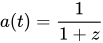
WMAP nine-year results combined with other measurements give the redshift of photon decoupling as z = 1091.64±0.47,[34] which implies that the scale factor at the time of photon decoupling would be 1⁄1092.64. So if the matter that originally emitted the oldest CMBR photons has a present distance of 46 billion light-years, then the distance would have been only about 42 million light-years at the time of decoupling.
The light-travel distance to the edge of the observable universe is the age of the universe times the speed of light, 13.8 billion light years. This is the distance that a photon emitted shortly after the Big Bang, such as one from the cosmic microwave background, has traveled to reach observers on Earth. Because spacetime is curved, corresponding to the expansion of space, this distance does not correspond to the true distance at any moment in time.[35]
Matter and mass
[edit]Number of galaxies and stars
[edit]The observable universe contains as many as an estimated 2 trillion galaxies[36][37][38] and, overall, as many as an estimated 1024 stars[39][40] – more stars (and, potentially, Earth-like planets) than all the grains of beach sand on planet Earth.[41][42][43] Other estimates are in the hundreds of billions rather than trillions.[44][45][46] If the model of cosmic inflation is correct and the universe expanded by >60 e-folds, then the universe could contain over 10100 stars.[47]
Matter content—number of atoms
[edit]Assuming the mass of ordinary matter is about 1.45×1053 kg as discussed above, and assuming all atoms are hydrogen atoms (which are about 74% of all atoms in the Milky Way by mass), the estimated total number of atoms in the observable universe is obtained by dividing the mass of ordinary matter by the mass of a hydrogen atom. The result is approximately 1080 hydrogen atoms, also known as the Eddington number.[48]
Mass of ordinary matter
[edit]The mass of the observable universe is often quoted as 1053 kg.[49] In this context, mass refers to ordinary (baryonic) matter and includes the interstellar medium (ISM) and the intergalactic medium (IGM). However, it excludes dark matter and dark energy. This quoted value for the mass of ordinary matter in the universe can be estimated based on critical density. The calculations are for the observable universe only as the volume of the whole is unknown and may be infinite.
Estimates based on critical density
[edit]Critical density is the energy density for which the universe is flat.[50] If there is no dark energy, it is also the density for which the expansion of the universe is poised between continued expansion and collapse.[51] From the Friedmann equations, the value for critical density, is:[52]


where G is the gravitational constant and H = H0 is the present value of the Hubble constant. The value for H0, as given by the European Space Agency's Planck Telescope, is H0 = 67.15 kilometres per second per megaparsec. This gives a critical density of 0.85×10⁻²⁶ kg/m3, or about 5 hydrogen atoms per cubic metre. This density includes four significant types of energy/mass: ordinary matter (4.8%), neutrinos (0.1%), cold dark matter (26.8%), and dark energy (68.3%).[53]
Although neutrinos are Standard Model particles, they are listed separately because they are ultra-relativistic and hence behave like radiation rather than like matter. The density of ordinary matter, as measured by Planck, is 4.8% of the total critical density or 4.08×10⁻²⁸ kg/m3. To convert this density to mass we must multiply by volume, a value based on the radius of the "observable universe". Since the universe has been expanding for 13.8 billion years, the comoving distance (radius) is now about 46.6 billion light-years. Thus, volume (4/3πr3) equals 3.58×1080 m3 and the mass of ordinary matter equals density (4.08×10⁻²⁸ kg/m3) times volume (3.58×1080 m3) or 1.46×1053 kg.
Large-scale structure
[edit]
The large-scale structure of the universe is the term in cosmology for the character of matter distribution at the scale of the entire observable universe. Sky surveys and mappings of the various wavelength bands of electromagnetic radiation (in particular 21-cm emission) have yielded much information on the content and character of the universe's structure. The organization of structure appears to follow a hierarchical model with organization up to the scale of superclusters and filaments. Larger than this (at scales between 30 and 200 megaparsecs),[54] there seems to be no continued structure, a phenomenon that has been referred to as the End of Greatness.[55] The shape of the large scale structure can be summarized by the matter power spectrum.
Most distant objects
[edit]The most distant astronomical object identified is a galaxy classified as MoM-z14,[56] at a redshift of 14.44. In 2009, a gamma ray burst, GRB 090423, was found to have a redshift of 8.2, which indicates that the collapsing star that caused it exploded when the universe was only 630 million years old.[57] The burst happened approximately 13 billion years ago,[58] so a distance of about 13 billion light-years was widely quoted in the media, or sometimes a more precise figure of 13.035 billion light-years.[57]
This would be the "light travel distance" (see Distance measures (cosmology)) rather than the "proper distance" used in both Hubble's law and in defining the size of the observable universe. Cosmologist Ned Wright argues against using this measure.[59] The proper distance for a redshift of 8.2 would be about 9.2 Gpc,[60] or about 30 billion light-years.
Horizons
[edit]The limit of observability in the universe is set by cosmological horizons which limit—based on various physical constraints—the extent to which information can be obtained about various events in the universe. The most famous horizon is the particle horizon which sets a limit on the precise distance that can be seen due to the finite age of the universe. Additional horizons are associated with the possible future extent of observations, larger than the particle horizon owing to the expansion of space, an "optical horizon" at the surface of last scattering, and associated horizons with the surface of last scattering for neutrinos and gravitational waves.
Gallery
[edit]

See also
[edit]- Bolshoi cosmological simulation – Computer simulation of the universe
- Causality (physics) – Physics of the cause–effect relation
- Chronology of the universe – History and future of the universe
- Dark flow – Controversial hypothesis in astrophysics
- Hubble volume – Region of the observable universe
- Illustris project – Computer-simulated universes
- Multiverse – Hypothetical group of multiple universes
- Orders of magnitude (length) – Comparison of a wide range of lengths
- UniverseMachine – Computer simulated universes
Notes
[edit]- ^ Special relativity prevents nearby objects in the same local region from moving faster than the speed of light with respect to each other, but there is no such constraint for distant objects when the space between them is expanding; see uses of the proper distance for a discussion.
- ^ The comoving distance of the future visibility limit is calculated on p. 8 of Gott et al.'s A Map of the Universe to be 4.50 times the Hubble radius, given as 4.220 billion parsecs (13.76 billion light-years), whereas the current comoving radius of the observable universe is calculated on p. 7 to be 3.38 times the Hubble radius. The number of galaxies in a sphere of a given comoving radius is proportional to the cube of the radius, so as shown on p. 8 the ratio between the number of galaxies observable in the future visibility limit to the number of galaxies observable today would be (4.50/3.38)3 = 2.36.
- ^ This does not mean "unbounded" in the mathematical sense; a finite universe would have an upper bound on the distance between two points. Rather, it means that there is no boundary past which there is nothing. See Geodesic manifold.
References
[edit]- ^ Itzhak Bars; John Terning (2009). Extra Dimensions in Space and Time. Springer. pp. 27–. ISBN 978-0387776378. Retrieved 2011-05-01.
- ^ "Homepage". www.wolframalpha.com.[failed verification]
- ^ a b Aghanim, N.; Akrami, Y.; Ashdown, M.; et al. (2020). "Planck 2018 results. VI. Cosmological parameters". Astronomy & Astrophysics. 641: A6. arXiv:1807.06209. Bibcode:2020A&A...641A...6P. doi:10.1051/0004-6361/201833910.
- ^ Aghanim, N.; Akrami, Y.; Ashdown, M.; et al. (2020). "Planck 2018 results. VI. Cosmological parameters". Astronomy & Astrophysics. 641. page A6 (see PDF page 15, Table 2: "Age/Gyr", last column). arXiv:1807.06209. Bibcode:2020A&A...641A...6P. doi:10.1051/0004-6361/201833910. S2CID 119335614.
- ^ Fixsen, D. J. (30 November 2009). "The Temperature of the Cosmic Microwave Background". The Astrophysical Journal. 707 (2): 916–920. arXiv:0911.1955. Bibcode:2009ApJ...707..916F. doi:10.1088/0004-637X/707/2/916. S2CID 119217397.
- ^ "Planck cosmic recipe". European Space Agency. 2013-03-21.
- ^ a b c Gott III, J. Richard; Mario Jurić; David Schlegel; Fiona Hoyle; et al. (2005). "A Map of the Universe" (PDF). The Astrophysical Journal. 624 (2): 463–484. arXiv:astro-ph/0310571. Bibcode:2005ApJ...624..463G. doi:10.1086/428890. S2CID 9654355.
- ^ "Frequently Asked Questions in Cosmology". astro.ucla.edu. Retrieved 2023-09-15.
- ^ a b c d Lineweaver, Charles; Davis, Tamara M. (2005). "Misconceptions about the Big Bang". Scientific American. 292 (3): 36–45. Bibcode:2005SciAm.292c..36L. doi:10.1038/scientificamerican0305-36.
- ^ See the "Mass of ordinary matter" section in this article.
- ^ Overbye, Dennis (3 December 2018). "All the Light There Is to See? 4 x 1084 Photons". The New York Times. Retrieved 4 December 2018.
- ^ Abdollahi, S.; Ackermann, M.; Ajello, M.; et al. (30 November 2018). "A gamma-ray determination of the Universe's star formation history". Science. 362 (6418): 1031–1034. arXiv:1812.01031. Bibcode:2018Sci...362.1031F. doi:10.1126/science.aat8123. PMID 30498122.
- ^ a b Loeb, Abraham (2002). "Long-term future of extragalactic astronomy". Physical Review D. 65 (4) 047301. arXiv:astro-ph/0107568. Bibcode:2002PhRvD..65d7301L. doi:10.1103/PhysRevD.65.047301. S2CID 1791226.
- ^ Liddle, Andrew (2015). An Introduction to Modern Cosmology. John Wiley. ISBN 978-1118502143.
- ^ Is the universe expanding faster than the speed of light? (see the last two paragraphs).
- ^ Krauss, Lawrence M.; Scherrer, Robert J. (2007). "The Return of a Static Universe and the End of Cosmology". General Relativity and Gravitation. 39 (10): 1545–1550. arXiv:0704.0221. Bibcode:2007GReGr..39.1545K. doi:10.1007/s10714-007-0472-9. S2CID 123442313.
- ^ Using Tiny Particles To Answer Giant Questions. Science Friday, 3 Apr 2009. According to the transcript, Brian Greene makes the comment "And actually, in the far future, everything we now see, except for our local galaxy and a region of galaxies will have disappeared. The entire universe will disappear before our very eyes, and it's one of my arguments for actually funding cosmology. We've got to do it while we have a chance."
- ^ See also Faster than light#Universal expansion and Future of an expanding universe#Galaxies outside the Local Supercluster are no longer detectable.
- ^ Siegel, Ethan. "How Much Of The Unobservable Universe Will We Someday Be Able To See?". Forbes. Retrieved 2023-04-04.
- ^ Siegel, Ethan (2021-10-25). "94% of the universe's galaxies are permanently beyond our reach". Starts With A Bang!. Retrieved 2023-04-04.
- ^ Ord, Toby (2021). "The Edges of Our Universe". arXiv:2104.01191 [gr-qc].
- ^ Kazanas, D. (1980). "Dynamics of the universe and spontaneous symmetry breaking". The Astrophysical Journal. 241: L59 – L63. Bibcode:1980ApJ...241L..59K. doi:10.1086/183361.
- ^ Guth, Alan H. (1997). The inflationary universe: the quest for a new theory of cosmic origins. Basic Books. pp. 186–. ISBN 978-0201328400. Retrieved 1 May 2011.
- ^ Bielewicz, P.; Banday, A. J.; Gorski, K. M. (2013). Auge, E.; Dumarchez, J.; Tran Thanh Van, J. (eds.). "Constraints on the Topology of the Universe". Proceedings of the XLVIIth Rencontres de Moriond. 2012 (91). arXiv:1303.4004. Bibcode:2013arXiv1303.4004B.
- ^ Mota, B.; Reboucas, M. J.; Tavakol, R. (1 July 2010). "Observable circles-in-the-sky in flat universes". arXiv:1007.3466 [astro-ph.CO].
- ^ Malhotra, Sangeeta. "As far as the Hubble can see" (PDF). Arizona State University. Retrieved October 28, 2010.
- ^ "Search: 93 billion light years in parsecs". WolframAlpha. Retrieved 29 November 2011.
- ^ "Search: size of universe". WolframAlpha. Retrieved 29 November 2011.
- ^ "Search: (volume of universe) == (3.57x10^80 m^3) == (4.21594x10^5 Gly^3) == (1.2151x10^4 Gpc^3)". WolframAlpha. Retrieved 15 February 2016.
- ^ "Seven-Year Wilson Microwave Anisotropy Probe (WMAP) Observations: Sky Maps, Systematic Errors, and Basic Results" (PDF). nasa.gov. Retrieved 2010-12-02. (see p. 39 for a table of best estimates for various cosmological parameters).
- ^ Abbott, Brian (May 30, 2007). "Microwave (WMAP) All-Sky Survey". Hayden Planetarium. Retrieved 2008-01-13.
- ^ Davies, Paul (1992). The new physics. Cambridge University Press. pp. 187–. ISBN 978-0521438315. Retrieved 1 May 2011.
- ^ Mukhanov, V. F. (2005). Physical foundations of cosmology. Cambridge University Press. pp. 58–. ISBN 978-0521563987. Retrieved 1 May 2011.
- ^ Bennett, C. L.; Larson, D.; Weiland, J. L.; Jarosik, N.; et al. (1 October 2013). "Nine-year Wilkinson Microwave Anisotropy Probe (WMAP) Observations: Final Maps and Results". The Astrophysical Journal Supplement Series. 208 (2): 20. arXiv:1212.5225. Bibcode:2013ApJS..208...20B. doi:10.1088/0067-0049/208/2/20. S2CID 119271232.
- ^ Wright, Ned. "Light Travel Time Distance". astro.ucla.edu. Retrieved 2023-09-15.
- ^ Gunn, Alistair (29 November 2023). "How many galaxies are there in the universe? – Do astronomers know how many galaxies exist? How many can we see in the observable Universe?". BBC Sky at Night. Archived from the original on 3 December 2023. Retrieved 2 December 2023.
- ^ "New Horizons spacecraft answers the question: How dark is space?". phys.org. Archived from the original on January 15, 2021. Retrieved January 15, 2021.
- ^ Howell, Elizabeth (March 20, 2018). "How Many Galaxies Are There?". Space.com. Archived from the original on February 28, 2021. Retrieved March 5, 2021.
- ^ "How Many Stars Are There In The Universe?". European Space Agency. 2019. Archived from the original on September 23, 2019. Retrieved September 21, 2019.
- ^ Marov, Mikhail Ya. (2015). "The Structure of the Universe". The Fundamentals of Modern Astrophysics. pp. 279–294. doi:10.1007/978-1-4614-8730-2_10. ISBN 978-1-4614-8729-6.
- ^ Mackie, Glen (February 1, 2002). "To see the Universe in a Grain of Taranaki Sand". Centre for Astrophysics and Supercomputing. Archived from the original on June 30, 2012. Retrieved January 28, 2017.
- ^ Mack, Eric (19 March 2015). "There may be more Earth-like planets than grains of sand on all our beaches – New research contends that the Milky Way alone is flush with billions of potentially habitable planets – and that's just one sliver of the universe". CNET. Archived from the original on 1 December 2023. Retrieved 1 December 2023.
- ^ Bovaird, T. T.; Lineweaver, C. H.; Jacobsen, S. K. (13 March 2015). "Using the inclinations of Kepler systems to prioritize new Titius–Bode-based exoplanet predictions". Monthly Notices of the Royal Astronomical Society. 448 (4): 3608–3627. arXiv:1412.6230. doi:10.1093/mnras/stv221. Archived from the original on 1 December 2023. Retrieved 1 December 2023.
- ^ Lauer, T. R.; Postman, M.; Spencer, J. R.; Weaver, H. A.; Stern, S. A.; Gladstone, G. R.; Binzel, R. P.; Britt, D. T.; Buie, M. W.; Buratti, B. J.; Cheng, A. F.; Grundy, W. M.; Horányi, M.; Kavelaars, J. J.; Linscott, I. R.; Lisse, C. M.; McKinnon, W. B.; McNutt, R. L.; Moore, J. M.; Núñez, J. I.; Olkin, C. B.; Parker, J. W.; Porter, S. B.; Reuter, D. C.; Robbins, S. J.; Schenk, P. M.; Showalter, M. R.; Singer, K. N.; Verbiscer, A. J.; Young, L. A. (2022). "Anomalous Flux in the Cosmic Optical Background Detected with New Horizons Observations". The Astrophysical Journal Letters. 927 (1): L8. arXiv:2202.04273. Bibcode:2022ApJ...927L...8L. doi:10.3847/2041-8213/ac573d.
- ^ Lauer, Todd (12 January 2021). "NOIRLab Scientist Finds the Universe to be Brighter than Expected". NOIRLab. Retrieved 12 January 2021.
- ^ Lauer, Tod R.; Postman, Marc; Weaver, Harold A.; Spencer, John R.; Stern, S. Alan; Buie, Marc W.; Durda, Daniel D.; Lisse, Carey M.; Poppe, A. R.; Binzel, Richard P.; Britt, Daniel T.; Buratti, Bonnie J.; Cheng, Andrew F.; Grundy, W. M.; Horányi, Mihaly; Kavelaars, J. J.; Linscott, Ivan R.; McKinnon, William B.; Moore, Jeffrey M.; Núñez, J. I.; Olkin, Catherine B.; Parker, Joel W.; Porter, Simon B.; Reuter, Dennis C.; Robbins, Stuart J.; Schenk, Paul; Showalter, Mark R.; Singer, Kelsi N.; Verbiscer, Anne J.; Young, Leslie A. (11 January 2021). "New Horizons Observations of the Cosmic Optical Background". The Astrophysical Journal. 906 (2): 77. arXiv:2011.03052. Bibcode:2021ApJ...906...77L. doi:10.3847/1538-4357/abc881. hdl:1721.1/133770. S2CID 226277978.
- ^ Totani, Tomonori (3 February 2020). "Emergence of life in an inflationary universe". Scientific Reports. 10 (1671) 1671. arXiv:1911.08092. Bibcode:2020NatSR..10.1671T. doi:10.1038/s41598-020-58060-0. PMC 6997386. PMID 32015390.
- ^ There are about 1082 atoms in the observable universe – LiveScience, July 2021
- ^ Davies, Paul (2006). The Goldilocks Enigma. First Mariner Books. p. 43–. ISBN 978-0618592265.
- ^ See Friedmann equations#Density parameter.
- ^ Kaku, Michio (2006). Parallel Worlds: A Journey Through Creation, Higher Dimensions, and the Future of the Cosmos. Knopf Doubleday. p. 385. ISBN 978-0307276988.
- ^ Schutz, Bernard F. (2003). Gravity from the ground up. Cambridge University Press. pp. 361–. ISBN 978-0521455060.
- ^ Ade, P. A. R.; Aghanim, N.; Armitage-Caplan, C. (2013). "Planck 2013 results. XVI. Cosmological parameters". Astronomy & Astrophysics. 571: A16. arXiv:1303.5076. Bibcode:2014A&A...571A..16P. doi:10.1051/0004-6361/201321591. S2CID 118349591.
- ^ Carroll, Bradley W.; Ostlie, Dale A. (2013). An Introduction to Modern Astrophysics (International ed.). Pearson. p. 1178. ISBN 978-1292022932.
- ^ Kirshner, Robert P. (2002). The Extravagant Universe: Exploding Stars, Dark Energy and the Accelerating Cosmos. Princeton University Press. p. 71. ISBN 978-0691058627.
- ^ Naidu, Rohan P.; Oesch, Pascal A.; Brammer, Gabriel; Weibel, Andrea; Li, Yijia; Matthee, Jorryt; Chisholm, John; Pollock, Clara L.; Heintz, Kasper E. (2025-05-16). "A Cosmic Miracle: A Remarkably Luminous Galaxy at zspec = 14.44 Confirmed with JWST". arXiv:2505.11263 [astro-ph.GA].
- ^ a b "New Gamma-Ray Burst Smashes Cosmic Distance Record | Science Mission Directorate". science.nasa.gov. Archived from the original on 2011-03-10. Retrieved 2023-09-15.
- ^ Atkinson, Nancy (2009-10-28). "More Observations of GRB 090423, the Most Distant Known Object in the Universe". Universe Today. Retrieved 2023-09-15.
- ^ "Light Travel Time Distance". www.astro.ucla.edu. Retrieved 2023-07-01.
- ^ Meszaros, Attila; et al. (2009). "Impact on cosmology of the celestial anisotropy of the short gamma-ray bursts". Baltic Astronomy. 18: 293–296. arXiv:1005.1558. Bibcode:2009BaltA..18..293M.
Further reading
[edit]- Labini, F. Sylos; Montuori, M.; Pietronero, L. (1998). "Scale-invariance of galaxy clustering". Physics Reports. 293 (1): 61–226. arXiv:astro-ph/9711073. Bibcode:1998PhR...293...61S. doi:10.1016/S0370-1573(97)00044-6.
- Lineweaver, Charles H. (2005). "Inflation and the Cosmic Microwave Background". In Colless, Matthew (ed.). The New Cosmology. Canberra International Physics Summer Schools. Vol. 16. World Scientific. pp. 31–65. arXiv:astro-ph/0305179. doi:10.1142/9789812702357_0002. ISBN 978-981-256-066-7.
- Martinez, Vicent J.; Starck, Jean-Luc; Saar, Enn; Donoho, David L.; Reynolds, Simon C.; de la Cruz, Pablo; Paredes, Silvestre (2005). "Morphology Of The Galaxy Distribution From Wavelet Denoising". The Astrophysical Journal. 634 (2): 744–755. arXiv:astro-ph/0508326. Bibcode:2005ApJ...634..744M. doi:10.1086/497125.
- Mureika, J. R.; Dyer, C. C. (2004). "Review: Multifractal Analysis of Packed Swiss Cheese Cosmologies". General Relativity and Gravitation. 36 (1): 151–184. arXiv:gr-qc/0505083. Bibcode:2004GReGr..36..151M. doi:10.1023/B:GERG.0000006699.45969.49.
External links
[edit]- "Millennium Simulation" of structure forming – Max Planck Institute of Astrophysics, Garching, Germany
- NASA Astronomy Picture of the Day: The Sloan Great Wall: Largest Known Structure? (7 November 2007)
- Forming Galaxies Captured In The Young Universe By Hubble, VLT & Spitzer
- Animation of the cosmic light horizon
- Logarithmic Maps of the Universe
- List of publications of the 2dF Galaxy Redshift Survey
- The Universe Within 14 Billion Light Years – NASA Atlas of the Universe – Note, this map only gives a rough cosmographical estimate of the expected distribution of superclusters within the observable universe; very little actual mapping has been done beyond a distance of one billion light-years.
- Video: The Known Universe, from the American Museum of Natural History
- NASA/IPAC Extragalactic Database
- Cosmography of the Local Universe at irfu.cea.fr (17:35) (arXiv)
- Limits to knowledge about Universe – Forbes, May 2019
| Included | Earth → Solar System → Local Interstellar Cloud → Local Bubble → Gould Belt → Orion Arm → Milky Way → Milky Way subgroup → Local Group → Local Sheet → Local Volume → Virgo Supercluster → Laniakea Supercluster → Pisces–Cetus Supercluster Complex → Local Hole → Observable universe → Universe Each arrow (→) may be read as "within" or "part of". |
|---|---|
| Related | |


