


Cairo
Cairo
القاهرة | |
|---|---|
Capital city and Megacity | |
 Flag  Emblem | |
| Nickname: City of a Thousand Minarets | |
  Cairo Location of Cairo within Egypt  Cairo Cairo (Africa) | |
| Coordinates: 30°2′40″N 31°14′9″E / 30.04444°N 31.23583°E | |
| Country | Egypt |
| Governorate | Cairo |
| First major foundation | 641–642 AD (Fustat) |
| Last major foundation | 969 AD (Cairo) |
| Government | |
| • Governor | Dr. Ibrahim Saber[1] |
| Area | |
• Capital city and Megacity | 606 km2 (234 sq mi) |
| • Metro | 2,734 km2 (1,056 sq mi) |
| Elevation | 23 m (75 ft) |
| Population (2023)[2] | |
• Capital city and Megacity | 9,801,536 |
| • Rank | 1st |
| • Density | 16,200/km2 (41,900/sq mi) |
| • Metro | 22,800,000 |
| • Metro density | 8,340/km2 (21,600/sq mi) |
| • Demonym | Cairene |
| GDP (PPP, constant 2015 values) | |
| • Year | 2024 |
| • Total (Metro) | $360.8 billion[4] |
| • Per capita | $15,900 |
| Time zone | UTC+2 (EET) |
| • Summer (DST) | UTC+3 (EEST) |
| Area code | (+20) 2 |
| Website | cairo.gov.eg |
| Official name | Historic Cairo |
| Type | Cultural |
| Criteria | i, v, vi |
| Designated | 1979 |
| Reference no. | 89 |
.jpg?lang=en)


Cairo[b] is the capital and largest city of Egypt and the Cairo Governorate, it is home to more than 10 million people.[5] It is also part of the largest urban agglomeration in Africa, the Arab world, and the Middle East. The Greater Cairo metropolitan area is one of the largest in the world by population with over 22 million people.[3] The area that would become Cairo was part of ancient Egypt, as the Giza pyramid complex and the ancient cities of Memphis and Heliopolis are suburbs of the city.
Located near the Nile Delta, the predecessor city was Fustat following Babylon.[6][7] Subsequently, Cairo was founded in 969.[8] It later superseded Fustat as the main urban centre during the Ayyubid and Mamluk periods (12th–16th centuries).[9] Cairo has since become a longstanding centre of political and cultural life, and is titled "the city of a thousand minarets" for its preponderance of Islamic architecture. Cairo's historic center was awarded World Heritage Site status in 1979.[10] The city is considered a regional center of finance and commerce, academics and the arts, and is home to Cairo Symphony Orchestra and the Cairo Opera House,[11] while the Academy of Arts provides visual arts education.[12][13]
Cairo is home to Egypt's oldest university, Al-Azhar University, one of the oldest universities in the world,[14] as well as the oldest and largest film and music industry in Africa and the Arab world.[15] Many international media, businesses, and organizations have regional headquarters in Cairo, such as headquarters of the Arab League, the regional offices of the World Health Organization, Food and Agriculture Organization, International Civil Aviation Organization, United Nations Development Programme, African Space Agency, and also the headquarters of FIBA Africa.[16][17][18]
Cairo is a key global city, like many other megacities, suffers from high levels of pollution and traffic.[19][20] The Cairo Metro, opened in 1987, is the oldest metro system in Africa,[21] and ranks amongst the fifteen busiest in the world,[22] with over 1 billion[23] annual passenger rides. The economy of Cairo was ranked first in the Middle East in 2005 on Foreign Policy's Global Cities Index,[24][25] and first in Africa in 2025 according to International Monetary Fund,[26][27] and continues to be a major destination for foreign direct investment (FDI) due to its massive consumer market and strategic location.[28][29][30]
Etymology
[edit]The name of Cairo is derived from the Arabic al-Qāhirah (القاهرة), meaning 'the Vanquisher' or 'the Conqueror', given by the Fatimid Caliph al-Mu'izz following the establishment of the city as the capital of the Fatimid dynasty. Its full, formal name was al-Qāhirah al-Mu'izziyyah (القاهرة المعزيّة), meaning 'the Vanquisher of al-Mu'izz'.[31] It is also supposedly due to the fact that the planet Mars, known in Arabic by names such as an-Najm al-Qāhir (النجم القاهر, 'the Conquering Star'), was rising at the time of the city's founding.[32]
Egyptians often refer to Cairo as Maṣr (IPA: [mɑsˤɾ]; مَصر), the Egyptian Arabic name for Egypt itself, emphasising the city's importance for the country.[33][34]
There are a number of Coptic names for the city. Tikešrōmi (Coptic: Ϯⲕⲉϣⲣⲱⲙⲓ Late Coptic: [dikɑʃˈɾoːmi]) is attested in the 1211 text The Martyrdom of John of Phanijoit and is either a calque meaning 'man breaker' (Ϯ-, 'the', ⲕⲁϣ-, 'to break', and ⲣⲱⲙⲓ, 'man'), akin to Arabic al-Qāhirah, or a derivation from Arabic قَصْر الرُوم (qaṣr ar-rūm, "the Roman castle"), another name of Babylon Fortress in Old Cairo.[35] The Arabic name is also calqued as ⲧⲡⲟⲗⲓⲥ ϯⲣⲉϥϭⲣⲟ, "the victor city" in the Coptic antiphonary.[36]
The form Khairon (Coptic: ⲭⲁⲓⲣⲟⲛ) is attested in the modern Coptic text Ⲡⲓⲫⲓⲣⲓ ⲛ̀ⲧⲉ ϯⲁⲅⲓⲁ ⲙ̀ⲙⲏⲓ Ⲃⲉⲣⲏⲛⲁ (The Tale of Saint Verina).[37][better source needed] Lioui (Ⲗⲓⲟⲩⲓ Late Coptic: [lɪˈjuːj]) or Elioui (Ⲉⲗⲓⲟⲩⲓ Late Coptic: [ælˈjuːj]) is another name which is descended from the Greek name of Heliopolis (Ήλιούπολις).[35] Some argue that Mistram (Ⲙⲓⲥⲧⲣⲁⲙ Late Coptic: [ˈmɪstəɾɑm]) or Nistram (Ⲛⲓⲥⲧⲣⲁⲙ Late Coptic: [ˈnɪstəɾɑm]) is another Coptic name for Cairo, although others think that it is rather a name for the Abbasid province capital al-Askar.[38] Ⲕⲁϩⲓⲣⲏ (Kahi•ree) is a popular modern rendering of an Arabic name (others being Ⲕⲁⲓⲣⲟⲛ [Kairon] and Ⲕⲁϩⲓⲣⲁ [Kahira]) which is modern folk etymology meaning 'land of sun'. Some argue that it was the name of an Egyptian settlement upon which Cairo was built, but it is rather doubtful as this name is not attested in any Hieroglyphic or Demotic source, although some researchers, like Paul Casanova, view it as a legitimate theory.[35] Cairo is also referred to as Ⲭⲏⲙⲓ (Late Coptic: [ˈkɪmi]) or Ⲅⲩⲡⲧⲟⲥ (Late Coptic: [ˈɡɪpdos]), which means Egypt in Coptic, the same way it is referred to in Egyptian Arabic.[38]
Sometimes the city is informally referred to as Cairo by people from Alexandria (IPA: [ˈkæjɾo]; Egyptian Arabic: كايرو).[39]
History
[edit]Ancient settlements
[edit]
The area around present-day Cairo had long been a focal point of Ancient Egypt due to its strategic location at the junction of the Nile Valley and the Nile Delta regions (roughly Upper Egypt and Lower Egypt), which also placed it at the crossing of major routes between North Africa and the Levant.[40][41] Memphis, the capital of Egypt during the Old Kingdom and a major city up until the Ptolemaic period, was located a short distance south west of present-day Cairo.[42] Heliopolis, another important city and major religious center, was located in what are now the modern districts of Matariya and Ain Shams in northeastern Cairo.[42][43] It was largely destroyed by the Persian invasions in 525 BC and 343 BC and partly abandoned by the late first century BC.[40]
However, the origins of modern Cairo are generally traced back to a series of settlements in the first millennium AD. Around the turn of the fourth century,[44] as Memphis was continuing to decline in importance,[45] the Romans established a large fortress along the east bank of the Nile. The fortress, called Babylon, was built by the Roman emperor Diocletian (r. 285–305) at the entrance of a canal connecting the Nile to the Red Sea that was created earlier by Emperor Trajan (r. 98–117).[c][46] Further north of the fortress, near the present-day district of al-Azbakiya, was a port and fortified outpost known as Tendunyas (Coptic: ϯⲁⲛⲧⲱⲛⲓⲁⲥ)[47] or Umm Dunayn.[48][49][50] While no structures older than the 7th century have been preserved in the area aside from the Roman fortifications, historical evidence suggests that a sizeable city existed. The city was important enough that its bishop, Cyrus, participated in the Second Council of Ephesus in 449.[51]
The Byzantine-Sassanian War between 602 and 628 caused great hardship and likely caused much of the urban population to leave for the countryside, leaving the settlement partly deserted.[49] The site today remains at the nucleus of the Coptic Orthodox community, which separated from the Roman and Byzantine churches in the late 4th century. Cairo's oldest extant churches, such as the Church of Saint Barbara and the Church of Saints Sergius and Bacchus (from the late 7th or early 8th century), are located inside the fortress walls in what is now known as Old Cairo or Coptic Cairo.[52]
Fustat and other early Islamic settlements
[edit]
The Muslim conquest of Byzantine Egypt was led by Amr ibn al-As from 639 to 642. Babylon Fortress was besieged in September 640 and fell in April 641. In 641 or early 642, after the surrender of Alexandria, the Egyptian capital at the time, he founded a new settlement next to Babylon Fortress.[53][54] The city, known as Fustat (Arabic: الفسطاط, romanised: al-Fusṭāṭ, lit. 'the tent'), served as a garrison town and as the new administrative capital of Egypt. Historians such as Janet Abu-Lughod and André Raymond trace the genesis of present-day Cairo to the foundation of Fustat.[55][56]
The choice of founding a new settlement at this inland location, instead of using the existing capital of Alexandria on the Mediterranean coast, may have been due to the new conquerors' strategic priorities. One of the first projects of the new Muslim administration was to clear and re-open Trajan's ancient canal in order to ship grain more directly from Egypt to Medina, the capital of the caliphate in Arabia.[57][58][59][60] Ibn al-As also founded a mosque for the city at the same time, now known as the Mosque of Amr Ibn al-As, the oldest mosque in Egypt and Africa (although the current structure dates from later expansions).[41][61][62][63]
.jpg?lang=en)
In 750, following the overthrow of the Umayyad Caliphate by the Abbasids, the new rulers created their own settlement to the northeast of Fustat which became the new provincial capital. This was known as al-Askar (Arabic: العسكر, lit. 'the camp') as it was laid out like a military camp. A governor's residence and a new mosque were also added, with the latter completed in 786.[64] The Red Sea canal re-excavated in the 7th century was closed by the Abbasid Caliph al-Mansur (r. 754–775),[65] but a part of the canal, known as the Khalij, continued to be a major feature of Cairo's geography and of its water supply until the 19th century.[66][41] In 861, on the orders of the Abbasid Caliph al-Mutawakkil, a Nilometer was built on Roda Island near Fustat. Although it was repaired and given a new roof in later centuries, its basic structure is still preserved today, making it the oldest preserved Islamic-era structure in Cairo today.[67][68]

In 868, a commander of Turkic origin named Bakbak was sent to Egypt by the Abbasid Caliph al-Mu'taz to restore order after a rebellion in the country. He was accompanied by his stepson, Ahmad ibn Tulun, who became effective governor of Egypt. Over time, Ibn Tulun gained an army and accumulated influence and wealth, allowing him to become the de facto independent ruler of both Egypt and Syria by 878.[69][70][71] In 870, he used his growing wealth to found a new administrative capital, al-Qata'i (Arabic: القطائـع, lit. 'the allotments'), to the northeast of Fustat and of al-Askar.[71][72]
The new city included a palace known as the Dar al-Imara, a parade ground known as al-Maydan, a bimaristan (hospital), and an aqueduct to supply water. Between 876 and 879 Ibn Tulun built a great mosque, now known as the Mosque of Ibn Tulun, at the center of the city, next to the palace.[70][72] After his death in 884, Ibn Tulun was succeeded by his son and his descendants who continued a short-lived dynasty, the Tulunids. In 905, the Abbasids sent general Muhammad Sulayman al-Katib to re-assert direct control over the country. Tulunid rule was ended and al-Qatta'i was razed to the ground, except for the mosque which remains standing today.[73][74]
Foundation and expansion of Cairo under the Fatimids
[edit].jpg?lang=en)
In 969, the Fatimid Caliphate conquered Egypt after ruling from Ifriqiya. The Fatimid Caliph al-Mu'izz li-Din Allah instructed his courtier and general Jawhar al-Saqili to establish a new fortified city northeast of Fustat and of former al-Qata'i. It took four years to build the city, initially known as al-Manṣūriyyah,[75] which was to serve as the new capital of the caliphate.[76] During that time, the construction of the al-Azhar Mosque was commissioned by order of the caliph, which developed into the third-oldest university in the world. Cairo would eventually become a centre of learning, with the library of Cairo containing hundreds of thousands of books.[77] When Caliph al-Mu'izz arrived from the old Fatimid capital of Mahdia in Tunisia in 973, he gave the city its present name, Qāhirat al-Mu'izz ("The Vanquisher of al-Mu'izz"),[75] from which the name "Cairo" (al-Qāhira) originates. The caliphs lived in a vast and lavish palace complex that occupied the heart of the city. Cairo remained a relatively exclusive royal city for most of this era, but during the tenure of Badr al-Gamali as vizier (1073–1094) the restrictions were loosened for the first time and richer families from Fustat were allowed to move into the city.[78] Between 1087 and 1092 Badr al-Gamali also rebuilt the city walls in stone and constructed the city gates of Bab al-Futuh, Bab al-Nasr, and Bab Zuweila that still stand today.[79]
During the Fatimid period Fustat reached its apogee in size and prosperity, acting as a center of craftsmanship and international trade and as the area's main port on the Nile.[80] Historical sources report that multi-story communal residences existed in the city, particularly in its center, which were typically inhabited by middle and lower-class residents. Some of these were as high as seven stories and could house some 200 to 350 people.[81] They may have been similar to Roman insulae and may have been the prototypes for the rental apartment complexes which became common in the later Mamluk and Ottoman periods.[81] However, in 1168 the Fatimid vizier Shawar set fire to the unfortified Fustat to prevent its potential capture by Amalric, the Crusader king of Jerusalem. While the fire did not destroy the city and it continued to exist afterward, it did mark the beginning of its decline. Over the following centuries it was Cairo, the former palace-city, that became the new economic center and attracted migration from Fustat.[82][83]

While the Crusaders did not capture the city in 1168, a continuing power struggle between Shawar, King Amalric, and the Zengid general Shirkuh led to the downfall of the Fatimid establishment.[84] In 1169, Shirkuh's nephew Saladin was appointed as the new vizier of Egypt by the Fatimids and two years later he seized power from the family of the last Fatimid caliph, al-'Āḍid.[85] As the first Sultan of Egypt, Saladin established the Ayyubid dynasty, based in Cairo, and aligned Egypt with the Sunni Abbasids, who were based in Baghdad.[86] In 1176, Saladin began construction on the Cairo Citadel, which was to serve as the seat of the Egyptian government until the mid-19th century. The construction of the Citadel definitively ended Fatimid-built Cairo's status as an exclusive palace-city and opened it up to common Egyptians and to foreign merchants, spurring its commercial development.[87] Along with the Citadel, Saladin also began the construction of a new 20-kilometre-long wall that would protect both Cairo and Fustat on their eastern side and connect them with the new Citadel. These construction projects continued beyond Saladin's lifetime and were completed under his Ayyubid successors.[88]
Further expansion and decline under the Ayyubids and Mamluks
[edit]
In 1250, during the Seventh Crusade, the Ayyubid dynasty had a crisis with the death of al-Salih and power transitioned instead to the Mamluks, partly with the help of al-Salih's wife, Shajar ad-Durr, who ruled for a brief period around this time.[89][90] Mamluks were soldiers who were purchased as young slaves and raised to serve in the sultan's army. Between 1250 and 1517 the throne of the Mamluk Sultanate passed from one mamluk to another in a system of succession that was generally non-hereditary, but also frequently violent and chaotic.[91][92] The Mamluk Empire nonetheless became a major power in the region and was responsible for repelling the advance of the Mongols (most famously at the Battle of Ain Jalut in 1260) and for eliminating the last Crusader states in the Levant.[93]
Despite their military character, the Mamluks were also prolific builders and left a rich architectural legacy throughout Cairo.[94] Continuing a practice started by the Ayyubids, much of the land occupied by former Fatimid palaces was sold and replaced by newer buildings, becoming a prestigious site for the construction of Mamluk religious and funerary complexes.[95] Construction projects initiated by the Mamluks pushed the city outward while also bringing new infrastructure to the centre of the city.[96] Meanwhile, Cairo flourished as a centre of Islamic scholarship and a crossroads on the spice trade route among the civilisations in Afro-Eurasia.[97] Under the reign of the Mamluk sultan al-Nasir Muhammad (1293–1341, with interregnums), Cairo reached its apogee in terms of population and wealth.[98] By 1340, Cairo had a population of close to half a million, making it the largest city west of China.[97]
Multi-story buildings occupied by rental apartments, known as a rab' (plural ribā' or urbu), became common in the Mamluk period and continued to be a feature of the city's housing during the later Ottoman period.[99][100] These apartments were often laid out as multi-story duplexes or triplexes. They were sometimes attached to caravanserais, where the two lower floors were for commercial and storage purposes and the multiple stories above them were rented out to tenants. The oldest partially-preserved example of this type of structure is the Wikala of Amir Qawsun, built before 1341.[99][100] Residential buildings were in turn organised into close-knit neighbourhoods called a harat, which in many cases had gates that could be closed off at night or during disturbances.[100]

When the traveller Ibn Battuta first came to Cairo in 1326, he described it as the principal district of Egypt.[101] When he passed through the area again on his return journey in 1348, the Black Death was ravaging most major cities. He cited reports of thousands of deaths per day in Cairo.[102][103] Although Cairo avoided Europe's stagnation during the Late Middle Ages, it could not escape the Black Death, which struck the city more than fifty times between 1348 and 1517.[104]
During its initial, and most deadly waves, approximately 200,000 people were killed by the plague,[105] and, by the 15th century, Cairo's population had been reduced to between 150,000 and 300,000.[106] The population decline was accompanied by a period of political instability between 1348 and 1412. It was nonetheless in this period that the largest Mamluk-era religious monument, the Madrasa-Mosque of Sultan Hasan, was built.[107] In the late 14th century, the Burji Mamluks replaced the Bahri Mamluks as rulers of the Mamluk state, but the Mamluk system continued to decline.[108]
Though the plagues returned frequently throughout the 15th century, Cairo remained a major metropolis and its population recovered in part through rural migration.[108] More conscious efforts were conducted by rulers and city officials to redress the city's infrastructure and cleanliness. Its economy and politics also became more deeply connected with the wider Mediterranean.[108] Some Mamluk sultans in this period, such as Barbsay (r. 1422–1438) and Qaytbay (r. 1468–1496), had relatively long and successful reigns.[109] After al-Nasir Muhammad, Qaytbay was one of the most prolific patrons of art and architecture of the Mamluk era. He built or restored numerous monuments in Cairo, in addition to commissioning projects beyond Egypt.[110][111] The crisis of Mamluk power and of Cairo's economic role deepened after Qaytbay. The city's status was diminished after Vasco da Gama discovered a sea route around the Cape of Good Hope between 1497 and 1499, thereby allowing spice traders to avoid Cairo.[97]
Ottoman rule
[edit]._Plan_g%C3%A9n%C3%A9ral_de_Boul%C3%A2q,_du_Kaire,_de_l%27%C3%AEle_de_Roudah_(el-R%C3%B4da),_du_Vieux_Kaire_et_de_Gyzeh_(J%C3%AEzah)_(NYPL_b14212718-1268726).jpg?lang=en)
Cairo's political influence diminished significantly after the Ottomans defeated Sultan al-Ghuri in the Battle of Marj Dabiq in 1516 and conquered Egypt in 1517. Ruling from Constantinople, Sultan Selim I relegated Egypt to a province, with Cairo as its capital.[112] For this reason, the history of Cairo during Ottoman times is often described as inconsequential, especially in comparison to other time periods.[97][113][114]
During the 16th and 17th centuries, Cairo still remained an important economic and cultural centre. Although no longer on the spice route, the city facilitated the transportation of Yemeni coffee and Indian textiles, primarily to Anatolia, North Africa, and the Balkans. Cairene merchants were instrumental in bringing goods to the barren Hejaz, especially during the annual hajj to Mecca.[113][115] It was during this same period that al-Azhar University reached the predominance among Islamic schools that it continues to hold today;[116][117] pilgrims on their way to hajj often attested to the superiority of the institution, which had become associated with Egypt's body of Islamic scholars.[118] The first printing press of the Middle East, printing in Hebrew, was established in Cairo c. 1557 by a scion of the Soncino family of printers, Italian Jews of Ashkenazi origin who operated a press in Constantinople. The existence of the press is known solely from two fragments discovered in the Cairo Geniza.[119]

Under the Ottomans, Cairo expanded south and west from its nucleus around the Citadel.[120] The city was the second-largest in the empire, behind Constantinople, and, although migration was not the primary source of Cairo's growth, twenty percent of its population at the end of the 18th century consisted of religious minorities and foreigners from around the Mediterranean.[121] Still, when Napoleon arrived in Cairo in 1798, the city's population was less than 300,000, forty percent lower than it was at the height of Mamluk—and Cairene—influence in the mid-14th century.[97][121]
The French occupation was short-lived as British and Ottoman forces, including a sizeable Albanian contingent, recaptured the country in 1801. Cairo itself was besieged by a British and Ottoman force culminating with the French surrender on 22 June 1801.[122] The British vacated Egypt two years later, leaving the Ottomans, the Albanians, and the long-weakened Mamluks jostling for control of the country.[123][124] Continued civil war allowed an Albanian named Muhammad Ali Pasha to ascend to the role of commander and eventually, with the approval of the religious establishment, viceroy of Egypt in 1805.[125]
Modern era
[edit]
Until his death in 1848, Muhammad Ali Pasha instituted a number of social and economic reforms that earned him the title of founder of modern Egypt.[126][127] However, while Muhammad Ali initiated the construction of public buildings in the city,[128] those reforms had minimal effect on Cairo's landscape.[129] Bigger changes came to Cairo under Isma'il Pasha (r. 1863–1879), who continued the modernisation processes started by his grandfather.[130] Drawing inspiration from Paris, Isma'il envisioned a city of maidans and wide avenues; due to financial constraints, only some of them, in the area now composing Downtown Cairo, came to fruition.[131] Isma'il also sought to modernise the city, which was merging with neighbouring settlements, by establishing a public works ministry, bringing gas and lighting to the city, and opening a theatre and opera house.[132][133]

The immense debt resulting from Isma'il's projects provided a pretext for increasing European control, which culminated with the British invasion in 1882.[97] The city's economic centre quickly moved west toward the Nile, away from the historic Islamic Cairo section and toward the contemporary, European-style areas built by Isma'il.[134][135] Europeans accounted for five percent of Cairo's population at the end of the 19th century, by which point they held most top governmental positions.[136]
In 1906, the Heliopolis Oasis Company headed by the Belgian industrialist Édouard Empain and his Egyptian counterpart Boghos Nubar, built a suburb called Heliopolis (city of the sun in Greek) ten kilometers from the center of Cairo.[137][138] In 1905–1907 the northern part of the Gezira island was developed by the Baehler Company into Zamalek, which would later become Cairo's upscale "chic" neighbourhood.[139] In 1906 construction began on Garden City, a neighbourhood of urban villas with gardens and curved streets.[139]


The British occupation was intended to be temporary, but it lasted well into the 20th century. Nationalists staged large-scale demonstrations in Cairo in 1919,[97] five years after Egypt had been declared a British protectorate.[140] Nevertheless, this led to Egypt's independence in 1922.
The King Fuad I Edition of the Qur'an[141] was first published on 10 July 1924 in Cairo under the patronage of King Fuad.[142][143] The goal of the government of the newly formed Kingdom of Egypt was not to delegitimise the other variant Quranic texts ("qira'at"), but to eliminate errors found in Qur'anic texts used in state schools. A committee of teachers chose to preserve a single one of the canonical qira'at "readings", namely that of the "Ḥafṣ" version,[144] an 8th-century Kufic recitation. This edition has become the standard for modern printings of the Quran[145][146] for much of the Islamic world.[147] The publication has been called a "terrific success", and the edition has been described as one "now widely seen as the official text of the Qur'an", so popular among both Sunni and Shi'a that the common belief among less well-informed Muslims is "that the Qur'an has a single, unambiguous reading". Minor amendments were made later in 1924 and in 1936 - the "Faruq edition" in honour of then ruler, King Faruq.[148]
British occupation until 1956
[edit]
British troops remained in the country until 1956. During this time, urban Cairo, spurred by new bridges and transport links, continued to expand to include the upscale neighbourhoods of Garden City, Zamalek, and Heliopolis.[149] Between 1882 and 1937, the population of Cairo more than tripled—from 347,000 to 1.3 million[150] —and its area increased from 10 to 163 km2 (4 to 63 sq mi).[151]
The city was devastated during the 1952 riots known as the Cairo Fire or Black Saturday, which saw the destruction of nearly 700 shops, movie theatres, casinos and hotels in downtown Cairo.[152] The British departed Cairo following the Egyptian Revolution of 1952, but the city's rapid growth showed no signs of abating. Seeking to accommodate the increasing population, President Gamal Abdel Nasser redeveloped Tahrir Square and the Nile Corniche, and improved the city's network of bridges and highways.[153] Meanwhile, additional controls of the Nile fostered development within Gezira Island and along the city's waterfront. The metropolis began to encroach on the fertile Nile Delta, prompting the government to build desert satellite towns and devise incentives for city-dwellers to move to them.[154]
After 1956
[edit]

In the second half of the 20th century, Cairo continued to grow enormously in both population and area. Between 1947 and 2006, the population of Greater Cairo went from 2,986,280 to 16,292,269.[155] The population explosion also drove the rise of "informal" housing ('ashwa'iyyat), meaning housing that was built without any official planning or control.[156] The exact form of this type of housing varies considerably but usually has a much higher population density than formal housing. By 2009, over 63% of the population of Greater Cairo lived in informal neighbourhoods, even though these occupied only 17% of the total area of Greater Cairo.[157] According to economist David Sims, informal housing has the benefits of providing affordable accommodation and vibrant communities to huge numbers of Cairo's working classes, but it also suffers from government neglect, a relative lack of services, and overcrowding.[158]
The "formal" city was also expanded. The most notable example was the creation of Madinat Nasr, a huge government-sponsored expansion of the city to the east which officially began in 1959 but was primarily developed in the mid-1970s.[159] Starting in 1977, the Egyptian government established the New Urban Communities Authority to initiate and direct the development of new planned cities on the outskirts of Cairo, generally established on desert land.[160][161][162] These new satellite cities were intended to provide housing, investment, and employment opportunities for the region's growing population as well as to pre-empt the further growth of informal neighbourhoods.[160] As of 2014, about 10% of the population of Greater Cairo lived in the new cities.[160]
Concurrently, Cairo established itself as a political and economic hub for North Africa and the Arab world, with many multinational businesses and organisations, including the Arab League, operating out of the city. In 1979 the historic districts of Cairo were listed as a UNESCO World Heritage Site.[10]
In 1992, Cairo was hit by an earthquake which caused 545 deaths, injured 6,512 and left around 50,000 people homeless.[163]
2011 Egyptian revolution
[edit]-edit2.jpg?lang=en)
Cairo's Tahrir Square was the focal point of the 2011 Egyptian revolution against former president Hosni Mubarak.[164] More than 50,000 protesters first occupied the square on 25 January, during which the area's wireless services were reported to be impaired.[165] In the following days Tahrir Square continued to be the primary destination for protests in Cairo.[166] The uprising was mainly a campaign of non-violent civil resistance, which featured a series of demonstrations, marches, acts of civil disobedience, and labour strikes. Millions of protesters from a variety of socio-economic and religious backgrounds demanded the overthrow of the regime of Egyptian President Hosni Mubarak.[167]
Despite being predominantly peaceful in nature, the revolution was not without violent clashes between security forces and protesters, with at least 846 people killed and 6,000 injured. The uprising took place in Cairo, Alexandria, and in other cities in Egypt, following the Tunisian revolution that resulted in the overthrow of the long-time Tunisian president Zine El Abidine Ben Ali.[168] On 11 February, following weeks of determined popular protest and pressure, Hosni Mubarak resigned from office.
Post-revolutionary Cairo
[edit]Under the rule of President el-Sisi, in March 2015 plans were announced for another yet-unnamed planned city to be built further east of the existing satellite city of New Cairo, intended to serve as the new capital of Egypt.[169]
Geography
[edit]
.jpg?lang=en)

Cairo is located in northern Egypt, known as Lower Egypt, 165 km (100 mi) south of the Mediterranean Sea and 120 km (75 mi) west of the Gulf of Suez and Suez Canal.[170] The city lies along the Nile River, immediately south of the point where the river leaves its desert-bound valley and branches into the low-lying Nile Delta region. Although the Cairo metropolis extends away from the Nile in all directions, the city of Cairo resides only on the east bank of the river and two islands within it on a total area of 453 km2 (175 sq mi).[171][172] Geologically, Cairo lies on alluvium and sand dunes which date from the quaternary period.[173][174]
Until the mid-19th century, when the river was tamed by dams, levees, and other controls, the Nile in the vicinity of Cairo was highly susceptible to changes in course and surface level. Over the years, the Nile gradually shifted westward, providing the site between the eastern edge of the river and the Mokattam highlands on which the city now stands. The land on which Cairo was established in 969 (present-day Islamic Cairo) was located underwater just over three hundred years earlier, when Fustat was first built.[175]
Low periods of the Nile during the 11th century continued to add to the landscape of Cairo; a new island, known as Geziret al-Fil, first appeared in 1174, but eventually became connected to the mainland. Today, the site of Geziret al-Fil is occupied by the Shubra district. The low periods created another island at the turn of the 14th century that now composes Zamalek and Gezira. Land reclamation efforts by the Mamluks and Ottomans further contributed to expansion on the east bank of the river.[176]
Because of the Nile's movement, the newer parts of the city—Garden City, Downtown Cairo, and Zamalek—are located closest to the riverbank.[177] The areas, which are home to most of Cairo's embassies, are surrounded on the north, east, and south by the older parts of the city. Old Cairo, located south of the centre, holds the remnants of Fustat and the heart of Egypt's Coptic Christian community, Coptic Cairo. The Boulaq district, which lies in the northern part of the city, was born out of a major 16th-century port and is now a major industrial centre.
The Citadel is located east of the city centre around Islamic Cairo, which dates back to the Fatimid era and the foundation of Cairo. While western Cairo is dominated by wide boulevards, open spaces, and modern architecture of European influence, the eastern half, having grown haphazardly over the centuries, is dominated by small lanes, crowded tenements, and Islamic architecture.
Northern and extreme eastern parts of Cairo, which include satellite towns, are among the most recent additions to the city, as they developed in the late 20th and early 21st centuries to accommodate the city's rapid growth. The western bank of the Nile is commonly included within the urban area of Cairo, but it composes the city of Giza and the Giza Governorate. Giza city has also undergone significant expansion over recent years, and today has a population of 2.7 million.[172] The Cairo Governorate was just north of the Helwan Governorate from 2008 when some Cairo's southern districts, including Maadi and New Cairo, were split off and annexed into the new governorate,[178] to 2011 when the Helwan Governorate was reincorporated into the Cairo Governorate.
According to the World Health Organization, the level of air pollution in Cairo is nearly 12 times higher than the recommended safety level.[179]

Climate
[edit]
In Cairo, and along the Nile River Valley, the climate is a hot desert climate (BWh according to the Köppen climate classification system[180]).
Wind storms can be frequent, bringing Saharan dust into the city, from March to May and the air often becomes uncomfortably dry. Winters are mild to warm, while summers are long and hot. High temperatures in winter range from 14 to 22 °C (57 to 72 °F), while night-time lows drop to below 11 °C (52 °F), often to 5 °C (41 °F). In summer, the highs often exceed 31 °C (88 °F) but rarely surpass 40 °C (104 °F), and lows drop to about 20 °C (68 °F). Rainfall is sparse and only happens in the colder months, but sudden showers can cause severe flooding. The summer months have high humidity due to its proximity to the Mediterranean coast. Snowfall is extremely rare; a small amount of graupel, widely believed to be snow, fell on Cairo's easternmost suburbs on 13 December 2013, the first time Cairo's area had received this kind of precipitation in many decades.[181] Dew points in the hottest months range from 13.9 °C (57 °F) in June to 18.3 °C (65 °F) in August.[182]
| Climate data for Cairo (Cairo International Airport) 1991–2020 | |||||||||||||
|---|---|---|---|---|---|---|---|---|---|---|---|---|---|
| Month | Jan | Feb | Mar | Apr | May | Jun | Jul | Aug | Sep | Oct | Nov | Dec | Year |
| Record high °C (°F) | 31.0 (87.8) |
34.8 (94.6) |
39.6 (103.3) |
43.2 (109.8) |
47.8 (118.0) |
46.4 (115.5) |
44.3 (111.7) |
43.4 (110.1) |
43.7 (110.7) |
41.0 (105.8) |
37.4 (99.3) |
31.7 (89.1) |
47.8 (118.0) |
| Mean daily maximum °C (°F) | 18.9 (66.0) |
20.5 (68.9) |
23.8 (74.8) |
28.1 (82.6) |
32.2 (90.0) |
34.6 (94.3) |
35.0 (95.0) |
34.9 (94.8) |
33.4 (92.1) |
30.0 (86.0) |
24.9 (76.8) |
20.5 (68.9) |
28.1 (82.6) |
| Daily mean °C (°F) | 14.4 (57.9) |
15.6 (60.1) |
18.3 (64.9) |
21.8 (71.2) |
25.6 (78.1) |
28.2 (82.8) |
29.1 (84.4) |
29.2 (84.6) |
27.6 (81.7) |
24.6 (76.3) |
20.0 (68.0) |
15.9 (60.6) |
22.5 (72.5) |
| Mean daily minimum °C (°F) | 10.1 (50.2) |
11.0 (51.8) |
13.2 (55.8) |
15.9 (60.6) |
19.3 (66.7) |
22.2 (72.0) |
23.8 (74.8) |
24.3 (75.7) |
22.7 (72.9) |
20.0 (68.0) |
15.6 (60.1) |
11.7 (53.1) |
17.5 (63.5) |
| Record low °C (°F) | 1.2 (34.2) |
3.6 (38.5) |
5.0 (41.0) |
7.6 (45.7) |
12.3 (54.1) |
16.0 (60.8) |
18.2 (64.8) |
19.0 (66.2) |
14.5 (58.1) |
12.3 (54.1) |
5.2 (41.4) |
3.0 (37.4) |
1.2 (34.2) |
| Average precipitation mm (inches) | 4.8 (0.19) |
3.8 (0.15) |
6.3 (0.25) |
1.3 (0.05) |
0.2 (0.01) |
0 (0) |
0 (0) |
0 (0) |
0 (0) |
0.7 (0.03) |
4.3 (0.17) |
3.4 (0.13) |
24.8 (0.98) |
| Average precipitation days (≥ 1.0 mm) | 1.3 | 2.0 | 1.2 | 1.3 | 0.6 | 0.6 | 0.7 | 1.0 | 0.7 | 0.1 | 0.6 | 0.8 | 11.0 |
| Average relative humidity (%) | 59 | 54 | 53 | 47 | 46 | 49 | 58 | 61 | 60 | 60 | 61 | 61 | 56 |
| Average dew point °C (°F) | 5.2 (41.4) |
5.0 (41.0) |
6.1 (43.0) |
7.5 (45.5) |
10.1 (50.2) |
13.9 (57.0) |
17.5 (63.5) |
18.3 (64.9) |
16.7 (62.1) |
14.0 (57.2) |
10.7 (51.3) |
6.7 (44.1) |
11.0 (51.8) |
| Mean monthly sunshine hours | 213 | 234 | 269 | 291 | 324 | 357 | 363 | 351 | 311 | 292 | 248 | 198 | 3,451 |
| Percentage possible sunshine | 66 | 75 | 73 | 75 | 77 | 85 | 84 | 86 | 84 | 82 | 78 | 62 | 77 |
| Average ultraviolet index | 4 | 5 | 7 | 9 | 10 | 11.5 | 11.5 | 11 | 9 | 7 | 5 | 3 | 7.8 |
| Source 1: NOAA (humidity, dew point, records 1961–1990)[183][184] | |||||||||||||
| Source 2: Danish Meteorological Institute for sunshine (1931–1960)[185] and Weather2Travel (ultraviolet)[186] | |||||||||||||
Metropolitan area and districts
[edit]
The city of Cairo forms part of Greater Cairo, the largest metropolitan area in Africa.[187] While it has no administrative body, the Ministry of Planning considers it as an economic region consisting of Cairo Governorate, Giza Governorate, and Qalyubia Governorate.[188] As a contiguous metropolitan area, various studies have considered Greater Cairo be composed of the administrative cities that are Cairo, Giza and Shubra al-Kheima, in addition to the satellite cities/new towns surrounding them.[189]
Cairo is a city-state where the governor is also the head of the city. Cairo City itself differs from other Egyptian cities in that it has an extra administrative division between the city and district levels, and that is areas, which are headed by deputy governors. Cairo consists of four areas (manatiq, singl. mantiqa) divided into 38 districts (ahya', singl. hayy) and 46 qisms (police wards, 1-2 per district):[190]
The Northern Area is divided into eight districts:[191]
- Shubra
- Al-Zawiya al-Hamra
- Hadayek al-Qubba
- Rod al-Farg
- Al-Sharabia
- Al-Sahel
- Al-Zeitoun
- Al-Amiriyya
.jpg?lang=en)
The Eastern Area is divided into nine districts and three new cities:[192]
- Misr al-Gadidah and Al-Nozha (Heliopolis)
- Nasr City East and Nasr City West
- Al-Salam 1 (Awwal) and al-Salam 2 (Than)
- Ain Shams
- Al-Matariya
- Al-Marg
- Shorouk (Under jurisdiction of NUCA)
- Badr (Under jurisdiction of NUCA)
- Al-Qahira al-Gadida (New Cairo, three qisms, under jurisdiction of NUCA)
.jpg?lang=en)
The Western Area is divided into nine districts:[193]
- Manshiyat Nasser
- Al-Wayli (Incl. qism al-Daher)
- Wasat al-Qahira (Central Cairo, incl. Al-Darb al-Ahmar, al-Gamaliyya qisms)
- Bulaq
- Gharb al-Qahira (West Cairo, incl. Zamalek qism, Qasr al-Nil qism incl. Garden City and part of Down Town)
- Abdeen
- Al-Azbakiya
- Al-Muski
- Bab al-Sha'aria
.jpg?lang=en)
The Southern Area is divided into 12 districts:[194]
- Masr El-Qadima (Old Cairo, including Al-Manial)
- Al-Khalifa
- Al-Moqattam
- Al-Basatin
- Dar al-Salam
- Sayyidah Zainab District
- El Tebbin
- Helwan
- Al-Ma'sara
- Al-Maadi
- Tora
- 15th of May (Under jurisdiction of NUCA)
.jpg?lang=en)
Satellite cities
[edit]Since 1977 a number of new towns have been planned and built by the New Urban Communities Authority (NUCA) in the Eastern Desert around Cairo, ostensibly to accommodate additional population growth and development of the city and stem the development of self-built informal areas, especially over agricultural land. As of 2022 four new towns have been built and have residential populations: 15th of May City, Badr City, Shorouk City, and New Cairo. In addition, two more are under construction: the New Administrative Capital.[160][161][195] And Capital Gardens, where land was allocated in 2021, and which will house most of the civil servants employed in the new capital.[196]
Planned new capital
[edit]In March 2015, plans were announced for a new city to be built east of Cairo, in an undeveloped area of the Cairo Governorate,[169] which would serve as the New Administrative Capital of Egypt. Cairo also introduced more modern metro lines to reduce traffic in central areas.
Demographics
[edit]| Year | Pop. | ±% p.a. |
|---|---|---|
| 1884 | 352,416 | — |
| 1907 | 654,476 | +2.73% |
| 1950 | 2,493,514 | +3.16% |
| 1960 | 3,680,160 | +3.97% |
| 1970 | 5,584,507 | +4.26% |
| 1980 | 7,348,778 | +2.78% |
| 1990 | 9,892,143 | +3.02% |
| 2000 | 13,625,565 | +3.25% |
| 2010 | 16,899,015 | +2.18% |
| 2019 | 20,484,965 | +2.16% |
| Source: Decennial census.[197][198] For Cairo agglomeration:[199] | ||
According to the 2017 census, Cairo had a population of 9,539,673 people, distributed across 46 qisms (police wards):[200][201]
| Qism | Code 2017 | Total population | Male | Female |
|---|---|---|---|---|
| El Tibbin | 010100 | 72,040 | 36,349 | 35,691 |
| Helwan | 010200 | 521,239 | 265,347 | 255,892 |
| Al Maasara | 010300 | 270,032 | 137,501 | 132,531 |
| 15 May City | 010400 | 93,574 | 49,437 | 44,137 |
| Tura | 010500 | 230,438 | 168,152 | 62,286 |
| Maadi | 010600 | 88,575 | 43,972 | 44,603 |
| El Basatin | 010700 | 495,443 | 260,756 | 234,687 |
| Dar El Salam | 010800 | 525,638 | 273,603 | 252,035 |
| Masr El Qedima | 010900 | 250,313 | 129,582 | 120,731 |
| El Sayeda Zeinab | 011000 | 136,278 | 68,571 | 67,707 |
| El Khalifa | 011100 | 105,235 | 54,150 | 51,085 |
| Mokattam | 011200 | 224,138 | 116,011 | 108,127 |
| Manshiyat Naser | 011300 | 258,372 | 133,864 | 124,508 |
| Al Darb Al Ahmar | 011400 | 58,489 | 30,307 | 28,182 |
| El Muski | 011500 | 16,662 | 8,216 | 8,446 |
| Abdeen | 011600 | 40,321 | 19,352 | 20,969 |
| Garden City | 011700 | 10,563 | 4,951 | 5,612 |
| Zamalek | 011800 | 14,946 | 7,396 | 7,550 |
| Bulaq | 011900 | 48,147 | 24,105 | 24,042 |
| Azbakeya | 012000 | 19,763 | 9,766 | 9,997 |
| Bab El Shariya | 012100 | 46,673 | 24,261 | 22,412 |
| El Gamaliya | 012200 | 36,368 | 18,487 | 17,881 |
| Al Daher | 012300 | 71,870 | 35,956 | 35,914 |
| Al Wayli | 012400 | 79,292 | 39,407 | 39,885 |
| Hadayek El Qobbah | 012500 | 316,072 | 161,269 | 154,803 |
| El Sharabiya | 012600 | 187,201 | 94,942 | 92,259 |
| Shubra | 012700 | 76,695 | 38,347 | 38,348 |
| Rod El Farag | 012800 | 145,632 | 72,859 | 72,773 |
| El Sahel | 012900 | 316,421 | 162,063 | 154,358 |
| El Zawya El Hamra | 013000 | 318,170 | 162,304 | 155,866 |
| Amairiya | 013100 | 152,554 | 77,355 | 75,199 |
| Zeitoun | 013200 | 174,176 | 87,235 | 86,941 |
| El Matareya | 013300 | 602,485 | 312,407 | 290,078 |
| Ain Shams | 013400 | 614,391 | 315,394 | 298,997 |
| El Marg | 013500 | 798,646 | 412,476 | 386,170 |
| El Salam 1 | 013600 | 480,721 | 249,639 | 231,082 |
| El Salam 2 | 013700 | 153,772 | 80,492 | 73,280 |
| El Nozha | 013800 | 231,241 | 117,910 | 113,331 |
| Heliopolis | 013900 | 134,116 | 68,327 | 65,789 |
| Nasr City 1 | 014000 | 634,818 | 332,117 | 302,701 |
| Nasr City 2 | 014100 | 72,182 | 38,374 | 33,808 |
| New Cairo 1 | 014200 | 135,834 | 70,765 | 65,069 |
| New Cairo 2 | 014300 | 90,668 | 46,102 | 44,566 |
| New Cairo 3 | 014400 | 70,885 | 37,340 | 33,545 |
| El Shorouk | 014500 | 87,285 | 45,960 | 41,325 |
| Badr City | 014600 | 31,299 | 17,449 | 13,850 |
Religion
[edit]The majority of Egypt and Cairo's population is Sunni Muslim.[202][203] A significant Christian minority exists, among whom Coptic Orthodox are the majority.[202][203] Precise numbers for each religious community in Egypt are not available and estimates vary.[204] Other churches that have, or had, a presence in modern Cairo include the Catholic Church (including Armenian Catholic, Coptic Catholic, Chaldean Catholic, Syrian Catholic, and Maronite), the Greek Orthodox Church, the Evangelical Church of Egypt (Synod of the Nile), and some Protestant churches.[205] Cairo has been the seat of the Coptic Orthodox Church since the 12th century,[206] and the seat of the Coptic Orthodox Pope is located in Saint Mark's Coptic Orthodox Cathedral.[207] Until the 20th century, Cairo had a sizeable Jewish community, but as of 2022 only three Jews were reported to be living in the city. A total of 12 synagogues in Cairo still exist.[208]
Economy
[edit]Cairo was ranked the top business city in Africa for 2025[209] and continues to be a major destination for foreign direct investment (FDI) due to its massive consumer market and strategic location.[210][211] As of 2025, the city remains the wealthiest in North Africa, though it faces significant challenges from high inflation and currency depreciation.[212][213] Cairo is home to a significant concentration of the country's high-net-worth individuals, including roughly 7,200 millionaires and 30 billionaires.[214]

Cairo accounts for 11% of Egypt's population and 22% of its economy (PPP). The majority of the nation's commerce is generated there, or passes through the city. The great majority of publishing houses and media outlets and nearly all film studios are there. Cairo is the vibrant heart of both the African and Arab film industries, often called the "Hollywood on the Nile", dominating Middle Eastern cinema with high production output.[215] The city also hosts major events like the Cairo International Film Festival (CIFF), and featuring dedicated infrastructure, huge number of production companies, while also fostering talent.[216]
Cairo's economy has traditionally been based on governmental institutions and services, with the modern productive sector expanding in the 20th century to include developments in textiles and food processing – specifically the production of sugar cane. As of 2005, Egypt has the largest non-oil based GDP in the Arab world.[217] This growth until recently surged well ahead of city services. Homes, roads, electricity, telephone and sewer services were all in short supply. Analysts trying to grasp the magnitude of the change coined terms like "hyper-urbanization".[217]
The city is a growing hub for digital innovation and outsourcing, with major firms like Amazon and Microsoft operating there. The sector currently contributes 5% to the GDP. Cairo ICT is the region's largest annual technology exhibition. The 29th edition in November 2025, themed "AI Everywhere," drew over 160,000 attendees and featured tracks on cybersecurity, 5G, and fintech.[218][219]
Services
[edit]
Cairo offers a wide range of financial and governmental services through a mix of established institutions and modern digital platforms. Key services include traditional banking, investment opportunities, and core government functions such as civil registration and real estate services.[220] Cairo hosts a robust financial sector with numerous local and international banks, along with a growing FinTech industry. Major Egyptian banks such as the National Bank of Egypt (NBE) and Banque Misr, Commercial International Bank (CIB), Banque du Caire, along with international players such as HSBC Bank Egypt and Arab Bank Egypt,[221][222] offer comprehensive services including current/savings accounts, personal and business loans, credit cards, and wealth management.[223] The Central Bank of Egypt (CBE) regulates the sector. Digital payment solutions are widely available through companies like Fawry, Paymob, and AMAN, which facilitate various electronic payments including taxes, utility bills, and social insurance. Firms such as EFG Holding and the General Authority for Investments (GAFI) provide investment banking, asset management, brokerage services, and consulting for both local and foreign investors.[224][225] GAFI's Investor Service Center offers support for company incorporation and other investment-related services.[226]
The Egyptian government is actively digitizing its services, with several physical and e-service centers available across the city.[227] Model centers provide multiple government services in one location, including real estate registration, civil status documentation, and traffic-related services.[228] The government's financial network, eFinance, provides the backbone for digital payment solutions for government collections and transactions, enabling online payment of taxes and customs.[229] The Ministry of Finance handles the state's financial affairs. The General Authority for Governmental Services (GAGS) is Involved in government procurement. General Authority for Investments (GAFI) also is a key point of contact for investors and offers services such as Investor Service Center, company registration and the "Golden License" for certain projects.[230][231]
Industry
[edit]Cairo's industry is diverse, centering on manufacturing, such as textile, automotive, food processing, chemicals, appliances, in key zones such as 10th of Ramadan alongside burgeoning sectors in IT and Tech, energy (oil, gas, renewables), construction, and a strong startup ecosystem, driven by its role as Egypt's economic hub and a gateway for foreign investment.[232][233] Home to a diverse industrial landscape ranging from heavy iron and steel production to traditional handicrafts and modern high-tech startups.[234][235]
The Helwan district, just south of Cairo, is the center of Egypt’s iron and steel industry. Large conglomerates such as El Araby Group and ElSewedy Electric are headquartered in Cairo, producing home appliances and electrical infrastructure for both local and international markets.[236] The city of Cairo hosts significant pharmaceutical manufacturing, including Minapharm Pharmaceuticals and Global Napi Pharma, which produce everything from basic generics to complex biologics.[237] Also the food and consumer goods included in Cairo are global giants such as Procter & Gamble, Nestlé, Unilever, and The Coca-Cola Company, maintain large manufacturing operations in Cairo. Local leaders include Edita Food Industries and Cairo 3A (agri-commodities).[238][239] Textile and Garments industries is a cornerstone of the economy, Cairo produces world-renowned Egyptian cotton textiles.[240] Companies like Jade Textile and Alpha Omega Egypt manufacture apparel for premium global brands.[241][242]
Automobile manufacturers from Cairo
[edit]- Arab American Vehicles Company (vehicles by Stellantis alliance)[243]
- Egyptian Light Transport Manufacturing Company (Egyptian NSU pedant)
- Ghabbour Group[244] (Fuso, Hyundai and Volvo)
- MCV Corporate Group[245] (a part of the Daimler AG)
- Mod Car[246]
- Seoudi Group[247] (Modern Motors: Nissan, BMW [formerly]; El-Mashreq: Alfa Romeo and Fiat)
- Speranza[248][249] (former Daewoo Motors Egypt; Chery, Daewoo)
- General Motors Egypt
Infrastructure and real estate
[edit]Cairo's real estate market shows resilient growth due to significant ongoing infrastructure projects and high demand in new urban communities.[250] Areas such as New Cairo are hotspots for both residential and commercial investments, supported by modern infrastructure and government initiatives.[251] Cairo was ranked first among 30 African cities in infrastructure and transport for 2025, reflecting comprehensive development transformations.[252] Cairo Metro Line is a planned metro line will span 34 kilometers with 26 stations, connecting northern and southern Cairo districts, with an international tender process expected by mid-2025.[253] Cairo Monorail, lines connecting the New Capital and 6th of October City are in development, linking major areas like Sheikh Zayed City and New Cairo to Giza governorate and the Cairo Metro Line 3.[254]
The real estate business is booming, with strong local demand driving price increases and new developments. The residential sector market is dominated by local buyers, with a strong demand for housing in integrated, gated communities. Sales prices in areas such as New Cairo saw notable annual increases in Q2 2025.[255][256] Developers are offering flexible payment plans, to manage affordability challenges. There's rising demand for high-quality Grade A office spaces, with occupancy rates improving and rents increasing. New office parks, particularly in New Cairo, are meeting the needs of multinational corporations and new market entrants.[257][258]
Infrastructure
[edit]Health
[edit]
Cairo, as well as neighbouring Giza, has been established as Egypt's main centre for medical treatment, and despite some exceptions, has the most advanced level of medical care in the country. Cairo's hospitals include the JCI-accredited As-Salaam International Hospital,[259] Ain Shams University Hospital,[260] Dar Al Fouad,[261] Nile Badrawi Hospital, 57357 Hospital,[262] and International Medical Center.
Cairo has numerous public hospitals, including large university hospitals and general hospitals managed by the Ministry of Health. University and major public hospitals include; Qasr El Eyni Hospital, Ain Shams University Hospital (El Demerdash), Nasser Specialized Hospital, Manshiet el Bakry Hospital, Victoria Hospital, General and Specialized Ministry of Health Hospitals, Shoubra General Hospital (Kitchener), Dar el Salam General Hospital, Abbassiya Psychiatric Hospital, National Cancer Institute, National Heart Institute, and Rod El Farag Eye Hospital.[263][264] The city was also chosen as the headquarters for the largest hospitals of the Egyptian Armed Forces Medical Services Administration, including the Armed Forces Medical Complex in Qubba, the Armed Forces Medical Complex in Maadi, Ghamra Military Hospital, Almaza Military Hospital, Helmiya Military Hospital for Orthopedics and Rehabilitation, Armed Forces Civilian Employees Hospital, and El Galaa Hospital for the families of Armed Forces officers.[265]
Education
[edit]Greater Cairo has long been the hub of education and educational services for Egypt and the region.
Today, Greater Cairo is the centre for many government offices governing the Egyptian educational system, has the largest number of educational schools, and higher education institutes among other cities and governorates of Egypt.
Some of the public schools in the city of Cairo include Zamalek National Language School, Zamalek National Co-educational School; Umm Ghafa Secondary School, Ali Ibn Abi Talib School, El-Nibras School for Boys, and the School for Gifted Students in Ain Shams. Cairo public schools also include; Mustafa Kamel Experimental Secondary School, Qasim Amin Secondary School for Girls, Ramses New College, and Ramses College (Girls). Asmaa Fahmy School, Al-Saidiya School, Martyr Ahmed Saeed School; Sayeda Khadija School, Al-Mu'taz Billah School, and Gamal Abdel Nasser School (mentioned in the context of the Dar El-Salam area adjacent to Maadi). Also in the Heliopolis district, public schools are Sina Primary, Al-Tahrir Primary, Al-Khulafa Preparatory School for Boys, and Martyr Amr Salah El-Din Preparatory School for Girls.
Some of the international schools in Cairo


Universities in Greater Cairo
| University | Date of foundation |
|---|---|
| Al Azhar University | 970–972 |
| Cairo University | 1908 |
| American University in Cairo | 1919 |
| Ain Shams University | 1950 |
| Arab Academy for Science & Technology and Maritime Transport | 1972 |
| Helwan University | 1975 |
| Sadat Academy for Management Sciences | 1981 |
| Higher Technological Institute | 1989 |
| Modern Academy In Maadi | 1993 |
| Misr International University | 1996 |
| Misr University for Science and Technology | 1996 |
| Modern Sciences and Arts University | 1996 |
| Université Française d'Égypte | 2002 |
| German University in Cairo | 2003 |
| Arab Open University | 2003 |
| Canadian International College | 2004 |
| British University in Egypt | 2005 |
| Ahram Canadian University | 2005 |
| Nile University | 2006 |
| Future University in Egypt | 2006 |
| Egyptian Russian University | 2006 |
| Heliopolis University for Sustainable Development | 2009 |
| New Giza University | 2016 |
Transport
[edit]Air
[edit]

The largest airport in Egypt, Cairo International Airport, is located near in the Heliopolis district and is accessible by car, taxi and bus. The third line of the Cairo Metro, opened in 2012, was originally planned to reach the Airport, but those plans were cancelled in mid-2020 in place of a future shuttle bus system that runs directly from Adly Mansour Station to the Airport.[266] However, some current maps still shows the line being connected to it. The Cairo Airport Shuttle Bus also operates all over Cairo for trips to or from the airport.
Cairo International is the second busiest airport in Africa after Johannesburg International Airport in South Africa. Cairo Airport handles about 3,400 daily flights, more than 12,100 weekly flights, and about 125,000 yearly flights.
Cairo Taxi
[edit]
Cairo is served by its "white taxis" which have been introduced in the early 2010s and aren't run by a company, but rather by individuals. These taxis have plummeted in popularity, due to things such as the drivers not turning on their meters and instead demanding a fare which is usually considerably inflated, and other problems such as the lack of air-conditioning.[267]
Limousine service
[edit]This service uses a luxury sedan or saloon car driven by chauffeur to drive passengers from the airport or other locations to their destination. There are types of limousine services the main one is Airport limousine and the second one to transport people from town to town in Egypt.
Cairo Metro
[edit]
The Cairo Metro is the first rapid transit system in Greater Cairo, Egypt and the first of only two full-fledged metro systems in Africa and only four in the Arab world. It was opened in 1987 as Line 1 from Helwan to Ramsis square, with a length of 29 kilometres (18.0 mi).
As of 2014, the Cairo Metro has 61 stations (mostly At-grade), of which three are transfer stations, with a total length of 77.9 kilometres (48.4 mi). The system consists of three operational lines numbered from 1 to 3. As of 2013, the metro carried nearly 4 million passengers per day. The cost of the Metro was E£1 to go anywhere until 2017, when it rose to E£2 (still heavily subsidized).
Tram
[edit]
Constructed near the beginning of the 20th century, until 2014, the Cairo tramway network was still used in modern-day Cairo, especially in modern areas, like Heliopolis, Nasr City. During the 1970s government policies favoured making space for cars, resulting in the removal of over half of the 120 km network. Trams were removed entirely from central Cairo but continued to run in Heliopolis and Helwan. However, in 2015, the tramway rails were removed and the streets and side walks became wider. The reason according to the city council is that "it has been rarely used by anyone during the past decade as it is a slow mean of transportation and it has a limited geographical coverage".
Train
[edit]
Cairo is extensively connected to other Egyptian cities and villages by rail operated by the Egyptian National Railways. Cairo's main railway station - Ramses Station (Mahattat Ramses) is located on Midan Ramses.
In May 2022, the Egyptian National Authority for Tunnels (NAT) and Siemens Mobility have signed a contract to create the sixth largest high-speed rail system - 2,000 km long - in the world.[268] The Cairo Light Rail Transit or LRT, inaugurated in June 2022, links Cairo to the 10th of Ramadan City and the New Administrative Capital, providing a connection to several other communities east of Cairo along the way. The LRT's western terminus is at Adly Mansour station, where transfer to the Cairo Metro Line 3 is possible.[269]
Nile ferry
[edit]
There's a maritime ferry boat system that crosses the Nile River. Here's an article from 2005 about the Nile Bus system. There is also a brief article, published in Al Ahram 2014 about the Nile Bus system.
Monorail
[edit]In 2015 plans to construct two monorail systems were announced, one linking October City to suburban Giza, a distance of 42 km, and the other linking Nasr City to New Cairo, a distance of 54 km. They will be Egypt's first monorail systems.[270][271] In May 2019 the contract to build 70 four-car trains was awarded to Bombardier Transportation with assembly to take place at its Derby Litchurch Lane Works in England. Delivery of the trains is expected between 2021 and 2024.[272] The network is to be built by Orascom Construction and Arab Contractors.[273]
Road System
[edit]
_from_the_Cairo_Tower_(14609687888).jpg?lang=en)
Two trans-African automobile routes originate in Cairo: the Cairo-Cape Town Highway and the Cairo-Dakar Highway. An extensive road network connects Cairo with other Egyptian cities and villages. There is a new Ring Road that surrounds the outskirts of the city, with exits that reach outer Cairo districts. There are flyovers and bridges, such as the 6th October Bridge that, when the traffic is not heavy, allow fast means of transportation from one side of the city to the other.[274]
Cairo traffic is known to be overwhelming and overcrowded.[275] Traffic moves at a relatively fluid pace. Drivers tend to be aggressive, but are more courteous at junctions, taking turns going, with police aiding in traffic control of some congested areas.[274]
Bus system
[edit]
There are two types of buses in Cairo, those run by the Cairo Transport Authority, and those run by private companies, with the latter using smaller minibuses. Bus lines are spread all over the Greater Cairo area, and are considered the main mean of transport for many Cairenes.[276][277]
Other forms of transport
[edit]Culture
[edit]Theatre
[edit]Cairo Opera House
[edit]
President Mubarak inaugurated the new Cairo Opera House of the Egyptian National Cultural Centres on 10 October 1988, 17 years after the Royal Opera House had been destroyed by fire. The National Cultural Centre was built with the help of JICA, the Japan International Co-operation Agency and stands as a prominent feature for the Japanese-Egyptian co-operation[280] and the friendship between the two nations.
Egyptian Royal Opera House
[edit]
The Egyptian Royal Opera House, or Royal Opera House, was the original opera house in Cairo. It was dedicated on 1 November 1869 and burned down on 28 October 1971. After the original opera house was destroyed, Cairo was without an opera house for nearly two decades until the opening of the new Cairo Opera House in 1988.
Cinema
[edit]Cairo knew film industry since the late 19th century. Films set in Cairo range from classic Egyptian cinema like Cairo Station to Hollywood blockbusters such as Death on the Nile, covering detective stories, historical dramas, modern life, and adventure, often featuring iconic locations like the bustling city streets, exploring themes from cultural identity to international intrigue.[281] Key examples of classical films include The Ten Commandments and newer films such as The Spy Who Loved Me, showcasing diverse perspectives on this vibrant metropolis.[282]
Cairo International Film Festival
[edit]Cairo held its first international film festival 16 August 1976, when the first Cairo International Film Festival was launched by the Egyptian Association of Film Writers and Critics, headed by Kamal El-Mallakh. The association ran the festival for seven years until 1983.[283]
This achievement led to the president of the festival again contacting the FIAPF with the request that a competition should be included at the 1991 festival. The request was granted.
In 1998, the festival took place under the presidency of one of Egypt's leading actors, Hussein Fahmy, who was appointed by the Minister of Culture, Farouk Hosni, after the death of Saad El-Din Wahba. Four years later, the journalist and writer Cherif El-Shoubashy became president.
Literature
[edit]
Cairo is a global literary capital, home to Nobel Prize-winning authors and a vibrant scene of historic bookstores and festivals. Its literature reflects a deep-rooted history that spans from ancient papyrus texts to modern masterpieces of the Egyptian novel. The city is home to a vibrant writing scene, from world-renowned Egyptian literary figures such Ibn Yunus (950–1009), Al-Maqrizi (1364–1442), Al-Sha'rani (1492–1565), Abd al-Rahman al-Jabarti (1753–1825), Aisha Taymur (1840–1902), Qasim Amin (1863–1908), Ahmed Taymour (1871–1930). From the 20th century writers, the Nobel laureate Naguib Mahfouz (1911–2006) tops the list, who captured Cairo's essence and feminist author Nawal El Saadawi (1931–2021), to a vast network of contemporary freelance writers, copywriters, academic writers, and social media content creators found on platforms. Notable contemporary voices from the city of Cairo are; Alaa Al Aswany, Ahmed Khaled Tawfik (1962-2018), Salwa Bakr, Radwa Ashour (1946-2014), Bahaa Taher (1938-2024), Yusuf Idris, Ahdaf Soueif and Omar Taher are also associated to the city of Cairo.[284][285]
Cairo Literature Festival is an annual event, typically held in April that brings together authors from around the world for panels, poetry readings, and discussions on themes like "Memory and the City". Cairo International Book Fair is usually held in late January/early February, it is the largest and oldest book fair in the Arab world, attracting millions of visitors and publishers from across the globe.[286][287]
Libraries
[edit]Cairo is home to numerous libraries, ranging from large public institutions to specialized academic collections. Founded in 1004 AD, the House of Knowledge, the oldest library in Modern Egypt's history.[288][289] Some of the most notable include the Greater Cairo Public Library, the Misr Public Library. The city also includes on-line library services such as The Egyptian Cabinet Information and Decision Support Center, The Egyptian Libraries Network, Egyptian University Libraries Consortium, and the American University in Cairo.
Founded in 1870, the Egyptian National Library and Archives houses several million volumes on a wide range of topics.[290] It is one of the largest in the world with thousands of ancient collections. It contains a vast variety of Arabic-language and other Eastern manuscripts, the oldest in the world. The main library is a seven-story building in Ramlet Boulaq, a district of Cairo. The Egyptian National Archives are contained in an annex beside the building. There are also several academic libraries and archives in the city of Cairo.[291][292] The Ain Shams University Library, is the largest university library in Cairo.[293] Located in heart of the city, in downtown Cairo, the Geographical Association of Egypt was founded in 1875 to promote the exploration and study of the geography of Egypt and Africa.[294]
Holidays and festivals
[edit]Cairo celebrates its national day on the 6th of July of each year, which coincides with the day in 969 AD when Commander Jawhar al-Siqilli laid the foundation stone for the new capital of Egypt at the time by order of the country's ruler, the Fatimid Caliph Al-Mu'izz li-Din Allah and named it el-Mansuriyya.[295][296] When the Fatimid Caliph al-Mu'izz li-Din Allah arrived back to Egypt and entered the newly built city, he named it "Cairo", which means the conquerer. The city celebrates every year by organizing events such as marathons and festivals.[297][298]
Cairo also celebrates a mix of Islamic, Coptic Christian, and national holidays, featuring vibrant festivals like the Eid holidays such as Eid al-Fitr, Eid al-Adha, religious observances like Coptic Christmas on January 7th and Mawlid al-Nabi, and national days such as Revolution Day on January 25th and Armed Forces Day on October 6th, alongside cultural events like Sham El-Nessim and unique spectacles offering diverse cultural experiences year-round. Ramadan is the holy month of fasting, observed with special meals and community focus.[299][300]
Music
[edit]
Cairo's music history spans almost a thousand years ago, evolving Egyptian Music from ancient traditions to a modern African and Arab music powerhouse, evolving from courtly and religious performances such as Sufi, epic poetry to public cafes in the late 19th century, blooming into a Golden Age in the 1930s-60s with radio, iconic stars such as Umm Kulthum and Mohamed Abdel Wahab, and establishing institutions such the Egyptian Royal Opera House, Cairo Opera House and the Arab Music Institute.[301][302]
Music existed in ancient Egypt, but Cairo's distinct modern scene emerged later. From Sufi and Folk, Al-Awalem and Ghawazi to the Golden Age and Modernization. The radio and state support fueled Cairo's rise as a music capital. Iconic Stars such blended eastern and western music and others defined this era, creating "Arab Music". Music became a tool for modernization and cultural influence. The Cairo Symphony Orchestra established in 1959, introduced Western classical music, enriching the scene. Cairo remains a center, mixing traditional sounds with contemporary global influences.[303][304]
El Sawy Culture Wheel is a premier private cultural center in Cairo. Established in 2003 by architect Mohamed El-Sawy, it is located on Gezira Island in the Zamalek district. It serves as a vibrant cultural hub and platform for indie music, alternative arts, and community engagement.[305] The "Culture Wheel" symbol represents continuous movement and growth in thought. The venue is famous for "The White Circle" campaign, maintaining a strict non-smoking policy across all premises. The center has organized hundreds of concerts and musical events, including those for oud, jazz, musical theatre, children chorus and performances for several Egyptian and Arab bands, singers and entertainers.[306][307] It also hosts several seminars, workshops, art exhibitions, book fairs and movie shows. The Culture Wheel is also committed to promoting open-source culture by teaching Linux and other open-source software.[308] The center's activities are generally funded by donations and annual membership fees from its more than ten thousand members. The center receives over 20,000 visitors monthly.[309]
Painting and sculpture
[edit]
Cairo is a major global hub for both ancient and contemporary art, offering a diverse landscape of monumental sculptures and intricate paintings that span over 5,000 years of history.
The city's modern art scene is centered in districts like Zamalek and New Cairo, where established galleries and annual fairs thrive. Museum Of Modern Egyptian Art in the Cairo Opera House grounds in Zamalek, this museum houses the largest collection of paintings, sculptures, and other artworks by Egyptian artists from the 20th century onward. Gayer Anderson Museum housed in a beautifully preserved 17th-century home, showcasing diverse art pieces and architecture, including Islamic, Persian, and Chinese art. The Museum of Islamic Art features an extensive collection of artifacts from the Islamic era, including metallic and porcelain utensils, textiles, and architectural elements. [310] Known for the largest collection of contemporary Egyptian art, hosting the annual Cairo Art Fair, a long-standing hub for modern Egyptian art since 1968, located in Zamalek.
Media
[edit]
Egypt is the first country in the Middle East and Africa to provide television broadcasting, with its first signals transmitted in 1960, from the Maspero television building hosting the Egyptian Television Network on the Nile banks in the city of Cairo.[311] Today, the industry is a mix of state-run national channels and a wide array of private satellite networks.[312] Cairo is the media hub of the Arab world, hosting major state and private television networks, influential newspapers, and massive production facilities. Also the Middle East News Agency is based in Cairo. National Media Authority (NMA) is the state-run body that operates domestic networks and international channels.[313] The United Media Services (UMS) is the dominant media conglomerate that manages several major TV channels and digital platforms.[314] Major newspapers and digital platforms are based in Cairo, such as Al-Ahram, the country's most influential national daily and the second-oldest in Modern Egypt's history.[315][316] Others include Al-Akhbar and Al-Gomhuria. Private arabic dailies and major private outlets include Al-Masry Al-Youm, Youm7, and Al-Shorouk. English Language newspapers based in the city, include Ahram Online, and Egypt Independent, and Mada Masr, a prominent independent news site.[317][318]
Cairo Geniza
[edit]
The Cairo Geniza is an accumulation of almost 200,000 Jewish manuscripts that were found in the genizah of the Ben Ezra Synagogue (built 882) of Fustat, Egypt (now Old Cairo), the Basatin cemetery east of Old Cairo, and a number of old documents that were bought in Cairo in the later 19th century. These documents were written from about 870 to 1880 AD and have been archived in various American and European libraries. The Taylor-Schechter collection in the University of Cambridge runs to 140,000 manuscripts; a further 40,000 manuscripts are housed at the Jewish Theological Seminary of America.
Sports
[edit]
Football is the most popular sport in Egypt,[319] and Cairo has sporting teams that compete in national and regional leagues, most notably Al Ahly and Zamalek SC, who were the CAF first and second African clubs of the 20th century. The annual match between Al Ahly and El Zamalek is one of the most watched sports events in Egypt. The teams form the major rivalry of Egyptian football. They play their home games at Cairo International Stadium, which is the second largest stadium in Egypt, as well as the largest in Cairo.
The Cairo International Stadium was built in 1960. Its multi-purpose sports complex houses the main football stadium, an indoor stadium, satellite fields that hold regional and continental games, including the African Games, U17 Football World Championship and the 2006 Africa Cup of Nations. Egypt later won the competition and the next edition in Ghana (2008) making the Egyptian and Ghanaian national teams the only to win the African Nations Cup back to back. Egypt won the title for a record six times in the history of African Continental Competition. This was followed by a third consecutive win in Angola in 2010, making Egypt the only country with a record 3-consecutive and 7-total Continental Football Competition winner. As of 2021, Egypt's national team is ranked #46 in the world by FIFA.[320]
Cairo failed at the applicant stage when bidding for the 2008 Summer Olympics, which was hosted in Beijing.[321] However, Cairo did host the 2007 Pan Arab Games.[322]
There are other sports teams in the city that participate in several sports including Gezira Sporting Club, el Shams Club, Shooting Club, Heliopolis Sporting Club, and several smaller clubs. There are new sports clubs in the area of New Cairo (one hour far from Cairo's downtown), these are Al Zohour sporting club, Wadi Degla sporting club and Platinum Club.[323]
Most of the sports federations of the country are located in the city suburbs, including the Egyptian Football Association.[324] The headquarters of the Confederation of African Football (CAF) was previously located in Cairo, before relocating to its new headquarters in 6 October City, a small city away from Cairo's crowded districts. In 2008, the Egyptian Rugby Federation was officially formed and granted membership into the International Rugby Board.[325]
Egypt is internationally known for the excellence of its squash players who excel in professional and junior divisions.[326] Egypt has seven players in the top ten of the PSA men's world rankings, and three in the women's top ten. Mohamed El Shorbagy held the world number one position for more than a year. Nour El Sherbini has won the Women's World Championship twice and has been the women's world number one. On 30 April 2016, she became the youngest woman to win the Women's World Championship. In 2017 she retained her title.
Cairo is the official endpoint of Cross Egypt Challenge where its route ends yearly in the most sacred place in Egypt, under the Great Pyramids of Giza with a huge trophy-giving ceremony.[327]
Cityscape and landmarks
[edit].jpg?lang=en)
Cairo forms a sprawling urban fabric, blending a rich history spanning millennia with rapid urban development. Situated on the banks of the Nile, the city's skyline is characterized by iconic monuments, medieval minarets, and modern skyscrapers.[328][329] It is a unique fusion of ancient ruins, Islamic architecture, and contemporary urban development.[330] As a result, its rich history is reflected in its streets, and centuries of rulers leaving their architectural mark on the capital have resulted in a wealth of monuments and buildings of immense historical value, whose beauty plays a key role in giving Cairo its status today.[331]
Architecture
[edit].jpg?lang=en)

Cairo's architecture is a layered "cultural tapestry" that reflects its evolution from a medieval Islamic capital to a modern metropolis. The city's style is characterized by a blend of Islamic, European, and contemporary modernist designs.[332][333] Islamic and Medieval Architecture, known as the "City of a Thousand Minarets," Cairo’s UNESCO-listed historic core contains masterpieces from several eras, such as the Mosque of Ibn Tulun built in the 9th century, one of the oldest in the city, famous for its unique external spiral minaret and brick construction.[334] Al-Azhar Mosque, founded 970 AD, blends styles from multiple eras. The Mosque-Madrasa of Sultan Hasan is a pinnacle of Egyptian Mamluk architecture, noted for its monumental size and intricate stonework. The Mosque of Muhammad Ali at the Cairo Citadel features a prominent Ottoman style with cascading domes and slender minarets, visible across the skyline.[335][336]
Landmarks
[edit]Downtown
[edit]_DSCF0622.jpg?lang=en)
Downtown Cairo is the vibrant commercial heart of the city, encompassing districts such as Western Cairo, El-Darb al-Ahmar, al-Maski, al-Khalifa, Mokattam, Bab al-Shari'a, and Sayyida Zeinab. It is one of Cairo's oldest and most elegantly planned and architecturally developed districts.[337] Built during the reign of Isma'il Pasha of Egypt, coinciding with the opening of the Suez Canal, it was intended to be a distinctive gateway to Egypt and was designed according to the latest architectural styles. Downtown Cairo and Historic Cairo contain approximately 537 monuments registered as UNESCO World Heritage Sites, and it is surrounded on all sides by other Cairo districts and Greater Cairo.[338]
Besides the iconic Tahrir Square, and hosting the Egyptian Museum, downtown Cairo includes Talaat Harb Street and square, where a statue of economist and entrepreneur Talaat Harb, the founder of Banque Misr and its group of subsidiaries, stands. The area also encompasses Abdeen Palace, the former royal residence now used as the official presidential palace, which houses several museums. Qasr El Nil Street, one of downtown Cairo's main thoroughfares, is lined with buildings reflecting a rich architectural style dating from the late 19th and early 20th centuries. This style blends Egyptian Islamic architecture with influences from the Beaux-Arts architecture and European architecture. The 19th-century Qasr El Nil Bridge, famous for its four colossal bronze lion statues, is located in the heart of Cairo and offers a wonderful opportunity to stroll across the Nile to Gezira Island, home to the upscale Zamalek district.[citation needed] The Yacoubian Building is a prime example of the upscale lifestyle in downtown Cairo in the mid-20th century, and its residents were featured in the 2006 film of the same name.[339] Groppi Ice Cream Shop, located in Talaat Harb Square, was founded in 1909 by Swiss businessmen Jacomo Groppi, and is one of Cairo's oldest and most famous ice cream parlors.[340] The Groppi family survived the nationalizations of the 1950s and 60s, and the shop remained in their possession until 1981 when it was purchased by Abdel Aziz Loqma.[341]
Another prominent landmark in downtown Cairo is Café Riche, located at 29 Talaat Harb Street, which opened in 1908. Over the years, the café has been a meeting place for intellectuals and revolutionaries, and it witnessed many significant historical events during the 20th century. It is said that King Farouk met his second wife, Nariman Sadek, there.[342] This same location was also the site of an assassination attempt on Youssef Wahba Pasha, the prime minister of Egypt, in 1919, when the assassin lay in wait for his victim. Many members of the resistance during the 1919 revolution met in the basement of this place to organize their activities and print their leaflets.[343] Among its frequent visitors were the Egyptian Nobel laureate novelist and nationalist writer Naguib Mahfouz, and the future president Gamal Abdel Nasser.[344][345]
Tahrir Square
[edit].jpg?lang=en)

Tahrir Square was founded during the mid-19th century with the establishment of modern downtown Cairo. It was first named Ismailia Square, after the 19th-century ruler Khedive Ismail, who commissioned the new downtown district's 'Paris on the Nile' design. After the Egyptian Revolution of 1919 the square became widely known as Tahrir (Liberation) Square, though it was not officially renamed as such until after the 1952 Revolution which eliminated the monarchy. Several notable buildings surround the square including, the American University in Cairo's downtown campus, the Mogamma governmental administrative Building, the headquarters of the Arab League, the Nile Ritz Carlton Hotel, and the Egyptian Museum. Being at the heart of Cairo, the square has witnessed several major protests over the years. However, the most notable event in the square was being the focal point of the 2011 Egyptian Revolution against former president Hosni Mubarak.[346] In 2020, the government completed the erection of a new monument in the center of the square featuring an ancient obelisk from the reign of Ramses II, originally unearthed at Tanis (San al-Hagar) in 2019, and four ram-headed sphinx statues moved from Karnak.[347][348][349]
Egyptian Museum
[edit]
The Museum of Egyptian Antiquities, known commonly as the Egyptian Museum, is home to the most extensive collection of ancient Egyptian antiquities in the world. It has 136,000 items on display, with many more hundreds of thousands in its basement storerooms. Among the collections on display are the finds from the tomb of Tutankhamun.[350]
National Museum of Egyptian Civilization
[edit]
The National Museum of Egyptian Civilization is a museum located in Fustat, covering an area of 33.5 acres. It houses 50,000 artifacts that tell the story of the development of Egyptian civilization, showcasing the achievements of the Egyptian people in various fields of life from the dawn of history to the present day.[351][352] The museum also contains models, photographs, manuscripts, oil paintings, works of art, and artifacts from the Stone Age, Ancient Egyptian, Coptic, and modern periods. The museum site overlooks the Ain El Sira natural lake.[353][354]
Cairo Tower
[edit]
The Cairo Tower is a free-standing tower with a revolving restaurant at the top. It is one of Cairo's landmarks and provides a bird's eye view of the city to restaurant patrons. It stands in the Zamalek district on Gezira Island on the Nile River, in the city centre. At 187 m (614 ft), it is 44 m (144 ft) higher than the Great Pyramid of Giza, which stands some 15 km (9 mi) to the southwest.[355]
Old Cairo
[edit]
This area of Cairo is so-named as it contains the remains of the ancient Roman fortress of Babylon and also overlaps the original site of Fustat, the first Arab settlement in Egypt (7th century AD) and the predecessor of later Cairo. The area includes Coptic Cairo, which holds a high concentration of old Christian churches such as the Hanging Church, the Greek Orthodox Church of St. George, and other Christian or Coptic buildings, most of which are located in an enclave on the site of the ancient Roman fortress. It is also the location of the Coptic Museum, which showcases the history of Coptic art from Greco-Roman to Islamic times, and of the Ben Ezra Synagogue, the oldest and best-known synagogue in Cairo, where the important collection of Geniza documents were discovered in the 19th century.[356]

To the north of this Coptic enclave is the Amr ibn al-'As Mosque, the first mosque in Egypt and the most important religious centre of what was formerly Fustat, founded in 642 AD right after the Arab conquest but rebuilt many times since.[357] A part of the former city of Fustat has also been excavated to the east of the mosque and of the Coptic enclave,[358][359][360] although the archeological site is threatened by encroaching construction and modern development.[359][361] To the northwest of Babylon Fortress and the mosque is the Monastery of Saint Mercurius (or Dayr Abu Sayfayn), an important and historic Coptic religious complex consisting of the Church of Saint Mercurius, the Church of Saint Shenute, and the Church of the Virgin (also known as al-Damshiriya).[362] Several other historic churches are also situated to the south of Babylon Fortress.[363]
Islamic Cairo
[edit]_2006.jpg?lang=en)


Cairo holds one of the greatest concentrations of historical monuments of Islamic architecture in the world.[364] The areas around the old walled city and around the Citadel are characterised by hundreds of mosques, tombs, madrasas, mansions, caravanserais, and fortifications dating from the Islamic era and are often referred to as "Islamic Cairo", especially in English travel literature.[365] It is also the location of several important religious shrines such as the al-Hussein Mosque (whose shrine is believed to hold the head of Husayn ibn Ali), the Mausoleum of Imam al-Shafi'i (founder of the Shafi'i madhhab, one of the primary schools of thought in Sunni Islamic jurisprudence), the Tomb of Sayyida Ruqayya, the Mosque of Sayyida Nafisa, and others.[366]
The first mosque in Egypt was the Mosque of Amr ibn al-As in what was formerly Fustat, the first Arab-Muslim settlement in the area. However, the Mosque of Ibn Tulun is the oldest mosque that still retains its original form and is a rare example of Abbasid architecture from the classical period of Islamic civilisation. It was built in 876–879 AD in a style inspired by the Abbasid capital of Samarra in Iraq.[367] It is one of the largest mosques in Cairo and is often cited as one of the most beautiful.[368][369] Another Abbasid construction, the Nilometer on Roda Island, is the oldest original structure in Cairo, built in 862 AD. It was designed to measure the level of the Nile, which was important for agricultural and administrative purposes.[370]
The settlement that was formally named Cairo (Arabic: al-Qahira) was founded to the northeast of Fustat in 959 AD by the victorious Fatimid army. The Fatimids built it as a separate palatial city which contained their palaces and institutions of government. It was enclosed by a circuit of walls, which were rebuilt in stone in the late 11th century AD by the vizier Badr al-Gamali,[371] parts of which survive today at Bab Zuwayla in the south and Bab al-Futuh and Bab al-Nasr in the north. Among the extant monuments from the Fatimid era are the large Mosque of al-Hakim, the Aqmar Mosque, Juyushi Mosque, Lulua Mosque, and the Mosque of Al-Salih Tala'i.[372][366]
One of the most important and lasting institutions founded in the Fatimid period was the Mosque of al-Azhar, founded in 970 AD, which competes with the al-Qarawiyyin in Fes for the title of oldest university in the world.[373] Today, al-Azhar University is the foremost Center of Islamic learning in the world and one of Egypt's largest universities with campuses across the country.[373] The mosque itself retains significant Fatimid elements but has been added to and expanded in subsequent centuries, notably by the Mamluk sultans Qaytbay and al-Ghuri and by Abd al-Rahman Katkhuda in the 18th century.[374]
The most prominent architectural heritage of medieval Cairo, however, dates from the Mamluk period, from 1250 to 1517 AD. The Mamluk sultans and elites were eager patrons of religious and scholarly life, commonly building religious or funerary complexes whose functions could include a mosque, madrasa, khanqah (for Sufis), a sabil (water dispensary), and a mausoleum for themselves and their families.[94] Among the best-known examples of Mamluk monuments in Cairo are the huge Mosque-Madrasa of Sultan Hasan, the Mosque of Amir al-Maridani, the Mosque of Sultan al-Mu'ayyad (whose twin minarets were built above the gate of Bab Zuwayla), the Sultan Al-Ghuri complex, the funerary complex of Sultan Qaytbay in the Northern Cemetery, and the trio of monuments in the Bayn al-Qasrayn area comprising the complex of Sultan al-Mansur Qalawun, the Madrasa of al-Nasir Muhammad, and the Madrasa of Sultan Barquq. Some mosques include spolia (often columns or capitals) from earlier buildings built by the Romans, Byzantines, or Copts.[364]
The Mamluks, and the later Ottomans, also built wikalas or caravanserais to house merchants and goods due to the important role of trade and commerce in Cairo's economy.[375] Still intact today is the Wikala al-Ghuri, which today hosts regular performances by the Al-Tannoura Egyptian Heritage Dance Troupe.[376] The Khan al-Khalili is a commercial hub which also integrated caravanserais (also known as khans).[377]
Citadel of Cairo
[edit].jpg?lang=en)
The Citadel is a fortified enclosure begun by Salah al-Din in 1176 AD on an outcrop of the Muqattam Hills as part of a large defensive system to protect both Cairo to the north and Fustat to the southwest.[375] It was the centre of Egyptian government and residence of its rulers until 1874, when Khedive Isma'il moved to 'Abdin Palace.[378] It is still occupied by the military today, but is now open as a tourist attraction comprising, notably, the National Military Museum, the 14th century Mosque of al-Nasir Muhammad, and the 19th century Mosque of Muhammad Ali which commands a dominant position on Cairo's skyline.[379]
Khan el-Khalili
[edit].jpg?lang=en)
Khan el-Khalili is an ancient bazaar, or marketplace adjacent to the Al-Hussein Mosque. It dates back to 1385, when Amir Jarkas el-Khalili built a large caravanserai, or khan. (A caravanserai is a hotel for traders, and usually the focal point for any surrounding area.) This original caravanserai building was demolished by Sultan al-Ghuri, who rebuilt it as a new commercial complex in the early 16th century, forming the basis for the network of souqs existing today.[380] Many medieval elements remain today, including the ornate Mamluk-style gateways.[381] Today, Khan el-Khalili is a major tourist attraction and popular stop for tour groups.[382]
Society
[edit]In the present day, Cairo is a heavily urbanised city. Because of the influx of people into the city, lone standing houses are rare, and apartment buildings accommodate for the limited space and abundance of people. Single detached houses are usually owned by the wealthy.[383] Formal education is also seen as important, with twelve years of standard formal education. Cairenes can take a standardised test similar to the SAT to be accepted to an institution of higher learning, but most children do not finish school and opt to pick up a trade to enter the workforce.[383] Egypt still struggles with poverty, with almost half the population living on $2 or less a day.[384]
Women's rights
[edit]
The civil rights movement for women in Cairo – and by extent, Egypt – has been a struggle for years. Women are reported to face constant discrimination, sexual harassment, and abuse throughout Cairo. A 2013 UN study found that over 99% of Egyptian women reported experiencing sexual harassment at some point in their lives.[385] The problem has persisted in spite of new national laws since 2014 defining and criminalising sexual harassment.[386] The situation is so severe that in 2017, Cairo was named by one poll as the most dangerous megacity for women in the world.[387] In 2020, the social media account "Assault Police" began to name and shame perpetrators of violence against women, in an effort to dissuade potential offenders.[388] The account was founded by student Nadeen Ashraf, who is credited for instigating an iteration of the #MeToo movement in Egypt.[389]
Pollution
[edit]

The air pollution in Cairo is a matter of serious concern. Greater Cairo's volatile aromatic hydrocarbon levels are higher than many other similar cities.[390] Air quality measurements in Cairo have also been recording dangerous levels of lead, carbon dioxide, sulphur dioxide, and suspended particulate matter concentrations due to decades of unregulated vehicle emissions, urban industrial operations, and chaff and trash burning. There are over 4,500,000 cars on the streets of Cairo, 60% of which are over 10 years old, and therefore lack modern emission cutting features. Cairo has a very poor dispersion factor because of its lack of rain and its layout of tall buildings and narrow streets, which create a bowl effect.[391]
In recent years, a black cloud (as Egyptians refer to it) of smog has appeared over Cairo every autumn due to temperature inversion. Smog causes serious respiratory diseases and eye irritations for the city's citizens. Tourists who are not familiar with such high levels of pollution must take extra care.[392]
Cairo also has many unregistered lead and copper smelters which heavily pollute the city. The results of this has been a permanent haze over the city with particulate matter in the air reaching over three times normal levels. It is estimated that 10,000 to 25,000 people a year in Cairo die due to air pollution-related diseases. Lead has been shown to cause harm to the central nervous system and neurotoxicity particularly in children.[393] In 1995, the first environmental acts were introduced and the situation has seen some improvement with 36 air monitoring stations and emissions tests on cars. Twenty thousand buses have also been commissioned to the city to improve congestion levels, which are very high.[394]
The city also suffers from a high level of land pollution. Cairo produces 10,000 tons of waste material each day, 4,000 tons of which are not collected or managed. This is a huge health hazard, and the Egyptian Government is looking for ways to combat this. The Cairo Cleaning and Beautification Agency was founded to collect and recycle the waste; they work with the Zabbaleen community that has been collecting and recycling Cairo's waste since the turn of the 20th century and live in an area known locally as Manshiyat Naser.[395] Both are working together to pick up as much waste as possible within the city limits, though it remains a pressing problem.
International relations
[edit]The Headquarters of the Arab League is located at Tahrir Square in downtown Cairo.
Twin towns – sister cities
[edit]- Abu Dhabi, United Arab Emirates
- Al-Quds, Palestine
- Amman, Jordan
- Baghdad, Iraq
- Beijing, China
- Damascus, Syria
- Istanbul, Turkey
- Kairouan, Tunisia
- Khartoum, Sudan
- Muscat, Oman
- Palermo Province, Italy
- Rabat, Morocco
- Sanaa, Yemen
- Seoul, South Korea
- Stuttgart, Germany
- Tashkent, Uzbekistan
- Tbilisi, Georgia
- Tokyo, Japan
- Tripoli, Libya
Notable people
[edit]- Abu Sa'id al-Afif, 15th-century Samaritan
- Rabab Al-Kadhimi (1918–1998), dentist and poet
- Wael Alaa (born 1987), musician known as Neobyrd
- Amr Aly (born 1962), American soccer player and Olympian
- Yasser Arafat (1929–2004), born Mohammed Abdel Rahman Abdel Raouf al-Qudwa al-Husseini, was the 3rd Chairman of The PLO and first president of the Palestinian Authority
- Gamal Aziz, also known as Gamal Mohammed Abdelaziz, former president and chief operating officer of Wynn Resorts, and former CEO of MGM Resorts International, indicted as part of the 2019 college admissions bribery scandal
- Avi Cohen (1956–2010), Israeli international footballer
- Dalida (1933–1987), Italian-Egyptian singer who lived most of her life in France, received 55 golden records and was the first singer to receive a diamond disc
- Farouk El-Baz (born 1938), Egyptian American space scientist who worked with NASA to assist in the planning of scientific exploration of the Moon, including the selection of landing sites for the Apollo missions and the training of astronauts in lunar observations and photography
- Freddy Elbaiady (born 1971), Egyptian politician
- Mohamed ElBaradei (born 1942), former Director General of the International Atomic Energy Agency, 2005 Nobel Peace Prize laureate
- C. S. Forester (1899–1966), English novelist known for writing tales of naval warfare, born in Cairo
- Nourane Foster (born 1987), Cameroonian entrepreneur, politician and member of the National Assembly
- Boutros Ghali (1922–2016), former Secretary-General of the United Nations
- William Donald Hamilton (1936–2000), British evolutionary biologist, was born in Cairo
- Mauro Hamza (born 1965/1966), fencing coach
- Ahmed Hassanein, NFL player for the Detroit Lions, spent most of his childhood in Cairo
- Taco Hemingway (born 1990), Polish hip-hop artist
- Dorothy Hodgkin (1910–1994), British chemist, credited with the development of protein crystallography, Nobel Prize in Chemistry in 1964
- Sonallah Ibrahim (1937–2025), novelist and short story writer
- Yakub Kadri Karaosmanoğlu (1889–1974), Turkish novelist
- Naguib Mahfouz (1911–2006), novelist, Nobel Prize in Literature laureate in 1988
- Roland Moreno (1945–2012), French inventor, engineer, humorist and author who invented the smart card
- Ismail Pacha (1830–1895), Egyptian politician who served as Khedive of Egypt from 1863 to 1879
- Maghlatay ibn Qalij (1291–1361), Islamic scholar and author of the Mamluk era
- Ahmed Sabri (1889–1955), painter
- Byron C. Sakiadis, chemical engineer
- Naguib Sawiris (born 1954), businessman, 62nd richest person on Earth in 2007 list of billionaires, reaching US$10.0 billion with his company Orascom Telecom Holding
- Mohamed Sobhi (born 1948), film, television and stage actor, and director
- Blessed Maria Caterina Troiani (1813–1887), charitable activist
- Magdi Yacoub (born 1935), Egyptian-British cardiothoracic surgeon
- Hesham Youssef, Egyptian diplomat
- Ezz El-Dine Zulficar (1919–1963), Egyptian film director, screenwriter, actor and producer, known for his distinctive style, which blends romance and action; one of the most influential filmmakers in Egyptian cinema's golden age
- Mona Zulficar (born 1950), lawyer and human rights activist; included in the Forbes 2021 list of the "100 most powerful businesswomen in the Arab region"
- Ahmed Mourad Bey Zulfikar (1888–1945), Egyptian chief of police
- Ahmed Zulfikar (1952–2010), mechanical engineer and entrepreneur
- Dina Zulfikar (born 1962), film distributor and animal welfare activist
See also
[edit]- Charles Ayrout
- Cultural tourism in Egypt
- List of buildings in Cairo
- List of cities and towns in Egypt
- Outline of Cairo
- Outline of Egypt
- Architecture of Egypt
Explanatory notes
[edit]- ^ Cairo Metropolitan is enlarged to cover all the area within the Governorate limits. Government statistics consider that the whole governorate is urban and the whole governorate is treated like as the metropolitan-city of Cairo. Governorate Cairo is considered a city-proper and functions as a municipality. The city of Alexandria is on the same principle as the city of Cairo, being a governorate-city. Because of this, it is difficult to divide Cairo into urban, rural, subdivisions, or to eliminate certain parts of the metropolitan administrative territory on various theme (unofficial statistics and data).
- ^ /ˈkaɪroʊ/ ⓘ KY-roh; Arabic: القاهرة, romanised: al-Qāhirah, Egyptian Arabic: [el‿ˈqɑːheɾɑ] ⓘ. Also known colloquially in Egypt as Maṣr (Egyptian Arabic: مَصر).
- ^ The historical chronicler John of Nikiou attributed the construction of the fortress to Trajan, but more recent excavations date the fortress to the time of Diocletian. A succession of canals connecting the Nile Valley with the Red Sea were also previously dug around this region in different periods prior to Trajan. Trajan's canal fell out of use some time between the reign of Diocletian and the 7th century.
References
[edit]Citations
[edit]- ^ "At least 8 killed in building collapse in Cairo". AP News. 10 December 2024. Archived from the original on 4 April 2025.
- ^ a b "Egypt: Governorates, Major Cities & Towns - Population Statistics, Maps, Charts, Weather and Web Information". www.citypopulation.de. Retrieved 9 August 2025.
- ^ a b "Major Agglomerations of the World - Population Statistics and Maps". citypopulation.de. Archived from the original on 25 February 2024. Retrieved 27 July 2025.
- ^ "TelluBase—Egypt Fact Sheet (Tellusant Public Service Series)" (PDF). Tellusant. Retrieved 11 July 2025.
- ^ "About Cairo". www.cairo.gov.eg. Archived from the original on 24 March 2023. Retrieved 3 October 2025.
- ^ Santa Maria Tours (4 September 2009). "Cairo – "Al-Qahira" – is Egypt's capital and the largest city in the Middle East and Africa". PRLog. Archived from the original on 30 November 2011. Retrieved 10 December 2011.
- ^ "World's Densest Cities - Forbes.com". www.forbes.com. Archived from the original on 6 August 2010. Retrieved 3 October 2025.
- ^ "Historic Cairo". egymonuments.gov.eg. Retrieved 23 December 2025.
- ^ Raymond 1993, p. 83-85.
- ^ a b "Historic Cairo". UNESCO World Heritage Centre. United Nations Educational, Scientific, and Cultural Organization. Archived from the original on 5 June 2017. Retrieved 7 September 2021.
- ^ "The World According to GaWC 2016". Globalization and World Cities Research Network. Loughborough University. 24 April 2017. Archived from the original on 10 October 2013. Retrieved 26 May 2017.
- ^ Yonga, Romuald (9 November 2020). "About Egyptian Exchange - african markets". www.african-markets.com. Retrieved 4 November 2025.
- ^ Richard. "JDP Global Expands to Cairo, Egypt – JDP Global". Retrieved 4 November 2025.
- ^ Academy, Oxford Scholastica (27 July 2023). "What Are the 15 Oldest Universities in the World?". Oxford Scholastica Academy. Retrieved 23 December 2025.
- ^ UNESCO (1 October 2021). The African Film Industry: Trends, challenges and opportunities for growth. UNESCO Publishing. ISBN 978-92-3-100470-4.
- ^ Herve (25 November 2025). "APM Economic Forum in Cairo: A Lever for African Growth". Capmad.com. Retrieved 30 November 2025.
- ^ "A City of Millionaires: How Cairo Became North Africa's Richest Metropolis". IMGlobal Wealth. 11 March 2025. Retrieved 30 November 2025.
- ^ "الشرق الأوسط". www.un.org (in Arabic). Archived from the original on 26 November 2020. Retrieved 17 December 2025.
- ^ "Strategic Development of Greater Cairo - English Version | UN-Habitat". unhabitat.org. Retrieved 19 December 2025.
- ^ "Brandon Joseph". Our Lady of the Lake. Retrieved 19 December 2025.
- ^ "Transport and Communications-SIS". sis.gov.eg. Archived from the original on 10 July 2022. Retrieved 3 October 2025.
- ^ "Cairo's third metro line beats challenges". Archived from the original on 3 July 2017. Retrieved 29 June 2015.
- ^ "Cairo Metro Statistics". Archived from the original on 23 March 2012. Retrieved 4 September 2012.
- ^ "The 2010 Global Cities Index". Archived from the original on 2 December 2014.
- ^ "City Mayors reviews the richest cities in the world in 2005". www.citymayors.com. Archived from the original on 18 September 2012. Retrieved 3 October 2025.
- ^ "Egypt ranks as second-largest economy in Africa by GDP in 2025 | IMF". Business Today. 27 April 2025. Retrieved 8 December 2025.
- ^ "Egypt Retains Rank as Africa's Second-Largest Economy in 2025". CairoScene. Retrieved 8 December 2025.
- ^ "Cairo Ranked as 'Top Business City in Africa' by Germany's Statista". CairoScene. Retrieved 19 December 2025.
- ^ "Cairo tops business cities in Africa in 2022: Cabinet - Economy - Business". Ahram Online. Retrieved 19 December 2025.
- ^ Zondi, Asanda (12 December 2025). "EGYPT'S CAIRO CROWNED AFRICA'S MOST ATTRACTIVE CITY FOR 2025".
- ^ Jiwa, Shainool (2017). The Fatimids: 1 - The Rise of a Muslim Empire. I.B. Tauris (in association with the Institute of Ismaili Studies). ISBN 978-1-78672-174-7.
- ^ Towards a Shi'i Mediterranean Empire: Fatimid Egypt and the Founding of Cairo. I. B. Tauris. 2009. p. 78. ISBN 978-0-85771-742-9.
- ^ Behrens-Abouseif 1992, p. 8.
- ^ Golia 2004, p. 152.
- ^ a b c Casanova, Paul (1901). "Les noms coptes du Caire et localités voisines". Bulletin de l'Institut français d'archéologie orientale. 1: 139–224. doi:10.3406/bifao.1901.1613. ISSN 0255-0962. S2CID 267275122.
- ^ Crum, W.E. (1909). Catalogue of the Coptic manuscripts in the collection of the John Rylands library, Manchester. p. 211.
- ^ "Ⲡⲓⲫⲓⲣⲓ ⲛ̀ⲧⲉ ϯⲁⲅⲓⲁ ⲙ̀ⲙⲏⲓ Ⲃⲉⲣⲏⲛⲁ". coptic.org. Archived from the original on 14 July 2021. Retrieved 29 June 2022.
- ^ a b Amélineau, Emile. La géographie de l'Égypte à l'époque copte. p. 543.
- ^ Good News for Me: بلال فضل يتفرغ لـ"أهل اسكندرية" بعد "أهل كايرو" Archived 5 March 2016 at the Wayback Machine (in Arabic) (Belal Fadl frees himself [to write] Ahl Eskendereyya (the People of Alexandria) after Ahl Kayro (the People of Cairo))
- ^ a b Gabra et al. 2013, p. 18.
- ^ a b c Bloom, Jonathan M.; Blair, Sheila S., eds. (2009). "Cairo". The Grove Encyclopedia of Islamic Art and Architecture. Oxford University Press. ISBN 9780195309911.
- ^ a b Snape, Steven (2014). The Complete Cities of Ancient Egypt. Thames & Hudson. pp. 170–177. ISBN 9780500051795.
- ^ "Al-Ahram Weekly | Features | City of the sun". Weekly.ahram.org.eg. 1 June 2005. Archived from the original on 25 March 2013. Retrieved 26 March 2013.
- ^ Hawass & Brock 2003, p. 456.
- ^ "Memphis (Egypt)". Encarta. Microsoft. 2009. Archived from the original on 6 October 2009. Retrieved 24 July 2009.
- ^ Gabra et al. 2013, pp. 20–22.
- ^ Amelineau, Emile (1980). La Géographie de l'Egypte À l'Époque Copte. p. 491.
- ^ Stanley, Bruce (2007). "Cairo". In Dumper, Michael R.T.; Stanley, Bruce (eds.). Cities of the Middle East and North Africa: A Historical Encyclopedia. ABC-CLIO. pp. 107–114. ISBN 978-1-57607-919-5.
- ^ a b Abu-Lughod 1971, p. 6.
- ^ Meinardus, Otto F. A. (2002). Two Thousand Years of Coptic Christianity. American University in Cairo Press. ISBN 978-1-61797-263-8.
- ^ Gabra et al. 2013, p. 33.
- ^ Gabra et al. 2013, p. 75.
- ^ Raymond 1993, p. 16-18.
- ^ Kennedy 2007, p. 161.
- ^ Raymond 1993, p. 13.
- ^ Abu-Lughod 1971, p. 7.
- ^ Raymond 1993, p. 19.
- ^ Kennedy 2007, p. 160.
- ^ AlSayyad 2011, p. 42.
- ^ Gabra et al. 2013, p. 21.
- ^ Gabra et al. 2013, p. 280.
- ^ Campanini, Massimo (2003). "Cairo". In Esposito, John L. (ed.). The Oxford Dictionary of Islam. Oxford University Press. ISBN 9780195125580.
- ^ O'Kane, Bernard (2016). The Mosques of Egypt. American University of Cairo Press. p. 2. ISBN 9789774167324.
- ^ Raymond 1993, p. 30-31.
- ^ Raymond 2000, p. 16.
- ^ Abu-Lughod 1971, p. 134.
- ^ Williams 2018, p. 42.
- ^ Behrens-Abouseif 1992, p. 50.
- ^ Swelim 2015, pp. 28–32.
- ^ a b Raymond 1993, p. 33.
- ^ a b Bloom, Jonathan M.; Blair, Sheila S., eds. (2009). "Tulunid". The Grove Encyclopedia of Islamic Art and Architecture. Oxford University Press. ISBN 9780195309911.
- ^ a b Swelim 2015, p. 37.
- ^ Swelim 2015, pp. 32–37.
- ^ Raymond 1993, p. 34.
- ^ a b Glassé & Smith 2003, p. 96.
- ^ AlSayyad, Nezar (2013). Cairo: Histories of a City. Harvard University Press. ISBN 978-0-674-07245-9.
- ^ Meri & Bacharach 2006, p. 451.
- ^ Raymond 1993, p. 78.
- ^ Raymond 1993, p. 62-63.
- ^ Raymond 1993, p. 66-69.
- ^ a b Raymond 2000, p. 65.
- ^ Daly & Petry 1998, p. 213.
- ^ Raymond 1993, pp. 83–85, 103.
- ^ Daly & Petry 1998, pp. 213–215.
- ^ Daly & Petry 1998, p. 215.
- ^ Shillington 2005, p. 438.
- ^ Denoix, Sylvie; Depaule, Jean-Charles; Tuchscherer, Michel, eds. (1999). Le Khan al-Khalili et ses environs: Un centre commercial et artisanal au Caire du XIIIe au XXe siècle. Cairo: Institut français d'archéologie orientale.
- ^ Raymond 1993, p. 89-97.
- ^ Raymond 1993, p. 110.
- ^ Ruggles, D.F. (2020). Tree of pearls: The extraordinary architectural patronage of the 13th-century Egyptian slave-queen Shajar al-Durr. Oxford University Press.
- ^ Raymond 1993, pp. 115–117.
- ^ Clot 1996, p. 47-48.
- ^ Clot 1996, p. 34-37, 83-107, 112-118.
- ^ a b Behrens-Abouseif, Doris. 2007. Cairo of the Mamluks: A History of Architecture and its Culture. Cairo: The American University in Cairo Press.
- ^ Raymond 2000, p. 122.
- ^ Raymond 2000, pp. 120–128.
- ^ a b c d e f g Shillington 2005, p. 199.
- ^ Raymond 1993, p. 122-124, 140-142.
- ^ a b Sayed, Hazem I. (1987). The Rab' in Cairo: A Window on Mamluk Architecture and Urbanism (PhD thesis). MIT. pp. 7–9, 58. hdl:1721.1/75720. Archived from the original on 5 January 2023. Retrieved 11 June 2022.
- ^ a b c Raymond 2000, p. 123, 157.
- ^ Battuta 1829, p. 13.
- ^ Bartel, Nick. "Return Home: 1346 - 1349". The Travels of Ibn Battuta. UC Berkeley, Office of Resources for International and Area Studies. Archived from the original on 1 March 2021. Retrieved 21 March 2021.
- ^ Battuta 1829, p. 225.
- ^ Shoshan 2002, p. 4.
- ^ Byrne 2004, pp. 104–105.
- ^ Shoshan 2002, p. 1.
- ^ Raymond 1993, pp. 143–147.
- ^ a b c Raymond 1993, pp. 169–177.
- ^ Clot 1996, pp. 183, 222–230.
- ^ Clot 1996, p. 223.
- ^ Behrens-Abouseif 2007, p. 69.
- ^ Shillington 2005, p. 447.
- ^ a b Winter 1992, p. 225.
- ^ Rose, Christopher; Boxberger, Linda (1995). "Ottoman Cairo". Cairo: Living Past, Living Future. The University of Texas Centre for Middle Eastern Studies. Archived from the original on 6 June 2007. Retrieved 30 July 2009.
- ^ İnalcık et al. 1997, pp. 507–509.
- ^ Winter 2004, p. 115.
- ^ Daly & Petry 1998, pp. 94–95.
- ^ Winter 2004, pp. 115–117.
- ^ ROWLAND-SMITH, DIANA (1989). "The Beginnings of Hebrew Printing in Egypt". The British Library Journal. 15 (1): 16–22. ISSN 0305-5167. JSTOR 42554269. Archived from the original on 31 May 2022. Retrieved 22 May 2022.
- ^ Winter 1992, p. 226.
- ^ a b Winter 1992, pp. 226–227.
- ^ Sicker 2001, p. 103.
- ^ Sicker 2001, p. 104.
- ^ Afaf Lutfi Sayyid-Marsot 1984, p. 39.
- ^ Sicker 2001, pp. 104–105.
- ^ Afaf Lutfi Sayyid-Marsot 1984, p. 1.
- ^ McGregor 2006, p. 53.
- ^ Shillington 2005, p. 437.
- ^ Raymond 2000, pp. 291, 302.
- ^ Roman Adrian Cybriwsky, Capital Cities around the World: An Encyclopedia of Geography, History, and Culture, ABC-CLIO, USA, 2013, p. 76
- ^ Raymond 2000, pp. 313–314.
- ^ Raymond 2000, pp. 311–313.
- ^ Abu-Lughod 1965, pp. 436–444.
- ^ Abu-Lughod 1965, pp. 429–431, 455–457.
- ^ Hourani, Khoury & Wilson 2004, p. 317.
- ^ Abu-Lughod 1965, p. 431.
- ^ Raymond 2000, p. 329.
- ^ Elyachar 2005, p. 56.
- ^ a b Raymond 2000, p. 328.
- ^ Hourani, Khoury & Wilson 2004, p. 12.
- ^ Jane Dammen McAuliffe (ed.). "Supplement II - Qurʾān Concordance". Encyclopaedia of the Qurʾān. Brill Online. doi:10.1163/1875-3922_q3_intro. Archived from the original on 10 January 2023. Retrieved 10 July 2020.
- ^ Brockett, Adrian Alan (1985). Studies in two transmissions of the Qur'an (PhD). University of St Andrews. hdl:10023/2770. Archived from the original on 14 July 2020 – via St. Andrews Research Repository.
- ^ Peter G. Riddell, Early Malay Qur'anic exegical activity Archived 27 July 2020 at the Wayback Machine, p. 164. Taken from Islam and the Malay-Indonesian World: Transmission and Responses. London: C. Hurst & Co., 2001. ISBN 9781850653363
- ^ Böwering 2008, p. 74.
- ^ Rippin, Andrew; et al. (2006). The Blackwell companion to the Qur'an ([2a reimpr.] ed.). Blackwell. ISBN 978140511752-4.
- For the history of compilation see Introduction by Tamara Sonn pp. 5–6
- ^ Melchert, Christopher (2000). "Ibn Mujahid and the Establishment of Seven Qur'anic Readings". Studia Islamica (91): 5–22. doi:10.2307/1596266. JSTOR 1596266.
- ^ Geissinger, Aisha (2 June 2015). Gender and Muslim Constructions of Exegetical Authority. BRILL. ISBN 978-90-04-29444-8. Archived from the original on 5 June 2022.
- ^ Reynolds 2008, p. 2.
- ^ Raymond 2000, pp. 326–329.
- ^ Raymond 2000, p. 319.
- ^ Raymond 2000, p. 322.
- ^ خسائر الحريق [The Fire Damage]. Al-Ahram (in Arabic). 12 May 2010. Archived from the original on 12 May 2011. Retrieved 4 February 2011.
- ^ Raymond 2000, p. 349.
- ^ Raymond 2000, pp. 343–345.
- ^ Sims 2012, p. 83.
- ^ Sims 2012, p. 95.
- ^ Sims 2012, p. 96.
- ^ Sims 2012, pp. 120–122.
- ^ Sims 2012, pp. 52–53.
- ^ a b c d Ali, Amal K. (2020). "Challenges in Managing Urban Growth: The Case of Cairo". In Rukmana, Deden (ed.). The Routledge Handbook of Planning Megacities in the Global South. Routledge. pp. 337–339. ISBN 978-1-000-06205-2.
- ^ a b United Nations Economic Commission for Africa (2017). Economic Report on Africa 2017: Urbanization and Industrialization for Africa's Transformation. United Nations. p. 150. ISBN 978-92-1-060392-8.
- ^ Sims, David (2018). Egypt's Desert Dreams: Development or Disaster? (New ed.). American University in Cairo Press. ISBN 978-1-61797-884-5.
- ^ National Geophysical Data Center / World Data Service (NGDC/WDS): NCEI/WDS Global Significant Earthquake Database. NOAA National Centers for Environmental Information (1972). "Significant Earthquake Information". NOAA National Centers for Environmental Information. doi:10.7289/V5TD9V7K.
- ^ "Hundreds held over Egypt protests". BBC News. Archived from the original on 26 January 2011. Retrieved 3 October 2025.
- ^ "Egyptians report poor communication services on Day of Anger". Almasry Alyoum. 25 January 2011. Archived from the original on 30 January 2011. Retrieved 25 January 2011.
- ^ "Egyptians losing fear of regime". BBC News. Archived from the original on 29 January 2011. Retrieved 3 October 2025.
- ^ Chrisafis, Angelique; Black, Ian (15 January 2011). "Zine al-Abidine Ben Ali forced to flee Tunisia as protesters claim victory". The Guardian. Archived from the original on 15 January 2011. Retrieved 23 April 2018.
- ^ Chrisafis, Angelique; Black, Ian (15 January 2011). "Zine al-Abidine Ben Ali forced to flee Tunisia as protesters claim victory". The Guardian. Archived from the original on 15 January 2011. Retrieved 23 April 2018.
- ^ a b "Egypt unveils plans to build new capital east of Cairo". BBC News. 13 March 2015. Archived from the original on 13 March 2015. Retrieved 14 March 2015.
- ^ "cairo to suez - Wolfram|Alpha". www.wolframalpha.com. Archived from the original on 11 August 2011. Retrieved 3 October 2025.
- ^ "Cairo Maps". Cairo Governorate. Archived from the original on 19 April 2009. Retrieved 10 September 2009.
- ^ a b Brinkhoff, Thomas. "Egypt: Governorates & Cities". City Population. Archived from the original on 2 September 2013. Retrieved 12 September 2009.
- ^ El-Shazly E.M. (1977) The Ocean Basins and Margins, The Geology of the Egyptian Region (Plenum press, New York-London) "The Eastern Mediterranean". Retrieved 20 September 2020
- ^ El-Sohby M.A., Mazen S.O (1985) Proceedings, Eleventh International Conference on soil Mechanics & Foundation Engineering (san Francisco), Geological Aspects in Cairo subsoil Development, 4, pp 2401–2415. Retrieved 20 September 2020
- ^ Collins 2002, p. 125.
- ^ Collins 2002, p. 126.
- ^ Amanda Briney (20 February 2011). "Ten Facts about Cairo, Egypt". Geography of Cairo. About.com. Archived from the original on 28 March 2012. Retrieved 14 July 2012.
- ^ Leila, Reem (24–30 April 2008). "Redrawing the Map". No. 894. al-Ahram Weekly. Archived from the original on 10 August 2009. Retrieved 12 September 2009.
- ^ "Egypte. Pollution: Forbes fâche les autorités du Caire". 4 September 2018. Archived from the original on 29 May 2019. Retrieved 3 June 2019.
- ^ "World Map of Köppen-Geiger Climate Classification". Köppen-Geiger. Archived from the original on 17 October 2011. Retrieved 22 January 2010.
- ^ Samenow, Jason (13 December 2013). "Biblical snowstorm: Rare flakes in Cairo, Jerusalem paralyzed by over a foot". The Washington Post. Archived from the original on 3 September 2015. Retrieved 22 August 2017.
- ^ "Sarajevo Climate Normals 1961–1990". National Oceanic and Atmospheric Administration. Archived from the original on 28 July 2020. Retrieved 25 August 2016.
- ^ "Cairo Airport Normals 1991–2020". World Meteorological Organization Climatological Standard Normals (1991–2020). National Oceanic and Atmospheric Administration. Archived from the original on 2 October 2023. Retrieved 2 October 2023.
- ^ "Cairo (A)". World Meteorological Organization Climatological Reference Normals (1961–1990). National Oceanic and Atmospheric Administration. Archived from the original on 2 October 2023. Retrieved 2 October 2023.
- ^ Cappelen, John; Jensen, Jens. "Egypten - Cairo" (PDF). Climate Data for Selected Stations (1931–1960) (in Danish). Danish Meteorological Institute. p. 82. Archived from the original (PDF) on 27 April 2013. Retrieved 14 April 2014.
- ^ "Cairo Climate Guide: Monthly Weather, Egypt". Retrieved 29 June 2019.
- ^ R.L. Forstall, R.P. Greene, and J.B. Pick, "Which are the largest? Why published populations for major world urban areas vary so greatly" Archived 31 May 2010 at the Wayback Machine, City Futures Conference, (University of Illinois at Chicago, July 2004) – Table 5 (p.34)
- ^ "The strategic urban development master plan study for a sustainable development of the Greater Cairo region in the Arab Republic of Egypt : final report ; Vol. 2. -Main report : strategic urban develo pment master plan". openjicareport.jica.go.jp. Archived from the original on 26 March 2023. Retrieved 22 December 2022.
- ^ Sims, David (2011). "A History of Modern Cairo: Three Cities in One". Understanding Cairo: The Logic of a City Out of Control. American University in Cairo Press. pp. 45–90. doi:10.5743/cairo/9789774164040.003.0004. ISBN 978-977-416-404-0. Archived from the original on 22 December 2022. Retrieved 22 December 2022.
- ^ "Regions". www.cairo.gov.eg. Archived from the original on 7 December 2022. Retrieved 3 October 2025.
- ^ "Northern Area". www.cairo.gov.eg. Archived from the original on 26 March 2023. Retrieved 23 February 2023.
- ^ "Eastern Area". www.cairo.gov.eg. Archived from the original on 26 March 2023. Retrieved 23 February 2023.
- ^ "Areas". www.cairo.gov.eg. Archived from the original on 26 March 2023. Retrieved 3 October 2025.
- ^ "Southern Area". www.cairo.gov.eg. Archived from the original on 26 March 2023. Retrieved 23 February 2023.
- ^ Cambanis, Thanassis (24 August 2010). "To Catch Cairo Overflow, 2 Megacities Rise in Sand". The New York Times. Archived from the original on 11 March 2017.
- ^ "Capital Gardens". New Urban Communities Authority. Archived from the original on 30 December 2022. Retrieved 30 December 2022.
- ^ Recensement général de l'Égypte, 15 Gamad Akher 1299 / 3 mai 1882. Cairo: Imprimerie Nationale de Boulaq. 1884.
- ^ The census of Egypt taken in 1907. Cairo: National Printing Department. 1909.
- ^ "Cairo population". Archived from the original on 9 July 2019. Retrieved 12 August 2019.
- ^ Central Agency for Public Mobilisation and Statistics (CAPMAS) (2017). "2017 Census for Population and Housing Conditions". CEDEJ-CAPMAS. Archived from the original on 10 April 2023. Retrieved 21 February 2023.
- ^ The interactive census site is the only available digital source (non-pdf) and must be queried as follows: Statistics and analysis > Population > 2017 Data > Gender >Statistical Tables >Total population and population by sex (Choose location).
- ^ a b "People of Cairo". Britannica. Archived from the original on 7 June 2023. Retrieved 6 June 2023.
- ^ a b "2022 Report on International Religious Freedom: Egypt". U.S. Embassy in Egypt. 2022. Archived from the original on 24 May 2023. Retrieved 6 June 2006.
- ^ Hackett, Conrad (16 February 2011). "How many Christians are there in Egypt?". Pew Research Center. Archived from the original on 2 October 2019. Retrieved 6 June 2023.
- ^ Meinardus, Otto Friedrich August (1977). Christian Egypt, Ancient and Modern (2nd ed.). American University in Cairo Press. pp. 272–339.
- ^ Micheau, Françoise (2006). "Eastern Christianities (eleventh to fourteenth century): Copts, Melkites, Nestorians and Jacobites". In Angold, Michael (ed.). The Cambridge History of Christianity: Volume 5: Eastern Christianity. Cambridge: Cambridge University Press. pp. 371–403. ISBN 978-0-521-81113-2. Archived from the original on 10 June 2018. Retrieved 20 December 2021.
- ^ "50 years on St Mark's, Pope consecrates renovated Cathedral". Watani. 19 November 2018. Retrieved 29 September 2022.
- ^ Shawkat, Ahmed (15 December 2022). "How Egypt's last Jews will mark Hanukkah, and make sure their culture doesn't "disappear" with them". CBS News. Archived from the original on 6 June 2023. Retrieved 6 June 2023.
- ^ "Egypt's Cairo crowned Africa's most attractive city for 2025 – Channel Africa". www.channelafrica.co.za. Archived from the original on 12 December 2025. Retrieved 19 December 2025.
- ^ "Cairo Ranked as 'Top Business City in Africa' by Germany's Statista". CairoScene. Retrieved 19 December 2025.
- ^ "Cairo tops business cities in Africa in 2022: Cabinet - Economy - Business". Ahram Online. Retrieved 19 December 2025.
- ^ "Africa Wealth Report 2025: Continent Outpaces Global Growth as New Wealth Hubs Surge". Henley & Partners. Retrieved 19 December 2025.
- ^ Samir, Farah (8 April 2025). "The Hidden Cost of Cairo's Wealth: A Tale of Two Cities | Egyptian Streets". Retrieved 19 December 2025.
- ^ De Bono, Ray (11 March 2025). "A City of Millionaires: How Cairo Became North Africa's Richest Metropolis". IMGlobal Wealth. Retrieved 19 December 2025.
- ^ "Hollywood On The Nile: The (R)Evolution Of Cinema In Egypt". University of Arkansas News. 10 March 2003. Retrieved 23 December 2025.
- ^ Magazine, We See You (31 July 2020). "Egypt: Hollywood of the Middle East". We See You. Retrieved 23 December 2025.
- ^ a b UN-Habitat 2011, p. 20-21.
- ^ "Information Technology Industry Development Agency". www.itida.gov.eg. Retrieved 19 December 2025.
- ^ "Top IT Services Companies in Egypt: 2025 Comprehensive Guide". 3 December 2025. Retrieved 19 December 2025.
- ^ "Egypt's Business Landscape 2025: Trends & Opportunities". Dun & Bradstreet. Retrieved 23 December 2025.
- ^ "Personal Banking | HSBC Egypt". www.hsbc.com.eg. Retrieved 23 December 2025.
- ^ "Top Finance Companies in Cairo". Glassdoor. Retrieved 23 December 2025.
- ^ "List of Banks in Egypt". www.egypt-business.com. Retrieved 23 December 2025.
- ^ "EFG Hermes Concludes Advisory on MLF Finance's First Securitization Issuance Worth EGP 1.139 Billion". بوابة الفجر (in Arabic). 21 December 2025. Retrieved 23 December 2025.
- ^ Writer, Staff; Finance, Arab. "Egypt: EFG Hermes completes advisory on MLF Finance's $23.9mln securitized bond issuance". www.zawya.com. Retrieved 23 December 2025.
- ^ "Invest in Egypt". www.investinegypt.gov.eg. Retrieved 23 December 2025.
- ^ Sarah (14 July 2025). "Between Ambition and Implementation: A Critical Reading of Egypt's E-Government Experience". Masaar. Retrieved 23 December 2025.
- ^ "Ministry of International Cooperation - The 1st Model Center Providing Government Services to Citizens After Sharm El-Sheikh, Aswan & Alexandria: The Ministers of Planning, Economic Development, International Cooperation, Local Development, Justice and the Governor of Cairo Inaugurate the Khadamat Misr (Egypt's Services Center) in Mokattam, Cairo". moic.gov.eg. Retrieved 23 December 2025.
- ^ "Go Green". eFinance. Retrieved 23 December 2025.
- ^ "Nasr City Free Zone". middleastfreezone.com. Retrieved 23 December 2025.
- ^ "Invest in Egypt". www.investinegypt.gov.eg. Retrieved 23 December 2025.
- ^ "Cairo Economy |". Retrieved 23 December 2025.
- ^ "ITIDA - ITIDA - Egypt's Thriving ICT Sector | Industry Outlook | ITIDA". www.itida.gov.eg. Retrieved 23 December 2025.
- ^ "GAFI". GAFI. Archived from the original on 5 October 2025. Retrieved 23 December 2025.
- ^ "Cairo Startup Ecosystem - Rankings, Startups, and Insights". www.startupblink.com. Retrieved 23 December 2025.
- ^ "Industry In egypt الصناعه فى مصر". I Love Egypt. Retrieved 23 December 2025.
- ^ admin (30 May 2024). "Manufacturers of Egypt and Their Exporting Potential". Made In Egypt Gate. Retrieved 23 December 2025.
- ^ "Edita Food Industries - AnnualReports.com". www.annualreports.com. Retrieved 23 December 2025.
- ^ Egypt, Daily News (9 November 2025). "Cairo 3A to invest $150m over three years to boost production capacity - Dailynewsegypt". Retrieved 23 December 2025.
- ^ "CID-Egypt القاهرة للإستثمار والتطوير – شركة القاهرة للاستثمار والتطوير العمراني والصناعي تدير وتطور مدينة الجلود بالروبيكي، وتعمل على تشغيلها وصيانتها واستثمارها لتحقيق التنمية الصناعية المستدامة. Cairo Company for Investment and Urban & Industrial Development manages and develops Al-Robiki Leather City, focusing on sustainable industrial growth and operations". 6 February 2019. Retrieved 23 December 2025.
- ^ "Invest in Egypt". www.investinegypt.gov.eg. Retrieved 23 December 2025.
- ^ Wyman, Oliver. "How Cairo Performs As A Commercial Hub". Oliver Wyman Forum. Retrieved 23 December 2025.
- ^ "Arab American Vehicles Co". Aav.com.eg. Archived from the original on 12 November 2010. Retrieved 14 June 2010.
- ^ "Ghabbourauto.com". Ghabbourauto.com. Archived from the original on 3 December 2011. Retrieved 10 December 2011.
- ^ "Welcome to MCV Web Site". Mcv-eg.com. Archived from the original on 16 May 2010. Retrieved 14 June 2010.
- ^ TradeHolding.com B2B Network. "Panda, Buy from Mod Car. Egypt – Ash Sharqiyah – Middle East Business B2B Directory – Saudi Arabia, UAE, Bahrain Companies, Middle East Businesses, Products & Trade Leads, Arab Business". Gulfbusiness.tradeholding.com. Archived from the original on 17 July 2011. Retrieved 14 June 2010.
{{cite web}}: CS1 maint: numeric names: authors list (link) - ^ "Seoudi Group 1001 opportunities for investment in Egypt and Arab World". Seoudi.com. Archived from the original on 1 February 2011. Retrieved 14 June 2010.
- ^ "اسبرانزا ايجيبت". Speranza Egypt. Archived from the original on 30 August 2009. Retrieved 14 June 2010.
- ^ "Welcome to Daewoo Motor Website". Aboulfotouh.com. Archived from the original on 31 January 2010. Retrieved 14 June 2010.
- ^ Egypt, Daily News (14 September 2025). "Cairo's real estate market shows resilient growth as economy stabilizes: JLL - Dailynewsegypt". Retrieved 23 December 2025.
- ^ Elbatrawy, Ahmed (25 November 2025). "Top 5 Areas to Invest in Greater Cairo Right Now". AHMED ELBATRAWY. Retrieved 23 December 2025.
- ^ "Cairo tops African cities in infrastructure, transport for 2025 - Egyptian Gazette". 22 December 2025. Retrieved 23 December 2025.
- ^ Egypt, Daily News (11 December 2024). "GIZ Egypt to begin 2nd phase of Urban Infrastructure Development Project by 2025 - Dailynewsegypt". Retrieved 23 December 2025.
- ^ "New Egypt Metro Line to Use International Tender in 2025". CairoScene. Retrieved 23 December 2025.
- ^ Egypt, Daily News (23 November 2025). "Cairo real estate market rebounds on policy reforms, renewed investor confidence - Dailynewsegypt". Retrieved 23 December 2025.
- ^ El-Din, Wael Hossam (28 May 2025). "Cairo's Real Estate Q1 Market Rebounds in 2025 as Inflation Cools, EGP Stabilizes | INVEST-GATE". invest-gate.me. Retrieved 23 December 2025.
- ^ Wagner, Reinhard (3 July 2019). "Projects and project management in Egypt". IPMA International Project Management Association. Retrieved 23 December 2025.
- ^ "The Best New Cairo Compounds | Diarna Egypt". Diarna 19839. Retrieved 23 December 2025.
- ^ "As-Salam International Hospital | Cairo".
- ^ "Ain Shams university".
- ^ "Dar al Fouad Hospital | Leading hospital in Egypt and Middle East". Archived from the original on 27 February 2024. Retrieved 31 December 2023.
- ^ "Children's Cancer Hospital Egypt 57357(CCHE) website".
- ^ "التراث الحضاري". www.cairo.gov.eg. Archived from the original on 8 August 2016. Retrieved 17 December 2025.
- ^ "Hospitals List | PDF | Cairo | Health Sciences". Scribd. Retrieved 17 December 2025.
- ^ "Healthcare Scenario In Cairo, Egypt | Hospaccx Consulting". 22 August 2025. Retrieved 17 December 2025.
- ^ ""القومية للأنفاق" تقرر إلغاء وصلة مترو مطار القاهرة وتستبدله بـ"شاتل باص"". اليوم السابع. 8 July 2020.
- ^ "Cairo taxi drivers press demands to shut down Uber, Careem - Politics - Egypt". Ahram Online.
- ^ press.siemens.com: Siemens Mobility finalizes contract for 2,000 km high-speed rail system in Egypt
- ^ "Egypt: First electrified light rail transit system begins operations". AfricaNews. 4 July 2022. Retrieved 8 July 2022.
- ^ "Orascom, Bombardier to build $1.5 billion monorail in Egypt". Reuters. 3 May 2015. Retrieved 29 May 2019.
- ^ Tawfeek, Farah (21 December 2017). "Egypt to build country's first ever monorail in Cairo". www.egyptindependent.com. Retrieved 29 May 2019.
- ^ "Cairo monorail trains to be built in UK". BBC News. 28 May 2019. Retrieved 29 May 2019.
- ^ Bombarder Transportation selected for Cairo monorail contract Metro Report International 28 May 2019
- ^ a b Travel Cairo. MobileReference. 2007. p. 44. ISBN 978-1-60501-055-7.[permanent dead link]
- ^ Reem Leila (1 February 2006). "Reaching an impasse". Al-Ahram Weekly. Weekly.ahram.org.eg. Archived from the original on 20 April 2009.
- ^ "Egypt becomes first country to debut new intercity Uber bus service". 19 July 2020.
- ^ "SWVL: An Egyptian Startup out to Reinvent Urban Mass Transit | Egyptian Streets". 29 May 2017.
- ^ "Bolt launches its ride-hailing operations in Cairo — Trade with Estonia". 5 March 2024. Retrieved 3 October 2025.
- ^ "Chinese ride sharing app Didi Chuxing to operate in Egypt mid-September". dailynewsegypt.com. 10 September 2021. Archived from the original on 8 February 2022. Retrieved 3 October 2025.
- ^ Zuhur, Sherifa (1998). Images of Enchantment: Visual and Performing Arts of the Middle East. American Univ in Cairo Press. p. 127. ISBN 978-9774244674.
- ^ Birtles, Katie (25 January 2021). "If you're excited for the new Death on the Nile film, watch these 11 movies all filmed in Egypt". Real Word. Retrieved 20 December 2025.
- ^ "Cairo in Frames: 9 Films Portraying the City". SecneNow. Retrieved 20 December 2025.
- ^ "Cairo International Film Festival - Short Film Competition". FilmFreeway. Retrieved 11 December 2023.
- ^ "Mahfouz Receives the Nobel Prize in Literature | Research Starters | EBSCO Research". EBSCO. Retrieved 20 December 2025.
- ^ "Naguib Mahfouz | Biography, Books, & Facts | Britannica". Encyclopedia Britannica. Archived from the original on 18 March 2025. Retrieved 20 December 2025.
- ^ "English and Comparative Literature | AUC School of Humanities and Social Sciences". huss.aucegypt.edu. Retrieved 20 December 2025.
- ^ "Downtown Cairo Bookstores: The Noteworthy, The Underrated and The Undiscovered". CairoScene. Retrieved 20 December 2025.
- ^ "Cairo's Lost House of Wisdom: The Great Cultural Legacy of Egypt". 10 November 2016.
- ^ "Cairo's House of Knowledge". www.aramcoworld.com. 2 January 2019. Retrieved 23 December 2025.
- ^ "Six Public Libraries in Cairo Where You Can Study, Read, or Just Relax". www.cairo.gov.eg. 4 November 2022. Archived from the original on 5 November 2018. Retrieved 23 December 2025.
- ^ CLUSTER. "Dar el Kotob - The National Library and Archive | Cairo Urban Initiatives Platform". www.cuipcairo.org. Retrieved 23 December 2025.
- ^ "Public Libraries in Cairo: A Guide to Nerdy Havens". Cairo 360 Guide to Cairo, Egypt. 13 February 2025. Retrieved 23 December 2025.
- ^ University, Ain Shams. "Libraries". 192.168.1.214. Retrieved 23 December 2025.
- ^ "Most Beautiful Libraries in the Middle East to Visit". SecneNow. Retrieved 23 December 2025.
- ^ "Egypt to host Cairo Marathon Friday to mark capital's anniversary". 14 July 2023.
- ^ "Jawahar al-Siqilli, the Italy-born commander who built Cairo, Al-Azhar mosque". Al Arabiya English. 23 May 2017. Retrieved 23 December 2025.
- ^ "Egypt to host Cairo Marathon Friday to mark capital's anniversary - Society - Egypt". Ahram Online. Retrieved 23 December 2025.
- ^ "صفحة الكتاب". www.neelwafurat.com. Retrieved 23 December 2025.
- ^ www.turndigital.net. "National Holidays 2025". www.presidency.eg. Archived from the original on 14 October 2025. Retrieved 20 December 2025.
- ^ "Festivals in Egypt 2025 - Ramadan in Egypt 2025 - Public Holidays in Egypt 2025". Egypt Tours Portal. 29 March 2018. Retrieved 20 December 2025.
- ^ "The Golden Era of Egyptian Music - Fanack.com". The MENA Chronicle | Fanack. Retrieved 20 December 2025.
- ^ Admin (28 April 2023). "Creating a Modern Musical Capital in Egypt, 1930s". Interdisciplinary Humanities Center UCSB. Retrieved 20 December 2025.
- ^ "Ihy | The Ancient Egyptian God Of Music". www.ancient-egypt-online.com. Retrieved 20 December 2025.
- ^ "A Brief History of Musical Instruments in Ancient Egypt". EgyptToday. 29 July 2024. Retrieved 20 December 2025.
- ^ "CNNArabic.com - ساقية الصاوي بمصر: من مرتع متسولين إلى منتجع للمثقفين". arabic.cnn.com. Archived from the original on 18 August 2024. Retrieved 23 December 2025.
- ^ "أخبار العالم | أخبار". الجزيرة نت (in Arabic). Retrieved 23 December 2025.
- ^ "et - Full Story". www.egypttoday.com. Archived from the original on 29 September 2010. Retrieved 23 December 2025.
- ^ "El Sawy Cultural Wheel". www.elbadeel.net. Archived from the original on 19 January 2025. Retrieved 23 December 2025.
- ^ CLUSTER. "El Sawy Culture Wheel | Cairo Urban Initiatives Platform". www.cuipcairo.org. Retrieved 23 December 2025.
- ^ "Bot Verification". egyptianmuseumcairo.eg. Retrieved 20 December 2025.
- ^ "A day that witnessed the birth of Egyptian television". 21 July 2024.
- ^ "Learn about the history of television broadcasting in Egypt". 21 November 2023.
- ^ Kemp, Stuart. "Egyptian Media Hub poised to boost vibrant generation of filmmakers". Screen. Retrieved 23 December 2025.
- ^ "عن الهيئة | الهيئة الوطنية للإعلام". www.maspero.eg. Retrieved 23 December 2025.
- ^ "Al Ahram". egypt.mom-gmr.org. Retrieved 23 December 2025.
- ^ "الأهرامات | مجلة المجلة". www.majalla.com (in Arabic). Retrieved 23 December 2025.
- ^ "Egypt Media Forum | Home". egymediaforum.com. Retrieved 23 December 2025.
- ^ "Ahram Online - News, Business, Culture, Sports & Multimedia from Egypt". Ahram Online. Retrieved 23 December 2025.
- ^ "Sport in Egypt". www.topendsports.com. Archived from the original on 31 July 2021. Retrieved 3 October 2025.
- ^ "FIFA". www.fifa.com. Archived from the original on 31 July 2021. Retrieved 3 October 2025.
- ^ "Report of the IOC Evaluation Commission for the Games of the XXIX Olympiad in 2008" (PDF). International Olympic Committee. 18 August 2000. Archived (PDF) from the original on 31 July 2021. Retrieved 1 August 2021.
- ^ "The 11th Arab Games". www.egypt2007.com.eg. Archived from the original on 14 November 2007. Retrieved 11 January 2022.
- ^ Helmy, Heba (16 March 2012). "Four clubs, four communities: The Gezira Sporting Club". Egyptian Independent. Archived from the original on 31 July 2021. Retrieved 1 August 2021.
- ^ CAF - Confedération Africaine du Football. "CAFOnline.com". CAFOnline.com. Archived from the original on 31 July 2021. Retrieved 3 October 2025.
- ^ "Welcome to the website of the Egyptian Rugby Football Union (ERFU)!". Archived from the original on 28 February 2009.
- ^ LoRé, Michael (9 February 2018). "Why Egyptians Are so Dominant at Squash". Archived from the original on 15 April 2018. Retrieved 14 April 2018.
- ^ "Cross Egypt Challenge". crossegyptchallenge.com. Archived from the original on 31 July 2021. Retrieved 31 July 2021.
- ^ Mahallati, Amar (12 July 2023). "Traveling to Cairo: A Complete Travelers Guide". Egypt Tours Plus. Retrieved 24 December 2025.
- ^ "Cairo - Business Travel City Guide - Principal Business Travel". 11 September 2025. Retrieved 24 December 2025.
- ^ Centre, UNESCO World Heritage. "Historic Cairo". UNESCO World Heritage Centre. Retrieved 24 December 2025.
- ^ Fakharany, Nour (4 July 2023). "Cairo Architecture City Guide: Exploring the Unique Architectural Blend of Historical and Contemporary in Egypt's Bustling Capital". ArchDaily. Retrieved 24 December 2025.
- ^ "Cairo | Tag | ArchDaily". www.archdaily.com. 5 November 2025. Retrieved 20 December 2025.
- ^ "Historic Cairo". Experience Egypt. Retrieved 20 December 2025.
- ^ "Cairo's Architecture: A Cosmopolitan Canvas". tahrirculturefest.aucegypt.edu. Retrieved 20 December 2025.
- ^ Hanafy, Zeina (22 August 2022). "A Walk Through History: European Influences on Cairo's Architecture | Egyptian Streets". Retrieved 20 December 2025.
- ^ Archive →, View (30 September 2020). "Cairo Since 1900: an architectural guide". Rhakotis. Retrieved 20 December 2025.
- ^ Volait, Mercedes (2 February 2013). "The reclaiming of "Belle Époque" Architecture in Egypt (1989-2010): On the Power of Rhetorics in Heritage-Making". ABE Journal. Architecture beyond Europe (3). doi:10.4000/abe.371. ISSN 2275-6639.
- ^ "Downtown Cairo & City Breaks". Experience Egypt. Retrieved 24 December 2025.
- ^ "Behind the scenes of Egypt's project to face-lift Khedivial Cairo - AL-Monitor: The Middle Eastʼs leading independent news source since 2012". www.al-monitor.com. Retrieved 24 December 2025.
- ^ Dee (26 June 2022). "18 Incredible Things To Do In Downtown Cairo". vanillatravels.net. Retrieved 24 December 2025.
- ^ "A Riche history". The Economist. ISSN 0013-0613. Retrieved 24 December 2025.
- ^ "Khedivial Cairo". egymonuments.gov.eg. Retrieved 24 December 2025.
- ^ "A Riche history". The Economist. ISSN 0013-0613. Retrieved 24 December 2025.
- ^ "DownTown". architecture.cultnat.org. Retrieved 24 December 2025.
- ^ الجهاز القومي للتنسيق الحضاري. "الجهاز القومي للتنسيق الحضاري" (PDF). urbanharmony.org (in Arabic). Archived from the original (PDF) on 19 August 2025. Retrieved 24 December 2025.
- ^ Vatikiotis, Panayiotis J. (1997). The Middle East: From the End of Empire to the End of the Cold War. Routledge. p. 194. ISBN 9780415158497.
- ^ Michaelson, Ruth (7 May 2020). "Egyptologists attack transfer of sphinxes to Tahrir Square". The Guardian. ISSN 0261-3077. Retrieved 3 October 2025.
- ^ "Tahrir Square soon to boast ancient obelisk and stone rams". EgyptToday. 16 February 2020. Archived from the original on 29 May 2022. Retrieved 8 June 2022.
- ^ Magazine, Smithsonian; Machemer, Theresa. "Egypt Defies Archaeologists' Protests by Relocating Four Ancient Sphinxes". Smithsonian Magazine. Archived from the original on 23 January 2022. Retrieved 8 June 2022.
- ^ "Under Constraction". www.antiquities.gov.eg. Archived from the original on 2 August 2022. Retrieved 3 October 2025.
- ^ "National Museum of Egyptian Civilization opens temporary exhibit, free admission - Museums - Antiquities". Ahram Online. Retrieved 18 December 2025.
- ^ "Main Gallery - NMEC Objects shows Egyptian civilization". NMEC. Retrieved 18 December 2025.
- ^ "Egypt mummies pass through Cairo in ancient rulers' parade". BBC News. 3 April 2021. Retrieved 18 December 2025.
- ^ "National Museum of Egyptian Civilization(NMEC)". egymonuments.gov.eg. Retrieved 19 December 2025.
- ^ Ask-Aladdin. "Cairo Tower | Cairo Tower , Egypt Cairo Tower | Cairo Tower information | Cairo Tower Facts - AskAladdin". Egypt Travel Experts. Archived from the original on 11 April 2022. Retrieved 3 October 2025.
- ^ Williams 2008, p. 43.
- ^ Williams 2008, p. 39.
- ^ Gabra et al. 2013, pp. 275–279.
- ^ a b Williams 2018, pp. 47–48.
- ^ Toler, Pamela D. (2016). "In Fragments from Fustat, Glimpses of a Cosmopolitan Old Cairo". AramcoWorld. Archived from the original on 6 June 2023. Retrieved 6 June 2023.
- ^ "Islamic Egypt's first capital under threat". Yahoo News. 17 April 2014. Retrieved 6 June 2023.
- ^ Gabra et al. 2013, p. 178.
- ^ Gabra et al. 2013, p. 230.
- ^ a b Williams 2008, p. [page needed].
- ^ e.g. O'Neill et al 2012
- ^ a b Williams 2008.
- ^ Williams 2008, pp. 50–54.
- ^ Williams 2008, p. 50.
- ^ O'Neill et al 2012, p. 87.
- ^ Yeomans, Richard. 2006. The Art and Architecture of Islamic Cairo. Garnet Publishing, p 29.
- ^ Raymond 1993, p. 62.
- ^ Behrens-Abouseif 1992, pp. 58–77.
- ^ a b Williams 2008, p. 169.
- ^ Behrens-Abouseif 1992, pp. 62.
- ^ a b Raymond 1993, pp. 90–97.
- ^ O'Neill et al 2012, p. 81.
- ^ Denoix, Sylvie; Depaule, Jean-Charles; Tuchscherer, Michel, eds. (1999). Le Khan al-Khalili et ses environs: Un centre commercial et artisanal au Caire du XIIIe au XXe siècle. Cairo: Institut français d'archéologie orientale.
- ^ Williams 2008, p. 221.
- ^ Williams 2018, pp. 259–272.
- ^ Raymond 1993, p. 179.
- ^ Williams 2008, p. 179.
- ^ O'Neill et al 2012, pp. 74–75.
- ^ a b "Life in Modern Cairo". www.laits.utexas.edu. Archived from the original on 25 February 2021. Retrieved 24 March 2021.
- ^ Mitchell Hartman, On Rich and Poor in Egypt. Marketplace, 2011.
- ^ United Nations Entity for Gender Equality and the Empowerement of Women, Study on Ways and Methods to Eliminate Sexual Harassment in Egypt Archived 28 May 2021 at the Wayback Machine
- ^ "Egypt brings in new sex assault laws". BBC News. Archived from the original on 12 October 2019. Retrieved 3 October 2025.
- ^ "Cairo 'most dangerous' city for women". BBC News. Archived from the original on 5 March 2020. Retrieved 3 October 2025.
- ^ Walsh, Declan (2 October 2020). "The 22-Year-Old Force Behind Egypt's Growing #MeToo Movement". The New York Times. ISSN 0362-4331. Archived from the original on 11 March 2021. Retrieved 9 January 2021.
- ^ "Egypt's #MeToo Activists See Progress, but 'the Road Ahead Is Long'". www.worldpoliticsreview.com. 17 December 2020. Archived from the original on 11 March 2021. Retrieved 3 October 2025.
- ^ Khoder, M.I. (January 2007). "Ambient levels of volatile organic compounds in the atmosphere of Greater Cairo". Atmospheric Environment. 41 (3): 554–66. Bibcode:2007AtmEn..41..554K. doi:10.1016/j.atmosenv.2006.08.051. ISSN 1352-2310.
- ^ Whittaker-Wood, Fran (25 July 2018). "The Most Polluted Cities in the World". The Eco Experts. Archived from the original on 1 July 2019. Retrieved 2 July 2019.
- ^ Khoder, M (2007). "Black cloud reappears over Cairo". Middle East Online. 41 (3): 554. Bibcode:2007AtmEn..41..554K. doi:10.1016/j.atmosenv.2006.08.051.
- ^ Lidsky, T. I.; Schneider, JS (January 2003). "Lead neurotoxicity in children: basic mechanisms and clinical correlates". Brain. 126 (1): 5–19. doi:10.1093/brain/awg014. PMID 12477693.
- ^ "A black cloud over Cairo | Earthdata". earthdata.nasa.gov. Archived from the original on 16 October 2020. Retrieved 3 October 2025.
- ^ Epstein, Jack (3 June 2006). "From Cairo's trash, a model of recycling / Old door-to-door method boasts 85% reuse rate". Sfgate.com. Archived from the original on 10 October 2008. Retrieved 5 May 2009.
- ^ "Brotherhood & Friendship Agreements". cairo.gov.eg. Cairo. Archived from the original on 24 January 2021. Retrieved 9 March 2022.
Works cited
[edit]- Abu-Lughod, Janet (July 1965). "Tale of Two Cities: The Origins of Modern Cairo". Comparative Studies in Society and History. 7 (4): 429–457. doi:10.1017/S0010417500003819. ISSN 0010-4175. S2CID 145607590.
- Abu-Lughod, Janet L. (1971). Cairo: 1001 Years of the City Victorious. Princeton University Press. ISBN 978-0-691-65660-1.
- Afaf Lutfi Sayyid-Marsot (1984). Egypt in the Reign of Muhammad Ali (illustrated, reprint ed.). Cambridge, UK: Cambridge University Press. ISBN 978-0-521-28968-9.
- AlSayyad, Nezar (2011). Cairo: Histories of a City. The Belknap Press of Harvard University Press. ISBN 9780674047860.
- Battuta, Ibn (1829) [1355]. The Travels of Ibn Battuta. Translated by Lee, Samuel. Cosimo Classics (published 2009). ISBN 9781616402624.
{{cite book}}: ISBN / Date incompatibility (help) - Behrens-Abouseif, Doris (1992). Islamic Architecture in Cairo: An Introduction (2nd ed.). Brill. ISBN 978-90-04-09626-4. Archived from the original on 1 July 2014. Retrieved 25 August 2020.
- Behrens-Abouseif, Doris (2007). Cairo of the Mamluks: A History of Architecture and its Culture. The American University in Cairo Press. ISBN 9789774160776.
- Böwering, Gerhard (2008). "Recent Research on the Construction of the Quran". In Reynolds, Gabriel Said (ed.). The Qur'an in its Historical Context. Routledge. pp. 1–26. ISBN 9780415491693.
- Byrne, Joseph Patrick (2004). The Black Death (illustrated, annotated ed.). Westport, Conn.: Greenwood Publishing Group. ISBN 978-0-313-32492-5.
- Clot, André (1996). L'Égypte des Mamelouks: L'empire des esclaves, 1250–1517 (in French). Perrin. ISBN 2-262-01030-7. OCLC 911345545.
- Collins, Robert O. (2002). The Nile (illustrated ed.). New Haven, Conn.: Yale University Press. ISBN 978-0-300-09764-1.
- Daly, M. W.; Petry, Carl F. (1998). The Cambridge History of Egypt: Islamic Egypt, 640–1517. Cambridge, UK: Cambridge University Press. ISBN 978-0-521-47137-4.
- Elyachar, Julia (2005). Markets of Dispossession: NGOs, Economic Development, and the State in Cairo. Duke University Press. ISBN 978-0-8223-8713-8.
- Gabra, Gawdat; van Loon, Gertrud J.M.; Reif, Stefan; Swelim, Tarek (2013). Ludwig, Carolyn; Jackson, Morris (eds.). The History and Religious Heritage of Old Cairo: Its Fortress, Churches, Synagogue, and Mosque. American University in Cairo Press. ISBN 9789774167690.
- Glassé, Cyril; Smith, Huston (2003). The New Encyclopedia of Islam (2nd revised ed.). Singapore: Tien Wah Press. ISBN 978-0-7591-0190-6.
- Golia, Maria (2004). Cairo: city of sand. Reaktion Books. ISBN 978-1-86189-187-7. Archived from the original on 21 April 2021. Retrieved 25 August 2020.
- Hawass, Zahi A.; Brock, Lyla Pinch (2003). Egyptology at the Dawn of the Twenty-First Century: Archaeology (2nd ed.). Cairo: American University in Cairo. ISBN 978-977-424-674-6.
- Hourani, Albert Habib; Khoury, Philip Shukry; Wilson, Mary Christina (2004). The Modern Middle East: A Reader (2nd ed.). London: I.B. Tauris. ISBN 978-1-86064-963-9.
- İnalcık, Halil; Faroqhi, Suraiya; Quataert, Donald; McGowan, Bruce; Pamuk, Sevket (1997). An Economic and Social History of the Ottoman Empire (illustrated, reprinted ed.). Cambridge, UK: Cambridge University Press. ISBN 978-0-521-57455-6.
- Kennedy, Hugh (2007). The Great Arab Conquests: How the Spread of Islam Changed the World We Live In. London: Weidenfeld & Nicolson. ISBN 9780297846574.
- McGregor, Andrew James (2006). A Military History of Modern Egypt: From the Ottoman Conquest to the Ramadan War. Westport, Conn.: Greenwood Publishing Group. ISBN 978-0-275-98601-8.
- Meri, Josef W.; Bacharach, Jere L. (2006). Medieval Islamic Civilization: An Encyclopedia. New York: Taylor & Francis. ISBN 978-0-415-96692-4.
- O'Neill, Zora; Benanav, Michael; Lee, Jessica; Sattin, Anthony (2012). Lonely Planet Egypt (11th ed.). Lonely Planet. ISBN 978-1-74179-959-0.
- Raymond, André (1993). Le Caire (in French). Fayard. ISBN 978-2-213-02983-2. English translation: Raymond, André (2000). Cairo. Translated by Wood, Willard. Cambridge, Mass.: Harvard University Press. ISBN 978-0-674-00316-3.
- Reynolds, Gabriel Said (2008). "Introduction: Qur'anic Studies and its Controversies". In Reynolds, Gabriel Said (ed.). The Qur'an in its Historical Context. Routledge. pp. 1–26. ISBN 9780415491693.
- Shillington, Kevin (2005). Encyclopedia of African History. New York: Taylor & Francis. ISBN 978-1-57958-453-5.
- Shoshan, Boaz (2002). David Morgan (ed.). Popular Culture in Medieval Cairo. Cambridge, UK: Cambridge University Press. ISBN 978-0-521-89429-6.
- Sicker, Martin (2001). The Islamic World in Decline: From the Treaty of Karlowitz to the Disintegration of the Ottoman Empire (illustrated ed.). Westport, Conn.: Greenwood Publishing Group. ISBN 978-0-275-96891-5.
- Sims, David (2012) [2010]. Understanding Cairo: The Logic of a City Out of Control. American University in Cairo Press. ISBN 9789774165535.
- Swelim, Tarek (2015). Ibn Tulun: His Lost City and Great Mosque. American University in Cairo Press. ISBN 9789774166914.
- UN-Habitat (2011). Cairo - a City in Transition. UN-Habitat. ISBN 978-9-211-32353-5.
- Williams, Caroline (2008). Islamic Monuments in Cairo: The Practical Guide (6th, Revised ed.). The American University in Cairo Press. ISBN 978-977-416-205-3.
- Williams, Caroline (2018). Islamic Monuments in Cairo: The Practical Guide (7th ed.). Cairo: The American University in Cairo Press.
- Winter, Michael (1992). Egyptian Society Under Ottoman Rule, 1517–1798. London: Routledge. ISBN 978-0-415-02403-7.
- Winter, Michael (2004). Egyptian Society Under Ottoman Rule, 1517–1798. London: Routledge. ISBN 978-0-203-16923-0.
Further reading
[edit]- Alsayyad, Nezar (2011). Cairo. doi:10.4159/harvard.9780674060791. ISBN 9780674060791.
- Beattie, Andrew (2005). Cairo: A Cultural History (illustrated ed.). New York: Oxford University Press. ISBN 978-0-19-517893-7.
- Butler, Alfred J. (2008). The Arab Conquest of Egypt – And the Last Thirty Years of the Roman Dominion. Portland, OR: Butler Press. ISBN 978-1-4437-2783-9.
- Artemis Cooper, Cairo in the War, 1939–1945, Hamish Hamilton, 1989 / Penguin Book, 1995. ISBN 0-14-024781-5 (Pbk)
- Max Rodenbeck, Cairo– the City Victorious, Picador, 1998. ISBN 0-330-33709-2 (Hbk) ISBN 0-330-33710-6 (Pbk)
- Wahba, Magdi (1990). Cairo Memories" in Studies in Arab History: The Antonius Lectures, 1978–87. Edited by Derek Hopwood. London: Macmillan Press.
- "Rescuing Cairo's Lost Heritage". Islamica Magazine (15). 2006. Archived from the original on 2 April 2007. Retrieved 6 December 2006.
- Peter Theroux, Cairo: Clamorous heart of Egypt National Geographic Magazine April 1993
- Cynthia Myntti, Paris Along the Nile: Architecture in Cairo from the Belle Epoque, American University in Cairo Press, 2003.
- Cairo's belle époque architects 1900–1950, by Samir Raafat.
- Antonine Selim Nahas, one of city's major belle époque (1900–1950) architects.
- Nagib Mahfooz novels, all tell great stories about Cairo's deep conflicts.
- Lewicka, Paulina (2011). Food and Foodways of Medieval Cairenes. doi:10.1163/ej.9789004194724.i-626. ISBN 9789004206465.
- Sanders, Paula (2008). Creating Medieval Cairo: Empire, Religion, and Architectural Preservation in Nineteenth-Century Egypt. Cairo: American University in Cairo. ISBN 978-977-416-095-0.
- Jörg Armbruster, Suleman Taufiq (Eds.) مدينتي القاهرة (MYCAI – My Cairo Mein Kairo), text by different authors, photos by Barbara Armbruster and Hala Elkoussy, edition esefeld & traub, Stuttgart 2014, ISBN 978-3-9809887-8-0.
External links
[edit] Media from Commons
 News from Wikinews
 Quotations from Wikiquote
 Travel information from Wikivoyage
 Data from Wikidata


- Cairo City Government
- Coptic Churches of Cairo
 Geographic data related to Cairo at OpenStreetMap
- Map of Cairo, 1914. Archived 24 July 2019 at the Wayback Machine Eran Laor Cartographic Collection, The National Library of Israel.
- Maps of Cairo. Archived 18 October 2021 at the Wayback Machine Historic Cities Research Project. Archived 25 March 2022 at the Wayback Machine
 Geographic locale Geographic locale | |||||||||||||||||||||||||||||||||||||||||||||||||||||||||||||||||
|---|---|---|---|---|---|---|---|---|---|---|---|---|---|---|---|---|---|---|---|---|---|---|---|---|---|---|---|---|---|---|---|---|---|---|---|---|---|---|---|---|---|---|---|---|---|---|---|---|---|---|---|---|---|---|---|---|---|---|---|---|---|---|---|---|---|
Lat. and Long. 30°2′40″N 31°14′9″E / 30.04444°N 31.23583°E
| |||||||||||||||||||||||||||||||||||||||||||||||||||||||||||||||||


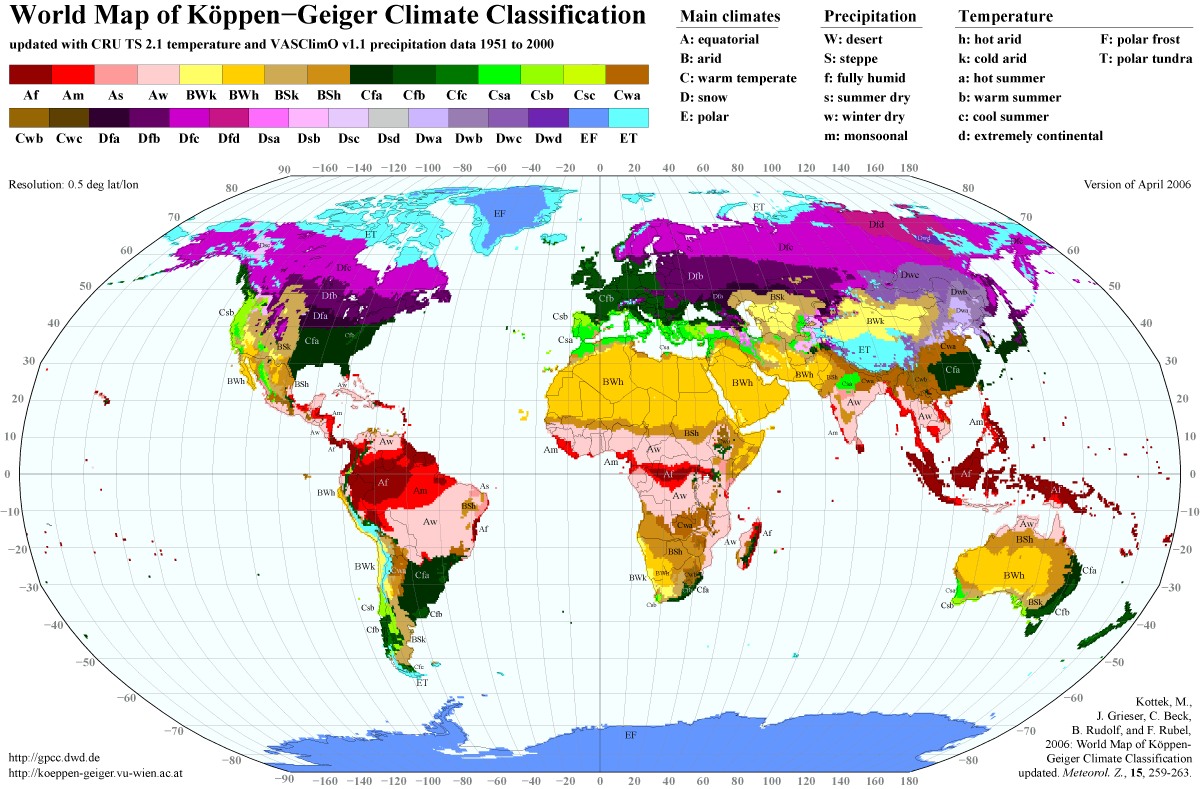

- Cairo
- 10th-century establishments in Egypt
- 10th-century establishments in the Fatimid Caliphate
- 969 establishments
- Burial sites of the Burji dynasty
- Capitals in Africa
- Capitals of caliphates
- Cities in Egypt
- Fatimid cities
- Governorate capitals in Egypt
- Medieval cities of Egypt
- Greater Cairo
- Nile Delta
- Populated places established in the 10th century
- Populated places in Cairo Governorate
- Populated places on the Nile
- Districts of Greater Cairo