

比重

| 比重 | |
|---|---|
常見符號 | SG |
| 国际单位 | 無單位 |
| 單位因次 | 1 |
從其他物理量的推衍 | |
| 因次 | 1 |
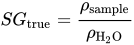
比重(英語:Specific gravity),也稱為相對密度(英語:Relative density),是指一物質的密度與參考物質的密度的比值,為一個无量纲量。[1][2]
液體的比重幾乎都是以水的最大密度(於4 °C或39.2 °F時的密度)為參考;氣體則是以室溫(20 °C或68 °F)下的空氣密度為基準。
若一物質的比重小於1,代表該物質的密度小於參考物;若大於1,則代表密度大於參考物;若等於1,則與參考物的密度相等。若參考物為水,比重大於1的物質,在水中會下沉,反之若小於1,則可以浮在水上。比重會因參考物的種類不同而有所變化。
定義
[编辑]比重可以定義為:
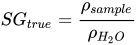


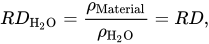
而為了方便起見,會量測與水同樣體積的待測物重量來與水的重量做比較

其中 g 為當地的重力加速度,V 為體積(與水保持相同), 為待測物的質量, 為水的質量。


範例
[编辑]| 材料 | 比重 |
|---|---|
| Balsa wood | 0.2 |
| Oak wood | 0.75 |
| Ethanol | 0.78 |
| Olive oil | 0.91 |
| Water | 1 |
| Ironwood | 1.5 |
| Graphite | 1.9–2.3 |
| Table salt | 2.17 |
| Quartz | 2.65 |
| Aluminium | 2.7 |
| Calcite | 2.71 |
| Aragonite | 2.94 |
| Cement | 3.15 |
| Iron | 7.87 |
| Copper | 8.96 |
| Lead | 11.35 |
| Mercury | 13.56 |
| Depleted uranium | 19.1 |
| Gold | 19.3 |
| Osmium | 22.59 |
(樣本可能有所不同,這些數字只是近似值。)
相對密度為 1 的物質具有中性浮力,相對密度大於 1 的物質比水密度大,因此(忽略表面張力效應)會沉入水中,而相對密度小於 1 的物質比水密度小,因此會漂浮。
例子:
氦氣的密度為 0.164 克/公升;[3]它的密度是空氣的 0.139 倍,空氣的密度為 1.18 克/公升。[3]
- 血液的正常比重約為1.060。[5]
- 80°酒精度伏特加(40% v/v)的比重為0.9498。[6]
外部連結
[编辑]- 材料的比重 (存檔於 2006 年 5 月 22 日)
- 精釀食品和飲料製造中使用的各種產品的比重和黏度表, CPE Systems,2025 年 4 月
参考资料
[编辑]- ^ Dana, Edward Salisbury. A Text-book of Mineralogy: With an Extended Treatise on Crystallography and Physical Mineralogy. J. Wiley & sons. 1910 [2021-07-19]. (原始内容存档于2021-09-19) (英语).
- ^ Schetz, Joseph A.; Fuhs, Allen E. Fundamentals of fluid mechanics. New York: John Wiley. 1999. ISBN 0-471-34856-2. OCLC 40501253.
- ^ 3.0 3.1 Lecture Demonstrations. physics.ucsb.edu.
- ^ 4.0 4.1 Lewis, Sharon Mantik; Dirksen, Shannon Ruff; Heitkemper, Margaret M.; Bucher, Linda; Harding, Mariann. Medical-surgical nursing : assessment and management of clinical problems 9th. St. Louis, Missouri. 5 December 2013. ISBN 978-0-323-10089-2. OCLC 228373703.
- ^ Shmukler, Michael. Elert, Glenn , 编. Density of blood. The Physics Factbook. 2004 [2022-01-23].
- ^ Good Cocktails - Specific Gravity of Liquor and Liqueurs. www.goodcocktails.com. [2025-04-09]. (原始内容存档于2023-06-04) (英语).
