


Uniform integrability
In mathematics, uniform integrability is an important concept in real analysis, functional analysis and measure theory, and plays a vital role in the theory of martingales.
Measure-theoretic definition
[edit]Uniform integrability is an extension to the notion of a family of functions being dominated in which is central in dominated convergence. Several textbooks on real analysis and measure theory use the following definition:[1]

Definition A: Let be a positive measure space. A set is called uniformly integrable if , and to each there corresponds a such that
whenever and


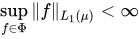


Definition A is rather restrictive for infinite measure spaces. A more general definition[2] of uniform integrability that works well in general measure spaces was introduced by G. A. Hunt.
Definition H: Let be a positive measure space. A set is called uniformly integrable if and only if
where .
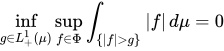

Since Hunt's definition is equivalent to Definition A when the underlying measure space is finite (see Theorem 2 below), Definition H is widely adopted in Mathematics.
The following result[3] provides another equivalent notion to Hunt's. This equivalency is sometimes given as definition for uniform integrability.
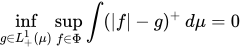
Theorem 1: If is a (positive) finite measure space, then a set is uniformly integrable if and only if
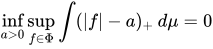
If in addition , then uniform integrability is equivalent to either of the following conditions
1. .
2.

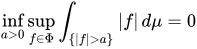
When the underlying space is -finite, Hunt's definition is equivalent to the following:

Theorem 2: Let be a -finite measure space, and be such that almost everywhere. A set is uniformly integrable if and only if , and for any , there exits such that
whenever .


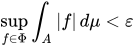

A consequence of Theorems 1 and 2 is that equivalence of Definitions A and H for finite measures follows. Indeed, the statement in Definition A is obtained by taking in Theorem 2.

Tightness and uniform integrability
[edit]Another concept associated with uniform integrability is that of tightness. In this article tightness is taken in a more general setting.
Definition: Suppose measurable space is a measure space. Let be a collection of sets of finite measure. A family is tight with respect to if
A tight family with respect to is just said to be tight.


When the measure space is a metric space equipped with the Borel algebra, is a regular measure, and is the collection of all compact subsets of , the notion of -tightness discussed above coincides with the well known concept of tightness used in the analysis of regular measures in metric spaces


For -finite measure spaces, it can be shown that if a family is uniformly integrable, then is tight. This is capture by the following result which is often used as definition of uniform integrabiliy in the Analysis literature:

Theorem 3: Suppose is a finite measure space. A family is uniformly integrable if and only if
- .
- is tight.
When , condition 3 is redundant (see Theorem 1 above).

Condition 2 in Theorem 3 is sometimes replaced by what is called equi-integrability in many books in Analysis [4][5][6][7]: A family of complex or real valued measurable functions is equi-integrable (or uniformly absolutely continuous with respect to a measure ) if for any there is such that


Relevant theorems
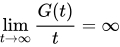
[edit]The following theorem describes a very useful criterion for uniform integrability which is very useful in Probability theory.
de la Vallée-Poussin theorem[8][9]
Suppose is a finite measure space. The family is uniformly integrable if and only if there exists a function such that and The function can be chosen to be monotone increasing and convex.




Uniform integrability gives a characterization of weak compactness in .
Dunford–Pettis theorem[10][11]
Suppose is a -finite measure. A family has compact closure in the weak topology if and only if is uniformly integrable.


Probability definition
[edit]In probability theory, Definition A or the statement of Theorem 1 are often presented as definitions of uniform integrability using the notation expectation of random variables.,[12][13][14] that is,
1. A class of random variables is called uniformly integrable if:
- There exists a finite such that, for every in , and
- For every there exists such that, for every measurable such that and every in , .


or alternatively
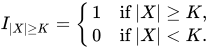
2. A class of random variables is called uniformly integrable (UI) if for every there exists such that , where is the indicator function .



Related corollaries
[edit]The following results apply to the probabilistic definition.[15]
- Definition 1 could be rewritten by taking the limits as
- A non-UI sequence. Let , and define Clearly , and indeed for all n. However, and comparing with definition 1, it is seen that the sequence is not uniformly integrable.

![{\displaystyle \Omega =[0,1]\subset \mathbb {R} }](https://wikimedia.org/api/rest_v1/media/math/render/svg/051774c56085fd1251cfab50a7cc824da5fe8b2a)
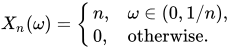

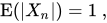



- By using Definition 2 in the above example, it can be seen that the first clause is satisfied as norm of all s are 1 i.e., bounded. But the second clause does not hold as given any positive, there is an interval with measure less than and for all .
- If is a UI random variable, by splitting and bounding each of the two, it can be seen that a uniformly integrable random variable is always bounded in .
- If any sequence of random variables is dominated by an integrable, non-negative : that is, for all ω and n, then the class of random variables is uniformly integrable.
- A class of random variables bounded in () is uniformly integrable.


![{\displaystyle E[|X_{m}|:(0,1/n)]=1}](https://wikimedia.org/api/rest_v1/media/math/render/svg/0863c3e7ff78cebe7724523cf2fedb876816a467)




Uniform integrability and stochastic ordering
[edit]A family of random variables is uniformly integrable if and only if[16] there exists a random variable such that and for all , where denotes the increasing convex stochastic order defined by if for all nondecreasing convex real functions .


Relation to convergence of random variables
[edit]A sequence converges to in the norm if and only if it converges in measure to and it is uniformly integrable. In probability terms, a sequence of random variables converging in probability also converge in the mean if and only if they are uniformly integrable.[17] This is a generalization of Lebesgue's dominated convergence theorem, see Vitali convergence theorem.
Citations
[edit]- ^ Royden, H.L. & Fitzpatrick, P.M. (2010). Real Analysis (4 ed.). Boston: Prentice Hall. p. 93. ISBN 978-0-13-143747-0.
- ^ Hunt, G. A. (1966). Martingales et Processus de Markov. Paris: Dunod. p. 33.
- ^ Klenke, A. (2008). Probability Theory: A Comprehensive Course. Berlin: Springer Verlag. pp. 134–137. ISBN 978-1-84800-047-6.
- ^ Fonseca, Irene; Leoni, Giovanni (2007). Modern Methods in the Calculus of Variations: Lp Spaces. New York, NY: Springer New York Springer e-books. ISBN 978-0387690063.
- ^ Benedetto, J. J. (1976). Real Variable and Integration. Stuttgart: B. G. Teubner. p. 89. ISBN 3-519-02209-5.
- ^ Burrill, C. W. (1972). Measure, Integration, and Probability. McGraw-Hill. p. 180. ISBN 0-07-009223-0.
- ^ Bass, Richard F. (2011). Stochastic Processes. Cambridge: Cambridge University Press. pp. 356–357. ISBN 978-1-107-00800-7.
- ^ Meyer, P.A. (1966). Probability and Potentials, Blaisdell Publishing Co, N. Y. (p.19, Theorem T22).
- ^ De La Vallée Poussin, C. (1915). "Sur L'Integrale de Lebesgue". Transactions of the American Mathematical Society. 16 (4): 435–501. doi:10.2307/1988879. hdl:10338.dmlcz/127627. JSTOR 1988879.
- ^ Dunford, Nelson (1938). "Uniformity in linear spaces". Transactions of the American Mathematical Society. 44 (2): 305–356. doi:10.1090/S0002-9947-1938-1501971-X. ISSN 0002-9947.
- ^ Dunford, Nelson (1939). "A mean ergodic theorem". Duke Mathematical Journal. 5 (3): 635–646. doi:10.1215/S0012-7094-39-00552-1. ISSN 0012-7094.
- ^ Williams, David (1997). Probability with Martingales (Repr. ed.). Cambridge: Cambridge Univ. Press. pp. 126–132. ISBN 978-0-521-40605-5.
- ^ Gut, Allan (2005). Probability: A Graduate Course. Springer. pp. 214–218. ISBN 0-387-22833-0.
- ^ Bass, Richard F. (2011). Stochastic Processes. Cambridge: Cambridge University Press. pp. 356–357. ISBN 978-1-107-00800-7.
- ^ Gut 2005, pp. 215–216.
- ^ Leskelä, L.; Vihola, M. (2013). "Stochastic order characterization of uniform integrability and tightness". Statistics and Probability Letters. 83 (1): 382–389. arXiv:1106.0607. doi:10.1016/j.spl.2012.09.023.
- ^ Bogachev, Vladimir I. (2007). "The spaces Lp and spaces of measures". Measure Theory Volume I. Berlin Heidelberg: Springer-Verlag. p. 268. doi:10.1007/978-3-540-34514-5_4. ISBN 978-3-540-34513-8.
References
[edit]- Shiryaev, A.N. (1995). Probability (2 ed.). New York: Springer-Verlag. pp. 187–188. ISBN 978-0-387-94549-1.
- Diestel, J. and Uhl, J. (1977). Vector measures, Mathematical Surveys 15, American Mathematical Society, Providence, RI ISBN 978-0-8218-1515-1