


List of Johnson solids


In geometry, a convex polyhedron whose faces are regular polygons is known as a Johnson solid, or sometimes as a Johnson–Zalgaller solid.[1] Some authors exclude uniform polyhedra (in which all vertices are symmetric to each other) from the definition; uniform polyhedra include Platonic and Archimedean solids as well as prisms and antiprisms.[2] The Johnson solids are named after American mathematician Norman Johnson (1930–2017), who published a list of 92 non-uniform Johnson polyhedra in 1966. His conjecture that the list was complete and no other examples existed was proven by Russian-Israeli mathematician Victor Zalgaller (1920–2020) in 1969.[3]
This article lists the 92 non-uniform Johnson solids, accompanied by images. They are listed alongside their basic elements (vertices, edges, and faces), and their most important general characteristics, including symmetry groups (, , , , , ), order, surface area, and volume; an overview of these follows first, before presenting the complete list of non-uniform Johnson solids.


Characteristics
Every polyhedron has its own characteristics, including symmetry and measurement. An object is said to have symmetry if there is a transformation that maps it to itself. All of those transformations may be composed in a group, alongside the group's number of elements, known as the order. In two-dimensional space, these transformations include rotating around the center of a polygon and reflecting an object around the perpendicular bisector of a polygon. The mensuration of polyhedra includes the surface area and volume. An area is a two-dimensional measurement calculated by the product of length and width; for a polyhedron, the surface area is the sum of the areas of all of its faces.[4] A volume is a measurement of a region in three-dimensional space.[5] The volume of a polyhedron may be ascertained in different ways: either through its base and height (like for pyramids and prisms), by slicing it off into pieces and summing their individual volumes, or by finding the root of a polynomial representing the polyhedron.[6]
A polygon that is rotated symmetrically by is denoted by , a cyclic group of order ; combining this with the reflection symmetry results in the symmetry of dihedral group of order .[7] In three-dimensional symmetry point groups, the transformations preserving a polyhedron's symmetry include the rotation around the line passing through the base center, known as the axis of symmetry, and the reflection relative to perpendicular planes passing through the bisector of a base, which is known as the pyramidal symmetry of order . The transformation that preserves a polyhedron's symmetry by reflecting it across a horizontal plane is known as the prismatic symmetry of order . The antiprismatic symmetry of order preserves the symmetry by rotating its half bottom and reflection across the horizontal plane.[8] The symmetry group of order preserves the symmetry by rotation around the axis of symmetry and reflection on the horizontal plane; the specific case preserving the symmetry by one full rotation is of order 2, often denoted as .[9]


The solids
Seventeen Johnson solids may be categorized as elementary polyhedra, meaning they cannot be separated by a plane to create two small convex polyhedra with regular faces. The first six Johnson solids satisfy this criterion: the equilateral square pyramid, pentagonal pyramid, triangular cupola, square cupola, pentagonal cupola, and pentagonal rotunda. The criterion is also satisfied by eleven other Johnson solids, specifically the tridiminished icosahedron, parabidiminished rhombicosidodecahedron, tridiminished rhombicosidodecahedron, snub disphenoid, snub square antiprism, sphenocorona, sphenomegacorona, hebesphenomegacorona, disphenocingulum, bilunabirotunda, and triangular hebesphenorotunda.[10] The rest of the Johnson solids are not elementary, and they are constructed using the first six Johnson solids together with Platonic and Archimedean solids in various processes. Augmentation involves attaching the Johnson solids onto one or more faces of polyhedra, while elongation or gyroelongation involve joining them onto the bases of a prism or antiprism, respectively. Some others are constructed by diminishment, the removal of one of the first six solids from one or more of a polyhedron's faces.[11]
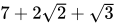
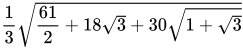
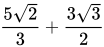
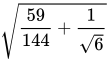
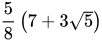
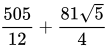
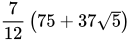
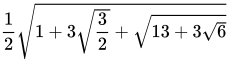
The table below lists the 92 (non-uniform) Johnson solids, with edge length 1. The table includes each solid's enumeration (denoted as ).[12] It also includes the number of vertices, edges, and faces of each solid, as well as its symmetry group, surface area , and volume .


| Solid name | Image | Vertices | Edges | Faces | Symmetry group and its order[13] | Surface area, exact, with edge length 1[14] | Surface area, approximate, with edge length 1[14] | Volume, exact, with edge length 1[14] | Volume, approximate, with edge length 1[14] | |
|---|---|---|---|---|---|---|---|---|---|---|
| 1 | Square pyramid | 
|
5 | 8 | 5 | of order 8 | 2.7321 | 0.2357 | ||
| 2 | Pentagonal pyramid | 
|
6 | 10 | 6 | of order 10 | 3.8855 | 0.3015 | ||
| 3 | Triangular cupola | 
|
9 | 15 | 8 | of order 6 | 7.3301 | 1.1785 | ||
| 4 | Square cupola | 
|
12 | 20 | 10 | of order 8 | 11.5605 | 1.9428 | ||
| 5 | Pentagonal cupola | 
|
15 | 25 | 12 | of order 10 | 16.5798 | 2.3241 | ||
| 6 | Pentagonal rotunda | 
|
20 | 35 | 17 | of order 10 | 22.3472 | 6.9178 | ||
| 7 | Elongated triangular pyramid | 
|
7 | 12 | 7 | of order 6 | 4.7321 | 0.5509 | ||
| 8 | Elongated square pyramid | 
|
9 | 16 | 9 | of order 8 | 6.7321 | 1.2357 | ||
| 9 | Elongated pentagonal pyramid | 
|
11 | 20 | 11 | of order 10 | 8.8855 | 2.022 | ||
| 10 | Gyroelongated square pyramid | 
|
9 | 20 | 13 | of order 8 | 6.1962 | 1.1927 | ||
| 11 | Gyroelongated pentagonal pyramid | 
|
11 | 25 | 16 | of order 10 | 8.2157 | 1.8802 | ||
| 12 | Triangular bipyramid | 
|
5 | 9 | 6 | of order 12 | 2.5981 | 0.2357 | ||
| 13 | Pentagonal bipyramid | 
|
7 | 15 | 10 | of order 20 | 4.3301 | 0.6030 | ||
| 14 | Elongated triangular bipyramid | 
|
8 | 15 | 9 | of order 12 | 5.5981 | 0.6687 | ||
| 15 | Elongated square bipyramid | 
|
10 | 20 | 12 | of order 16 | 7.4641 | 1.4714 | ||
| 16 | Elongated pentagonal bipyramid | 
|
12 | 25 | 15 | of order 20 | 9.3301 | 2.3235 | ||
| 17 | Gyroelongated square bipyramid | 
|
10 | 24 | 16 | of order 16 | 6.9282 | 1.4284 | ||
| 18 | Elongated triangular cupola | 
|
15 | 27 | 14 | of order 6 | 13.3301 | 3.7766 | ||
| 19 | Elongated square cupola | 
|
20 | 36 | 18 | of order 8 | 19.5605 | 6.7712 | ||
| 20 | Elongated pentagonal cupola | 
|
25 | 45 | 22 | of order 10 | 26.5798 | 10.0183 | ||
| 21 | Elongated pentagonal rotunda | 
|
30 | 55 | 27 | of order 10 | 32.3472 | 14.612 | ||
| 22 | Gyroelongated triangular cupola | 
|
15 | 33 | 20 | of order 6 | 12.5263 | 3.5161 | ||
| 23 | Gyroelongated square cupola | 
|
20 | 44 | 26 | of order 8 | 18.4887 | 6.2108 | ||
| 24 | Gyroelongated pentagonal cupola | 
|
25 | 55 | 32 | of order 10 | 25.2400 | 9.0733 | ||
| 25 | Gyroelongated pentagonal rotunda | 
|
30 | 65 | 37 | of order 10 | 31.0075 | 13.6671 | ||
| 26 | Gyrobifastigium | 
|
8 | 14 | 8 | of order 8 | 5.7321 | 0.8660 | ||
| 27 | Triangular orthobicupola | 
|
12 | 24 | 14 | of order 12 | 9.4641 | 2.3570 | ||
| 28 | Square orthobicupola | 
|
16 | 32 | 18 | of order 16 | 13.4641 | 3.8856 | ||
| 29 | Square gyrobicupola | 
|
16 | 32 | 18 | of order 16 | ||||
| 30 | Pentagonal orthobicupola | 
|
20 | 40 | 22 | of order 20 | 17.7711 | 4.6481 | ||
| 31 | Pentagonal gyrobicupola | 
|
20 | 40 | 22 | of order 20 | ||||
| 32 | Pentagonal orthocupolarotunda | 
|
25 | 50 | 27 | of order 10 | 23.5385 | 9.2418 | ||
| 33 | Pentagonal gyrocupolarotunda | 
|
25 | 50 | 27 | of order 10 | 23.5385 | |||
| 34 | Pentagonal orthobirotunda | 
|
30 | 60 | 32 | of order 20 | 29.306 | 13.8355 | ||
| 35 | Elongated triangular orthobicupola | 
|
18 | 36 | 20 | of order 12 | 15.4641 | 4.9551 | ||
| 36 | Elongated triangular gyrobicupola | 
|
18 | 36 | 20 | of order 12 | ||||
| 37 | Elongated square gyrobicupola | 
|
24 | 48 | 26 | of order 16 | 21.4641 | 8.714 | ||
| 38 | Elongated pentagonal orthobicupola | 
|
30 | 60 | 32 | of order 20 | 27.7711 | 12.3423 | ||
| 39 | Elongated pentagonal gyrobicupola | 
|
30 | 60 | 32 | of order 20 | ||||
| 40 | Elongated pentagonal orthocupolarotunda | 
|
35 | 70 | 37 | of order 10 | 33.5385 | 16.936 | ||
| 41 | Elongated pentagonal gyrocupolarotunda | 
|
35 | 70 | 37 | of order 10 | ||||
| 42 | Elongated pentagonal orthobirotunda | 
|
40 | 80 | 42 | of order 20 | 39.306 | 21.5297 | ||
| 43 | Elongated pentagonal gyrobirotunda | 
|
40 | 80 | 42 | of order 20 | ||||
| 44 | Gyroelongated triangular bicupola | 
|
18 | 42 | 26 | of order 6 | 14.6603 | 4.6946 | ||
| 45 | Gyroelongated square bicupola | 
|
24 | 56 | 34 | of order 8 | 20.3923 | 8.1536 | ||
| 46 | Gyroelongated pentagonal bicupola | 
|
30 | 70 | 42 | of order 10 | 26.4313 | 11.3974 | ||
| 47 | Gyroelongated pentagonal cupolarotunda | 
|
35 | 80 | 47 | of order 5 | 32.1988 | 15.9911 | ||
| 48 | Gyroelongated pentagonal birotunda | 
|
40 | 90 | 52 | of order 10 | 37.9662 | 20.5848 | ||
| 49 | Augmented triangular prism | 
|
7 | 13 | 8 | of order 4 | 4.5981 | 0.6687 | ||
| 50 | Biaugmented triangular prism | 
|
8 | 17 | 11 | of order 4 | 5.3301 | 0.9044 | ||
| 51 | Triaugmented triangular prism | 
|
9 | 21 | 14 | of order 12 | 6.0622 | 1.1401 | ||
| 52 | Augmented pentagonal prism | 
|
11 | 19 | 10 | of order 4 | 9.173 | 1.9562 | ||
| 53 | Biaugmented pentagonal prism | 
|
12 | 23 | 13 | of order 4 | 9.9051 | 2.1919 | ||
| 54 | Augmented hexagonal prism | 
|
13 | 22 | 11 | of order 4 | 11.9282 | 2.8338 | ||
| 55 | Parabiaugmented hexagonal prism | 
|
14 | 26 | 14 | of order 8 | 12.6603 | 3.0695 | ||
| 56 | Metabiaugmented hexagonal prism | 
|
14 | 26 | 14 | of order 4 | ||||
| 57 | Triaugmented hexagonal prism | 
|
15 | 30 | 17 | of order 12 | 13.3923 | 3.3052 | ||
| 58 | Augmented dodecahedron | 
|
21 | 35 | 16 | of order 10 | 21.0903 | 7.9646 | ||
| 59 | Parabiaugmented dodecahedron | 
|
22 | 40 | 20 | of order 20 | 21.5349 | 8.2661 | ||
| 60 | Metabiaugmented dodecahedron | 
|
22 | 40 | 20 | of order 4 | ||||
| 61 | Triaugmented dodecahedron | 
|
23 | 45 | 24 | of order 6 | 21.9795 | 8.5676 | ||
| 62 | Metabidiminished icosahedron | 
|
10 | 20 | 12 | of order 4 | 7.7711 | 1.5787 | ||
| 63 | Tridiminished icosahedron | 
|
9 | 15 | 8 | of order 6 | 7.3265 | 1.2772 | ||
| 64 | Augmented tridiminished icosahedron | 
|
10 | 18 | 10 | of order 6 | 8.1925 | 1.3950 | ||
| 65 | Augmented truncated tetrahedron | 
|
15 | 27 | 14 | of order 6 | 14.2583 | 3.8891 | ||
| 66 | Augmented truncated cube | 
|
28 | 48 | 22 | of order 8 | 34.3383 | 15.5425 | ||
| 67 | Biaugmented truncated cube | 
|
32 | 60 | 30 | of order 16 | 36.2419 | 17.4853 | ||
| 68 | Augmented truncated dodecahedron | 
|
65 | 105 | 42 | of order 10 | 102.1821 | 87.3637 | ||
| 69 | Parabiaugmented truncated dodecahedron | 
|
70 | 120 | 52 | of order 20 | 103.3734 | 89.6878 | ||
| 70 | Metabiaugmented truncated dodecahedron | 
|
70 | 120 | 52 | of order 4 | ||||
| 71 | Triaugmented truncated dodecahedron | 
|
75 | 135 | 62 | of order 6 | 104.5648 | 92.0118 | ||
| 72 | Gyrate rhombicosidodecahedron | 
|
60 | 120 | 62 | of order 10 | 59.306 | 41.6153 | ||
| 73 | Parabigyrate rhombicosidodecahedron | 
|
60 | 120 | 62 | of order 20 | ||||
| 74 | Metabigyrate rhombicosidodecahedron | 
|
60 | 120 | 62 | of order 4 | ||||
| 75 | Trigyrate rhombicosidodecahedron | 
|
60 | 120 | 62 | of order 6 | ||||
| 76 | Diminished rhombicosidodecahedron | 
|
55 | 105 | 52 | of order 10 | 58.1147 | 39.2913 | ||
| 77 | Paragyrate diminished rhombicosidodecahedron | 
|
55 | 105 | 52 | of order 10 | ||||
| 78 | Metagyrate diminished rhombicosidodecahedron | 
|
55 | 105 | 52 | of order 2 | ||||
| 79 | Bigyrate diminished rhombicosidodecahedron | 
|
55 | 105 | 52 | of order 2 | ||||
| 80 | Parabidiminished rhombicosidodecahedron | 
|
50 | 90 | 42 | of order 20 | 56.9233 | 36.9672 | ||
| 81 | Metabidiminished rhombicosidodecahedron | 
|
50 | 90 | 42 | of order 4 | ||||
| 82 | Gyrate bidiminished rhombicosidodecahedron | 
|
50 | 90 | 42 | of order 2 | ||||
| 83 | Tridiminished rhombicosidodecahedron | 
|
45 | 75 | 32 | of order 6 | 55.732 | 34.6432 | ||
| 84 | Snub disphenoid | 
|
8 | 18 | 12 | of order 8 | 5.1962 | 0.8595 | ||
| 85 | Snub square antiprism | 
|
16 | 40 | 26 | of order 16 | 12.3923 | 3.6012 | ||
| 86 | Sphenocorona | 
|
10 | 22 | 14 | of order 4 | 7.1962 | 1.5154 | ||
| 87 | Augmented sphenocorona | 
|
11 | 26 | 17 | of order 2 | 7.9282 | 1.7511 | ||
| 88 | Sphenomegacorona | 
|
12 | 28 | 18 | of order 4 | 8.9282 | 1.9481 | ||
| 89 | Hebesphenomegacorona | 
|
14 | 33 | 21 | of order 4 | 10.7942 | 2.9129 | ||
| 90 | Disphenocingulum | 
|
16 | 38 | 24 | of order 8 | 12.6603 | 3.7776 | ||
| 91 | Bilunabirotunda | 
|
14 | 26 | 14 | of order 8 | 12.346 | 3.0937 | ||
| 92 | Triangular hebesphenorotunda | 
|
18 | 36 | 20 | of order 6 | 16.3887 | 5.1087 |



































References
- ^ Araki, Horiyama & Uehara (2015).
- ^
- ^
- ^ Walsh (2014), p. 284.
- ^ Parker (1997), p. 264.
- ^
- ^
- Powell (2010), p. 27
- Solomon (2003), p. 40
- ^ Flusser, Suk & Zitofa (2017), p. 126.
- ^
- ^
- Cromwell (1997), p. 86–87, See the figure on p.89
- Johnson (1966)
- ^
- ^ Uehara (2020), p. 62.
- ^ Johnson (1966).
- ^ a b c d Berman (1971).
Bibliography
- Araki, Yoshiaki; Horiyama, Takashi; Uehara, Ryuhei (2015). "Common Unfolding of Regular Tetrahedron and Johnson-Zalgaller Solid". In Rahman, M. Sohel; Tomita, Etsuji (eds.). WALCOM: Algorithms and Computation. Lecture Notes in Computer Science. Vol. 8973. Cham: Springer International Publishing. pp. 294–305. doi:10.1007/978-3-319-15612-5_26. ISBN 978-3-319-15612-5.
- Berman, M. (1971). "Regular-faced convex polyhedra". Journal of the Franklin Institute. 291 (5): 329–352. doi:10.1016/0016-0032(71)90071-8. MR 0290245.
- Cromwell, P. R. (1997). Polyhedra. Cambridge University Press. ISBN 978-0-521-66405-9.
- Diudea, M. V. (2018). Multi-shell Polyhedral Clusters. Carbon Materials: Chemistry and Physics. Vol. 10. Springer. doi:10.1007/978-3-319-64123-2. ISBN 978-3-319-64123-2.
- Flusser, J.; Suk, T.; Zitofa, B. (2017). 2D and 3D Image Analysis by Moments. John Wiley & Sons. ISBN 978-1-119-03935-8.
- Hergert, W.; Geilhufe, M. (2018). Group Theory in Solid State Physics and Photonics: Problem Solving with Mathematica. John Wiley & Sons. ISBN 978-3-527-41300-3.
- Johnson, N. (1966). "Convex Solids with Regular Faces". Canadian Journal of Mathematics. 18: 169–200. doi:10.4153/CJM-1966-021-8.
- Parker, S. P. (1997). Dictionary of Mathematics. McGraw Hill. ISBN 978-0-070-52433-0.
- Powell, R. C. (2010). Symmetry, Group Theory, and the Physical Properties of Crystals. Lecture Notes in Physics. Vol. 824. Springer. doi:10.1007/978-1-4419-7598-0. ISBN 978-1-441-97598-0.
- Rajwade, A. R. (2001). Convex Polyhedra with Regularity Conditions and Hilbert's Third Problem. Texts and Readings in Mathematics. Hindustan Book Agency. doi:10.1007/978-93-86279-06-4. ISBN 978-9-386-27906-4.
- Solomon, R. (2003). Abstract Algebra. American Mathematical Society. ISBN 978-0-821-84795-4.
- Slobodan, M.; Obradović, M.; Ðukanović, G. (2015). "Composite Concave Cupolae as Geometric and Architectural Forms" (PDF). Journal for Geometry and Graphics. 19 (1): 79–91.
- Timofeenko, A. V. (2009). "The Non-Platonic and Non-Archimedean Noncomposite Polyhedra". Journal of Mathematical Sciences. 162 (5): 710–729. doi:10.1007/s10958-009-9655-0.
- Todesco, G. M. (2020). "Hyperbolic Honeycomb". In Emmer, M.; Abate, M. (eds.). Imagine Math 7: Between Culture and Mathematics. Springer. doi:10.1007/978-3-030-42653-8. ISBN 978-3-030-42653-8.
- Uehara, R. (2020). Introduction to Computational Origami: The World of New Computational Geometry. Springer. doi:10.1007/978-981-15-4470-5. ISBN 978-9-811-54470-5.
- Walsh, E. T. (2014). A First Course in Geometry. Dover. ISBN 978-0-486-78020-7.
- Williams, K.; Monteleone, C. (2021). Daniele Barbaro's Perspective of 1568. Springer. doi:10.1007/978-3-030-76687-0. ISBN 978-3-030-76687-0.
- Zalgaller, V. A. (1969). Convex Polyhedra with Regular Faces. Springer. ISBN 978-1-489-95671-2.
External links
- Hart, George W. "Johnson Solids".
- Bulatov, Vladimir. "Johnson solids". – VRML models of Johnson solids
- Gagnon, Sylvain (1982). "Les polyèdres convexes aux faces régulières" [Convex polyhedra with regular faces] (PDF). Topologie Structurale [Structural Topology] (in French) (6): 83–95.