


Fuchs's theorem
(Redirected from Fuchs' theorem)
 | This article has multiple issues. Please help improve it or discuss these issues on the talk page. (Learn how and when to remove these messages)
|


In mathematics, Fuchs's theorem, named after Lazarus Fuchs, states that a second-order differential equation of the form has a solution expressible by a generalised Frobenius series when , and are analytic at or is a regular singular point. That is, any solution to this second-order differential equation can be written as for some positive real s, or for some positive real r, where y0 is a solution of the first kind.



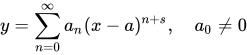

Its radius of convergence is at least as large as the minimum of the radii of convergence of , and .
See also
[edit]References
[edit]- Asmar, Nakhlé H. (2005), Partial differential equations with Fourier series and boundary value problems, Upper Saddle River, NJ: Pearson Prentice Hall, ISBN 0-13-148096-0.
- Butkov, Eugene (1995), Mathematical Physics, Reading, MA: Addison-Wesley, ISBN 0-201-00727-4.