


Duple and quadruple metre
 | This article needs additional citations for verification. (November 2019) |
Duple metre
[edit]Duple metre (or duple meter in US spelling, also known as duple time) is a musical metre characterized by a primary division of 2 beats to the bar, usually indicated by 2 and multiples (simple) or 6 and multiples (compound) in the upper figure of the time signature, with 2
2 (cut time, also notated as  ), 2
), 2
4, and fast 6
8 being the most common examples.
Shown below are a simple and a compound duple drum pattern.
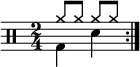
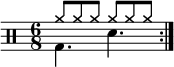
Though the upper figure must be divisible by 2 in duple metre, the contrary is not necessarily true. For instance, in the first movement of Maurice Ravel's Piano Trio, the 8
8 time signature is subdivided as 3+2+3 (3 beats) rather than a 4+4 subdivision (2 beats, duple metre). The movement is in odd time, not duple metre, even though the upper figure 8 is divisible by 2.
Duple time is especially common in marches (especially in American march music), where the duple meter provides a clear upbeat/downbeat feel that is suitable for marching. Duple time is also common in many styles including the polka, well known for its obvious "oom-pah" duple feel. Compare to the waltz, a form in triple metre, where the feel is an "oom-pah-pah" triple feel.
Quadruple metre
[edit]Quadruple metre (or quadruple meter in US spelling, also known as quadruple time) is a musical metre characterized in modern practice by a primary division of 4 beats to the bar,[1] usually indicated by 4 in the upper figure of the time signature, with 4
4 (common time, also notated as  ) being the most common example.
Shown below are a simple and a compound quadruple drum pattern.
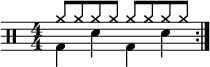

The most common time signature in rock, blues, country, funk, and pop is 4
4.[2] Although jazz writing has become more adventurous since Dave Brubeck's Time Out, the majority of jazz and jazz standards are still in "common time" (4
4).
Sources
[edit]- ^ Sadie, S.; Tyrrell, J., eds. (2001). "Quadruple time". The New Grove Dictionary of Music and Musicians (2nd ed.). London, UK: Macmillan.
- ^ Schroedl, Scott (2001). Play Drums Today!. Hal Leonard. p. 42. ISBN 0-634-02185-0.

